
Why Understanding Rehab Funding Matters for Your Recovery Journey
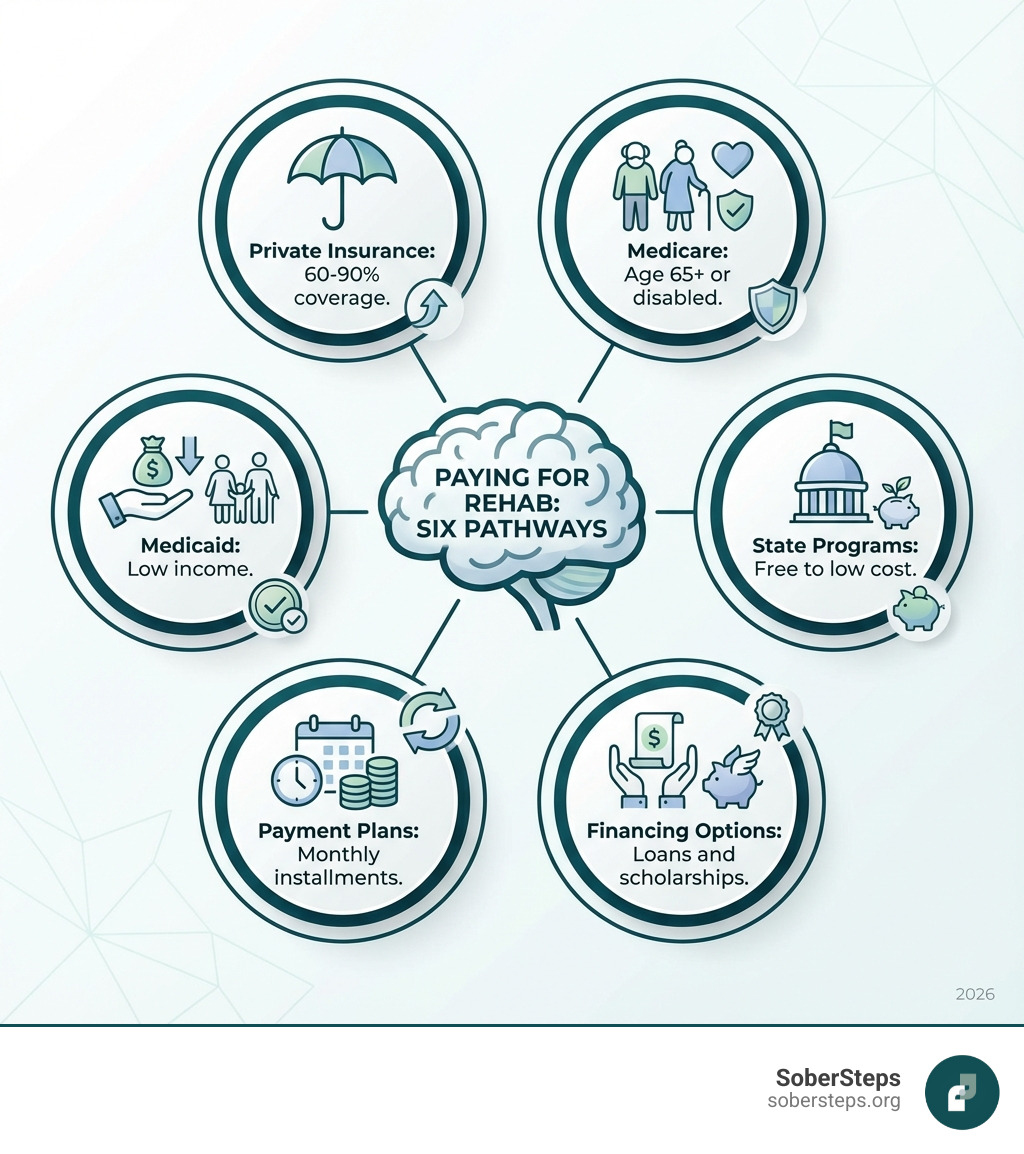
Paying for rehab can feel like navigating a maze, but understanding your options makes recovery accessible. Here are the main ways to cover addiction treatment costs:
- Private Health Insurance – Most plans cover 60-90% of rehab costs through the Affordable Care Act
- Public Insurance (Medicare/Medicaid) – Government programs that cover treatment for eligible individuals
- State-Funded Programs – Free or low-cost options through government grants and community resources
- Payment Plans & Financing – Installment options, sliding-scale fees, and healthcare loans
- Scholarships & Grants – Financial assistance from nonprofits and treatment centers
- VA Benefits – Coverage for eligible veterans through the Department of Veterans Affairs
According to the 2021 National Survey on Drug Use and Health, 46.3 million people aged 12 or older had a substance use disorder, yet only 4.1 million received treatment. Cost remains one of the biggest barriers—but it doesn’t have to be.
The good news? Multiple pathways exist to make treatment affordable. Whether you have insurance, qualify for government assistance, or need alternative financing, options are available. Research shows that every dollar invested in treatment saves $4 in healthcare costs and $7 in criminal justice expenses, making recovery not just personally valuable but financially sound.
For many people, the single-biggest barrier to entering addiction treatment is worrying about how to pay for it. The stress of financing treatment can feel just as burdensome as the challenge of living with addiction itself. But here’s what matters most: your health is worth the investment, and with the right information, you can find a path that works for your situation.
At Sober Steps, we’ve helped thousands of individuals and families steer the complexities of paying for rehab by connecting them with treatment centers that match their financial circumstances and insurance coverage. Our team understands that finding affordable, quality care is essential to starting your recovery journey with confidence.
Ready to explore your payment options? Verify your insurance coverage or contact our confidential helpline to discuss treatment centers that accept your specific insurance or offer financial assistance programs.
Understanding the Cost of Addiction Treatment
When we talk about paying for rehab, one of the first questions that comes to mind is, “How much does it actually cost?” The truth is, there’s no single answer. The cost of addiction treatment varies widely, influenced by a multitude of factors, much like buying a car or choosing a college.

Let’s break down the key factors that influence the overall cost of addiction treatment:
- Location: Facilities in desirable or high-cost-of-living areas often come with a higher price tag. Urban centers or scenic retreats may be more expensive than those in rural areas.
- Amenities: Think luxury versus basic. High-end facilities might offer gourmet meals, private rooms, spa services, fitness centers, and holistic therapies, all of which add to the cost. More modest centers provide essential, evidence-based care without the frills.
- Duration of Stay: This is a major cost driver. Treatment programs can range from a few days for detox to several months for residential care. The longer the program, the higher the total cost.
- Levels of Care: The intensity of treatment significantly impacts cost. We offer a detailed guide on Levels of Care to help you understand your options.
Here’s a general breakdown of average costs for different types of treatment:
- Detox: Medical detoxification, often the first step, can range from $250 to $800 per day for standard inpatient care. Supervised detox with 24/7 medical care might run $500–$650 per day. For more information, explore our resources on Detox Near Me.
- Inpatient vs. Outpatient Costs: Generally, inpatient (or residential) programs are more expensive because they include accommodation, meals, and 24/7 support. A 30-day inpatient program can range from $5,000 to $20,000, with luxury facilities soaring to $40,000 to $60,000 or more per month. By contrast, outpatient rehab for a three-month program typically costs around $5,000, though intensive outpatient programs (IOPs) can range from $3,500 to over $10,000. You can learn more about specific inpatient options through our Inpatient Drug Rehab guide.
- Residential Treatment Costs: The average cost of residential treatment can be significant, with some surveys showing averages around $50,000 to $57,000 per episode, depending on the year and data source.
- Other Treatment Types: A year of methadone treatment can cost around $4,500. Partial hospitalization programs (PHPs) might cost $350 to $450 per day.
It’s important to remember that the average cost of drug rehabilitation per person is about $13,475, but this is just an average. What might seem expensive upfront is often a wise investment. Research consistently shows that every dollar invested in a substance abuse center saves $4 in healthcare costs and $7 in law enforcement and criminal justice costs. This demonstrates a significant return on investment, with treatment costing an average of $1,583 per person but associated with a cost offset of $11,487—a greater than 7:1 benefit-cost ratio. Research shows treatment saves money on healthcare and legal costs in the long run.
Exploring various Drug Treatment Options can help you find a program that fits both your needs and your budget.
Using Insurance to Pay for Rehab
For many, health insurance is the primary way to cover the costs of addiction treatment. Thanks to landmark legislation, much of the guesswork and denial associated with mental health and substance abuse coverage has been removed.
The Affordable Care Act (ACA), also known as Obamacare, played a pivotal role here. Under the ACA, an insurance applicant cannot be penalized for a pre-existing condition, meaning someone already battling addiction can apply for a healthcare policy without fear of denial based on their health history.
Crucially, the ACA defines 10 essential health benefits, and substance use disorder services are one of them. This means that all health insurance policies sold on the ACA marketplace must treat addiction and mental health disorders with the same level of importance as any other medical condition. This concept is known as mental health parity. This means that All health insurance companies must cover addiction treatment to some extent.
While all plans must cover these services, the extent of coverage can vary. ACA-sponsored policies typically cover between 60% to 90% of the cost of rehab services, depending on the plan you select.
Verifying Your Benefits
The most critical step in using insurance for rehab is verifying your benefits. This means understanding exactly what your plan covers, what your out-of-pocket costs will be, and which facilities are in-network.
Here’s what you need to know:
- In-network vs. Out-of-network Providers: Your insurance company contracts with a “network” of providers who offer services at a set fee. Using an in-network provider usually means lower out-of-pocket costs. Out-of-network providers are not contracted, and while some plans (like PPOs) might offer partial coverage, others (like HMOs) generally won’t, except in emergencies.
- Deductibles, Copays, and Coinsurance:
- A deductible is the amount you pay out-of-pocket before your insurance plan starts covering expenses.
- A copay (or copayment) is a fixed amount you pay for a covered service after you’ve met your deductible.
- Coinsurance is a percentage of the cost of a covered service you pay after you’ve met your deductible.
We can help you steer this process. Verify your insurance with us today, and our team can assist in understanding your specific coverage.
Private Health Insurance
If you have private health insurance, it’s often the most straightforward path to paying for rehab. Most major U.S. insurance providers, such as Insurance Blue Cross Blue Shield, Insurance Aetna, and Insurance Cigna, have dedicated behavioral health divisions that specifically cover addiction treatment.
How to Check Your Plan:
- Call Your Provider: The easiest way is to call the customer service number on the back of your insurance card. Ask about your benefits for addiction treatment, including inpatient, outpatient, and detox services.
- Use the Patient Portal: Most insurance companies have online patient portals where you can log in and view your coverage details, including deductibles, copays, and in-network providers.
- Contact the Treatment Center: Many rehab facilities have admissions teams or financial advisors who can help you verify your benefits directly. They often have experience working with various insurance providers and can give you a clearer picture of your potential costs.
For a deeper dive into your options, check out our Mental Health Insurance Complete Guide.
Appealing a Denied Claim:
Sometimes, even with robust insurance, claims for addiction treatment can be denied. This can be stressful, but don’t lose hope! Many denials can be successfully overturned through an appeals process.
- Internal Appeals: This is your first step. You typically have 60 days from receiving a denial notice to file an internal appeal with your insurance company. Gather all relevant medical documentation and contact your insurer for the necessary forms.
- External Appeals: If your internal appeal is denied, you can pursue an external appeal. This involves an independent medical reviewer who is not employed by your insurance company.
- Professional Help: Treatment center insurance advocates, patient advocacy organizations, or even healthcare attorneys can be invaluable in navigating complex appeals.
Public Insurance: Medicare & Medicaid
For specific segments of the population, public insurance programs like Medicare and Medicaid offer crucial support for paying for rehab.
Medicare Coverage for Rehab:
Medicare provides coverage for substance use disorder (SUD) treatment for eligible individuals, typically those aged 65 or older, or younger individuals with qualifying disabilities or End-Stage Renal Disease.
- Medicare Part A (Hospital Insurance): This covers the facility costs for inpatient rehabilitation care. This includes a semi-private room, meals, nursing services, prescription drugs administered during your stay, and other hospital services. You’re eligible if your doctor certifies you need intensive rehabilitation, continued medical supervision, and coordinated care.
- Medicare Part B (Medical Insurance): This covers doctors’ services received while you are in an inpatient rehabilitation facility, as well as outpatient SUD treatment, including individual and group therapy.
- Medicare Part D (Prescription Drug Plans): This can cover medications prescribed for SUD treatment, though it generally excludes methadone.
Medicare Out-of-Pocket Costs (2025 rates provided in research):
- Deductibles and Daily Rates:
- For days 1-60 of inpatient rehabilitation care, you pay $0 after meeting your Part A deductible ($1,676 in 2025).
- For days 61-90, you pay $419 each day in 2025.
- For days 91 and beyond, you pay $838 each day in 2025 for each “lifetime reserve day.” You have a maximum of 60 lifetime reserve days.
- Deductible Waiver: You don’t have to pay a deductible for inpatient rehabilitation care if Medicare already charged you a deductible for care you received in a prior hospitalization within the same benefit period.
For full details on what’s covered, refer to the official Inpatient Rehabilitation Care Coverage – Medicare guidelines.
Medicaid for Addiction Treatment:
Medicaid is a state-specific program that provides support for low-income individuals and families. Eligibility varies by state but typically includes:
- Individuals who are elderly, pregnant, or families with young children.
- Those within a certain income level.
- Individuals with disabilities.
Medicaid coverage details depend on your specific state and plan, as each state administers its program differently. However, due to the ACA’s essential health benefits mandate, states that have expanded Medicaid are required to include substance use disorder services. Medicaid covers a range of services including inpatient treatment, outpatient rehab programs, medications, and counseling for eligible individuals.
How to Handle Paying for Rehab Without Insurance
Paying for rehab without private health insurance might seem daunting, but it’s far from impossible. There are numerous avenues to explore to ensure that financial constraints don’t prevent you or a loved one from accessing life-saving treatment.
If you’re wondering How Do I Pay for Addiction Treatment? without insurance, consider these alternatives:
- State and Local Government Programs: A significant portion of U.S. spending on alcohol and drug treatment comes from state governments and local municipalities. Many states offer funding for addiction and mental health care through grants and public programs. Your state’s department of health or substance abuse agency can provide information on programs in your area, which may include state-funded detox, inpatient, and outpatient services. These programs often have eligibility requirements related to residence, income, and addiction level.
- Veterans Administration (VA) Benefits: If you’re a veteran, you may qualify for Treatment through the VA healthcare system. The U.S. Department of Veterans Affairs provides comprehensive coverage for substance abuse treatment for eligible veterans. This can include screening, short-term outpatient counseling, intensive outpatient care, residential care, detox, aftercare, and necessary medications.
- SAMHSA Grants: The Substance Abuse and Mental Health Services Administration (SAMHSA) offers noncompetitive federal block grants to states to help fund substance abuse and mental health services. The Substance Abuse Prevention and Treatment Block Grant (SABG) is a key example, supporting treatment and prevention services. These grants often target specific populations, such as pregnant women, postpartum women, intravenous drug users, and uninsured individuals.
Financing, Scholarships, and Other Options for paying for rehab
Beyond government programs, several other financial strategies can make paying for rehab more manageable:
- Payment Plans: Many treatment centers understand that upfront costs can be prohibitive and offer in-house payment plans. These plans allow you to spread treatment costs over several months or even years, making expensive residential programs more budget-friendly. You’ll typically pay a fixed monthly amount until the full price is met.
- Sliding-Scale Fees: Some treatment centers, particularly non-profit organizations, offer sliding-scale fees. This means the cost of treatment is adjusted based on your household income and family size, significantly reducing the financial burden for those with limited resources. Documentation of your income and expenses is usually required. This is a great option for Affordable Mental Health Care.
- Personal Loans: You might consider a personal loan from a bank or online lender. Traditional bank loans for those with good credit typically have interest rates ranging from 6-15%, while online lenders might charge more (15-35% or higher). Be cautious of predatory lending practices with high-interest rates or excessive fees.
- Healthcare Credit Cards: Medical credit cards, like CareCredit, are another option. They often offer promotional 0% interest for an introductory period (e.g., 6-24 months). However, be aware that if the balance isn’t paid off by the end of the promotional period, retroactive interest (sometimes 25% or higher) can be applied from the original purchase date.
- Scholarships and Grants: Many organizations and even individual treatment centers offer scholarships or grants specifically for addiction treatment. For example, the Sobriety Foundation offers a scholarship program. We encourage you to submit an application for a sobriety scholarship if you believe you qualify. Search online for “addiction treatment scholarships” or inquire directly with treatment centers about available financial aid.
- Crowdfunding and Community Support: Online crowdfunding platforms (like GoFundMe) have become popular for raising money for medical expenses, including rehab. Sharing your story can rally support from loved ones and even strangers. Additionally, local community foundations and faith-based organizations often provide grants or assistance for healthcare needs. You can also contact the 211 helpline for information on local programs. Community support groups like Alcoholics Anonymous (AA), Narcotics Anonymous (NA), and SMART Recovery provide invaluable support and resources, often at no cost. You can locate a meeting center for AA, find a meeting center for NA, or find SMART Recovery groups near you.
Comparing Low-Cost vs. Private Options for paying for rehab
When exploring options for paying for rehab, you’ll likely encounter both low-cost (often public or state-funded) and private treatment centers. Each has its pros and cons.
Low-Cost or Free Rehab Centers:
- Pros: The most obvious advantage is affordability—many are free or significantly reduced in cost. These centers still use evidence-based treatments and can be a lifeline for individuals with limited financial means. There are over 440 facilities in the U.S. that offer free treatment. You can find options through our Free Rehab Centers Near Me directory.
- Cons: They may have fewer amenities, less individualized care due to higher staff-to-patient ratios, and often have waiting lists, sometimes quite long. Admission might prioritize certain groups (e.g., pregnant women, those referred by the court system).
Private Rehab Centers:
- Pros: Private facilities typically offer more personalized treatment plans, a wider range of amenities (from comfortable rooms to specialized therapies), lower staff-to-patient ratios, and often immediate admission without extensive waitlists. The atmosphere can feel more focused and conducive to long-term recovery for some individuals.
- Cons: The primary drawback is the higher cost. Luxury centers can be significantly more expensive than public options.
Any rehab treatment is better than no treatment. While private centers may offer more comfort and custom experiences, state-funded programs provide essential, effective care. The best choice depends on your individual needs, financial situation, and what’s available.
Frequently Asked Questions about Paying for Rehab
We know you have questions, and we’re here to answer them. Here are some of the most common inquiries we receive about paying for rehab.
How much does rehab typically cost?
The cost of rehab varies widely, making it difficult to give a single number. As we’ve discussed, factors like the type of treatment, duration, location, and amenities all play a role.
- Detox: Can range from $250 to $800 per day for standard medical detox.
- Inpatient Programs: A 30-day inpatient program can range from $5,000 to $20,000, with luxury facilities costing upwards of $60,000 per month. Longer stays, like 60-90 day programs, can be between $12,000 and $60,000. For specific short-term options, explore our 28 Day Rehabs Near Me.
- Outpatient Programs: A three-month outpatient program typically costs around $5,000, but intensive programs or luxury outpatient services can exceed $10,000.
- Residential Treatment: The average cost for residential treatment can range from $5,000 to $80,000, depending on the level of luxury and length of stay.
While these numbers can seem high, the cost of untreated addiction—financially, emotionally, and physically—is often far greater.
Does my insurance have to cover addiction treatment?
Yes, in most cases, your health insurance is required to cover addiction treatment. This is primarily due to the Affordable Care Act (ACA), which mandates that substance use disorder services are one of the 10 essential health benefits that all marketplace plans must cover. This means that insurance policies cannot deny coverage for addiction treatment based on pre-existing conditions and must treat mental health and substance abuse services with the same importance as medical services.
However, the level of coverage can vary depending on your specific plan:
- Bronze plans: Cover approximately 60% of expenses.
- Silver plans: Cover approximately 70% of expenses.
- Gold plans: Cover approximately 80% of expenses.
- Platinum plans: Cover approximately 90% of expenses.
- Catastrophic plans: Also cover a portion of costs.
It’s crucial to always verify your specific plan’s benefits directly with your insurance provider or through our Insurance page to understand your exact coverage, deductibles, copays, and any limitations.
What is the first step to figuring out payment?
The very first step is to contact the admissions department of a treatment center. Don’t hesitate! These teams are experts in navigating the financial complexities of rehab.
They can:
- Help you verify your insurance benefits and explain what your plan will cover.
- Discuss financing options or payment plans if you are uninsured or have high out-of-pocket costs.
- Guide you toward state-funded options, grants, or scholarships for which you might be eligible.
Being open and honest about your financial situation is key. Treatment centers are accustomed to these conversations and are committed to helping you find a solution.
Your Path to Recovery is Possible
We understand that the journey to recovery can feel overwhelming, and figuring out paying for rehab is a significant part of that challenge. But as we’ve explored, numerous pathways exist to make treatment accessible. From private and public insurance options to government grants, payment plans, scholarships, and community support, cost should not be an impossible barrier to getting the help you deserve.
Your health, happiness, and future are invaluable investments. Taking that first step—reaching out for help—is the most crucial decision you can make. At SoberSteps, we are dedicated to helping individuals and families explore treatment and recovery options. We offer a confidential 24/7 helpline that connects callers to paid advertiser treatment providers who can meet your unique needs and financial circumstances.
Don’t let financial concerns delay your healing journey. Get Help Now by calling our anonymous hotline. Our compassionate team is ready to discuss your situation, understand your options, and help you connect with a treatment center that fits your life. You can also find additional support and resources through our mental health guide. Your path to recovery is not just possible—it’s waiting for you.