
Making Recovery Affordable and Accessible
Finding rehabs that accept insurance is more common than you might think, and understanding your coverage is the key to accessing life-saving addiction treatment. Here’s a quick overview:
Quick Answer: Finding Rehabs That Accept Insurance
- Most health plans cover addiction treatment – The Affordable Care Act made mental health and substance use services essential health benefits.
- Multiple insurance types are accepted – This includes private insurance, Medicare, Medicaid, VA benefits, and COBRA.
- Coverage includes various levels of care – From medical detox and inpatient rehab to outpatient programs.
- Verification is simple – Call your insurance provider or contact SoberSteps for a free insurance check.
The Reality of Cost as a Barrier
Navigating addiction treatment can feel overwhelming, especially when cost is a concern. You might be asking: Can I afford this? Will my insurance cover it?
The good news is that recovery doesn’t have to break the bank. Federal laws like the Affordable Care Act (ACA) and the Mental Health Parity and Addiction Equity Act have transformed how insurance companies approach addiction treatment, mandating that they cover it similarly to other medical conditions.
While millions still face barriers to accessing care, your health insurance is a powerful tool to make treatment affordable. Whether you have private insurance, a marketplace plan, or government coverage, there’s a strong chance your plan includes benefits for rehab services.
At Sober Steps, we’ve helped thousands of individuals steer the complexities of insurance coverage, connecting them with rehabs that accept insurance and providing confidential guidance. Our mission is to remove the barriers between you and recovery.
Get your free, confidential insurance verification from SoberSteps today – and take the first step toward affordable, quality addiction treatment.
Understanding Your Insurance Coverage for Addiction Treatment
Does insurance cover rehab for addiction? The answer is a resounding yes. Thanks to landmark legislation, most health insurance plans provide coverage for addiction treatment, which is now considered an essential health benefit.

The Affordable Care Act (ACA) mandated that all Marketplace plans cover mental health and substance use services. Furthermore, the Mental Health Parity and Addiction Equity Act (MHPAEA) requires that plans offer the same level of coverage for substance use disorder (SUD) treatment as they do for other medical care. This means addiction is recognized as a medical condition requiring professional care.
However, the specific details—like deductibles, co-pays, and covered facilities—depend on your individual plan. The crucial takeaway is that your insurance is designed to help. For a deeper dive, explore our Mental Health Insurance Complete Guide.
If you’re feeling overwhelmed, we’re here to help. Get Help Now is an invitation to connect with resources and support.
Speak with a SoberSteps insurance specialist today to clarify your benefits and options.
Types of Insurance That Cover Rehab
A wide array of plans offer coverage, making treatment accessible to many. Here’s a breakdown of common insurance types that help pay for addiction treatment:
- Private Insurance: Typically obtained through an employer or purchased directly, most private plans compliant with the ACA include SUD treatment as a covered benefit. This includes employer-sponsored plans.
- Marketplace Plans: Purchased through Healthcare.gov, these plans are required by the ACA to cover mental health and substance use services. Learn more about mental health & substance abuse coverage here.
- Government Health Coverage:
- Medicare: This federal program for those 65+ or with certain disabilities covers inpatient (Part A) and outpatient (Part B) addiction services. See the official Medicare mental health & substance use disorders page for details.
- Medicaid: A joint federal and state program for low-income individuals, Medicaid is a major payer for SUD treatment. Coverage varies by state. See our Medicaid behavioral health services page for more.
- VA (Veterans Health Benefits): The U.S. Department of Veterans Affairs provides comprehensive SUD treatment for eligible veterans. Visit the official VA mental health services page for details.
- COBRA: If you’ve recently left a job, COBRA allows you to continue your employer-sponsored health coverage for a limited time, which can be a lifeline for those needing immediate treatment.
Check your insurance options with SoberSteps and let us help you understand what your plan covers.
Understanding Your Plan Type: HMO vs. PPO
Understanding your plan type—like HMO, PPO, or POS—is crucial when looking for rehabs that accept insurance, as it impacts your access to care and costs.
| Plan Type | Network Restrictions | Referral Requirements | Out-of-Pocket Costs | Flexibility |
|---|---|---|---|---|
| HMO (Health Maintenance Organization) | Limited to in-network providers, except in emergencies. | Often requires a referral from a Primary Care Provider (PCP). | Lower premiums and out-of-pocket costs when in-network. | Less flexible. |
| PPO (Preferred Provider Organization) | Can see in-network or out-of-network providers (out-of-network costs more). | No referral needed to see specialists. | Higher premiums, but lower costs for in-network care. | More flexible. |
| POS (Point of Service) | Hybrid of HMO and PPO. Can go out-of-network with a referral. | May require a referral for out-of-network care. | Mid-range premiums and costs. | Moderate flexibility. |
Knowing your plan type is vital. An HMO may not cover an out-of-network rehab at all, while a PPO might cover a portion at a higher cost to you. You can learn more on our health insurance plan types explained page.
Prominent providers like Aetna Insurance, Cigna Insurance, and Blue Cross Blue Shield Insurance offer various plan types. Always check your specific policy.
What Levels of Addiction Care Does Insurance Cover?
Addiction treatment isn’t one-size-fits-all. It involves a “continuum of care” with different levels of support custom to an individual’s needs. The good news is that most insurance plans cover a broad spectrum of these services, provided they are deemed “medically necessary.”

Medical necessity is often determined by clinical guidelines like the ASAM Criteria, which match a person’s needs to the right level of care. Understanding these levels is key, as your insurance coverage is tied to them. We offer detailed information on all Levels of Care and a full overview in our Drug Treatment Programs Complete Guide.
Ready to explore treatment options? Contact SoberSteps for guidance.
Medically Supervised Detox
Is medically supervised detox covered by insurance? Absolutely. This is a critical first step for safely managing withdrawal symptoms. Detox involves evaluation, stabilization with medical monitoring, and preparing you for the next phase of treatment. Insurance recognizes the medical necessity of this process, as it ensures safety and sets the stage for effective recovery. Find more information on our Inpatient Detox Program page or search for Detox Near Me.
Find detox programs that accept insurance by verifying your benefits with SoberSteps.
Inpatient and Residential Treatment
Is inpatient rehab covered by insurance? In most cases, yes, if it’s deemed medically necessary. These programs provide 24/7 structured care where patients live at the facility, typically for 28 days or more. This level of care is often recommended for individuals with severe addiction, co-occurring disorders, or unstable home environments. Programs offer a comprehensive approach with various therapies in an immersive setting. For more details, explore our Inpatient Drug Rehab and Alcohol Rehab Centers pages.
Curious about your coverage? See if your insurance covers inpatient rehab by contacting SoberSteps.
Outpatient Treatment Programs
Is outpatient rehab covered by insurance? Yes, these flexible programs are widely covered and allow individuals to receive support while maintaining daily responsibilities. They come in various intensities:
- Partial Hospitalization Programs (PHP): High-level care (5-7 days/week) where patients return home in the evenings. Learn more about Partial Hospitalization.
- Intensive Outpatient Programs (IOP): A step down from PHP, with fewer hours per week (3-5 days). Explore Intensive Outpatient options.
- Standard Outpatient: The least intensive level, often involving weekly therapy sessions.
- Online Rehab: Many insurance plans now cover telehealth options, providing accessible care from home. Learn about Online Rehab.
Outpatient programs are ideal for those with a stable home environment and a strong support system.
Let SoberSteps help you check your outpatient coverage and find the right program for you.
How to Find Rehabs That Accept Insurance and Verify Your Benefits
Finding rehabs that accept insurance and verifying your benefits is a straightforward process. Many rehab facilities have admissions staff who can complete an insurance verification on your behalf, taking the burden off you.
Our Verify Insurance page is designed for this purpose, connecting you with experts who can steer the complexities. You can also browse our list of Rehab Centers to guide your search.
Start your confidential insurance verification with SoberSteps today – it’s quick, easy, and free!
Step-by-Step Guide to Confirming Your Coverage
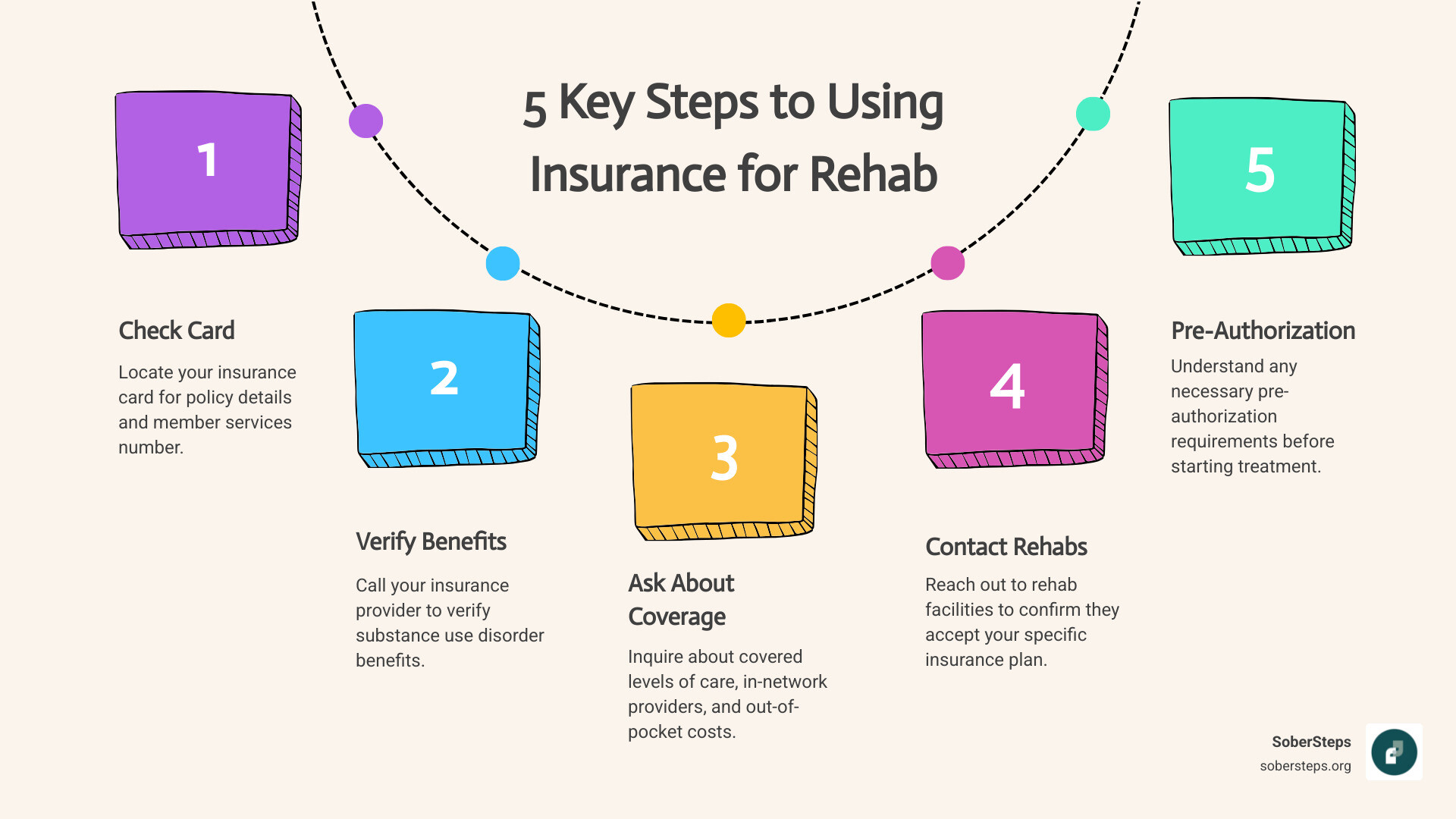
To confirm your insurance coverage for rehab, follow these steps:
- Call Your Insurer: Use the member services number on your insurance card. Have your policy information ready.
- Ask Specific Questions: Be prepared to ask about covered levels of care, in-network vs. out-of-network benefits, deductibles, copays, out-of-pocket maximums, and pre-authorization requirements.
- Contact the Rehab Facility: The admissions department can often verify your benefits directly with your insurer, giving you a precise breakdown of your estimated costs. They are experts in this process.
- Understand Pre-authorization: Many higher levels of care require pre-authorization, meaning your insurer must approve the treatment before it begins. The rehab facility typically handles this.
- Review Your Explanation of Benefits (EOB): After treatment, you’ll receive an EOB from your insurer detailing what was paid and what you owe. Review it for accuracy.
Taking these steps empowers you to make informed decisions. If you need immediate assistance, our Get Help Now page is a great place to start.
Let SoberSteps help you verify your benefits and simplify this process.
Finding In-Network Rehabs that Accept Insurance
Choosing an in-network provider almost always results in lower out-of-pocket costs. Here’s how to find them:
- Use Your Insurer’s Provider Directory: Most insurance companies, like Humana Insurance and UnitedHealth Group Insurance, have online directories of in-network providers. This is the most accurate way to find facilities linked to your plan.
- Contact SoberSteps Admissions Navigators: Our team can quickly verify your benefits, identify in-network rehabs that accept insurance, and connect you with treatment centers that meet your clinical and financial needs.
- Use National Resources: The SAMHSA Treatment Locator is a national resource for finding facilities. Once you find a potential rehab, you can then check its in-network status with your provider or with our help.
Finding the right treatment center is a personal decision. Explore our list to find a rehab near you.
Navigating Costs and Payment Options
Even with insurance, you will likely have some out-of-pocket costs. Understanding these common terms will help you anticipate your financial responsibility when looking for rehabs that accept insurance:
- Deductible: The amount you pay for covered services before your insurance plan starts to pay.
- Copayment (Copay): A fixed amount you pay for a covered service after meeting your deductible.
- Coinsurance: Your share of the costs of a covered service, calculated as a percentage (e.g., 20%).
- Out-of-Pocket Maximum: The most you’ll have to pay for covered services in a plan year. After you reach this limit, your insurance pays 100% of covered benefits.
The total cost of treatment varies based on your plan, the rehab, and the length of stay. Our How Do I Pay For Addiction Treatment? guide digs deeper into these financial aspects.
What if My Insurance Doesn’t Cover Everything?
If your insurance doesn’t cover the full cost of rehab, don’t be discouraged. Many options can make treatment affordable:
- Payment Plans: Many facilities offer flexible plans to pay your balance over time.
- Sliding Scale Fees: Some centers adjust costs based on your income.
- Financing Options: Healthcare financing companies offer loans specifically for medical treatment.
- Scholarships and Grants: Non-profits and treatment centers may offer financial aid.
Financial barriers shouldn’t stop you from getting help. Our Affordable Treatment Options page has more details on these avenues.
Ask SoberSteps about affordable options and how to bridge any gaps in your insurance coverage.
What if I Can’t Find Rehabs that Accept Insurance or I’m Uninsured?
If you don’t have insurance, there are still critical resources available to ensure you have a path to recovery:
- State-Funded Programs: Many states offer free or low-cost rehab services. While they may have waiting lists, they are a vital resource. Explore Free Rehab Centers Near Me for more information.
- SAMHSA Grants: The Substance Abuse and Mental Health Services Administration provides grants to states to expand access to treatment.
- Subsidized Coverage through the ACA: You may qualify for a subsidized health plan through the ACA Marketplace. Check your eligibility for lower costs on Healthcare.gov.
- Non-Profit and Community Resources: Organizations like The Salvation Army’s rehab programs offer free or very low-cost services.
It’s important to be persistent and explore all avenues. The journey to recovery is worth the effort.
Explore free and low-cost options with SoberSteps – we can help you find resources.
Frequently Asked Questions about Using Insurance for Rehab
Here are answers to common questions we receive about using insurance to pay for rehabs that accept insurance.
How do I get insurance to pay for inpatient rehab?
To get insurance to cover inpatient rehab, you’ll generally need to meet a few requirements:
- Medical Necessity: A clinical assessment must show that inpatient care is medically necessary for your condition.
- Pre-authorization: Your insurance company must approve your stay before you begin treatment. The rehab facility’s admissions team typically handles this.
- In-Network Facilities: Choosing an in-network facility will always maximize your coverage and minimize your costs.
Our Inpatient page provides more insights into this level of care.
Get help with insurance approval and verification by contacting SoberSteps.
What should I do if my insurance claim for rehab is denied?
A denial is frustrating, but it’s not the final answer. You have the right to appeal:
- Review the Denial Letter: It will explain the reason for the denial and the steps to appeal.
- Gather Documentation: Work with your treatment provider to gather medical records that support the necessity of your treatment.
- File an Internal Appeal: Ask your insurance company to reconsider its decision within the specified timeframe.
- Request an External Review: If the internal appeal is denied, you can have an independent third party review your case.
Remember your rights under the Mental Health Parity and Addiction Equity Act (MHPAEA). Our Mental Health Insurance Complete Guide has more on parity laws.
Contact SoberSteps for help with appeals and understanding your rights.
Does insurance cover aftercare programs like sober living?
This is a nuanced question. Coverage for aftercare services like Sober Living varies significantly by policy.
- Clinically Supervised Aftercare: Insurance is more likely to cover clinical components of an Aftercare plan, such as ongoing therapy or IOP.
- Sober Living Homes: Direct coverage for sober living rent is less common, as it’s often viewed as housing rather than a medical service. However, some integrated programs may have components that are covered.
- Check Your Plan: Always verify your plan’s “continuing care” benefits directly with your insurance provider to understand what is covered.
Ask SoberSteps about aftercare coverage and how to plan for long-term recovery support.
Your Path to Recovery Starts Here
We understand that navigating the complexities of addiction and insurance can be daunting. But we want you to know that recovery is not just a possibility; it’s a reality for millions of people. And with the increasing accessibility of rehabs that accept insurance, financial help is more available than ever before.
Taking the first step is often the hardest, but it’s also the most courageous. You don’t have to face this alone. At SoberSteps, we are dedicated to connecting you with the resources and support you need to begin your healing journey. Our confidential 24/7 helpline is staffed by compassionate individuals ready to listen and guide you without judgment. If you’re looking for support, our Anonymous Mental Health Hotline Guide is a great resource. You can also explore inspiring stories and advice on our Addiction Recovery Blogs.
Seeking help is a sign of strength, not weakness. We’re here to help you find the right treatment, understand your insurance, and take those crucial steps toward a healthier, happier life.
Contact SoberSteps now for confidential help and take control of your recovery.