
Comprehensive Addiction Services: Where to Find Help
SoberSteps offers comprehensive addiction services. Find help for SUD, detox, therapy, and recovery support. Start your journey today!

Partial Hospitalization Programs (PHPs) for Addiction Treatment offer a structured, intensive level of care that bridges the gap between 24-hour inpatient treatment and traditional outpatient services. If you’re struggling with substance use disorder and need more support than weekly therapy but don’t require round-the-clock supervision, a PHP might be the right fit for you.
Quick Answer: What is a PHP?
A PHP—sometimes called “day treatment”—provides comprehensive care similar to inpatient rehab, but you don’t stay overnight. You’ll spend several hours each day at a treatment facility engaging in therapy, learning coping skills, and receiving medical support, then return home to practice what you’ve learned in real-world settings.
Why PHPs Matter
PHPs serve as a critical middle ground in addiction treatment. They’re more intensive than standard outpatient programs (which might only meet a few hours per week) but less restrictive than residential treatment. This makes them ideal for:
The research shows that PHPs can dramatically reduce symptoms of substance use disorders while being more cost-effective than 24/7 inpatient care. Many insurance plans cover PHPs more extensively than residential treatment, often authorizing more days of care.
At Sober Steps, we’ve helped countless individuals steer the complexities of addiction treatment, including connecting them with quality Partial Hospitalization Programs (PHPs) for Addiction Treatment that meet their unique needs. Our team understands that finding the right level of care can feel overwhelming, which is why we’re here to guide you through every option with confidential, compassionate support. Call us at (844) 491-5566 for a free, confidential consultation.
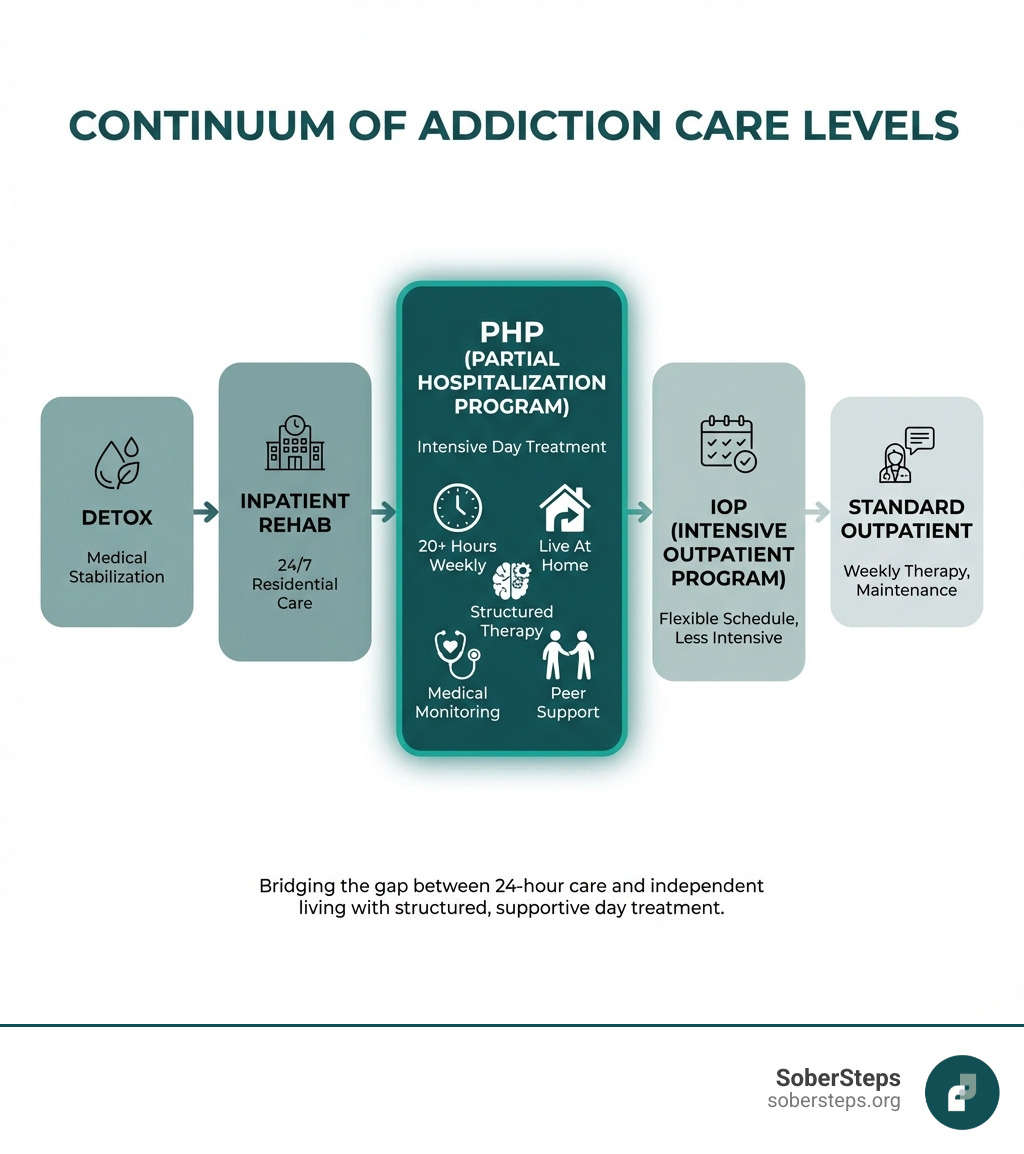
When we talk about addiction recovery, we often think of a spectrum of care, known as the continuum of care. This continuum ranges from intensive 24/7 inpatient hospitalization to less frequent outpatient therapy sessions. The American Society of Addiction Medicine (ASAM) provides guidelines for these different levels, ensuring that individuals receive care appropriate to their unique needs. Partial Hospitalization Programs (PHPs) for Addiction Treatment fit squarely in the middle, offering a unique blend of intensive treatment and personal autonomy.
| Feature | Partial Hospitalization Program (PHP) | Intensive Outpatient Program (IOP) | Standard Outpatient Program |
|---|---|---|---|
| Time Commitment | 20+ hours per week (typically 5-7 days, 5-6 hours/day) | 9-19 hours per week (typically 2-4 days, 3-hour sessions) | Fewer than 9 hours per week (e.g., 1-2 sessions/week) |
| Living Situation | Live at home, attend treatment during the day | Live at home, attend treatment at scheduled times | Live at home, attend treatment at scheduled times |
| Level of Supervision | High level of structured support and clinical oversight, medical and psychiatric services often included | Moderate level of structured support, clinical oversight, focus on therapy | Low level of structured support, focus on individual/group therapy |
| Typical Cost | $200-$600 per day (more cost-effective than inpatient) | Lower than PHP (varies widely) | Lowest (varies widely) |
| Ideal Candidate | Needs intensive care but has stable home life; stepping down from inpatient; stepping up from IOP; co-occurring disorders; relapse risk | Needs structured support but can manage daily responsibilities; stepping down from PHP; stable in recovery but needs ongoing support | Stable in recovery; needs minimal ongoing support; seeking preventative care or long-term maintenance |
PHPs are designed to provide a supportive and structured environment for individuals to work towards their recovery goals while maintaining some connection to their daily lives. The core idea is to offer a comprehensive, intensive treatment experience during the day, allowing participants to return to their homes in the evenings. This balance of structure and flexibility is a key differentiator.
This model is particularly valuable because it allows individuals to practice new coping strategies and relapse prevention techniques in their natural environment, rather than in an isolated residential setting. It’s a bridge that helps people gradually reintegrate into daily life while still receiving intensive care. Compared to inpatient hospitalization, PHPs tend to be more cost-effective while still providing intensive treatment, making high-quality care more accessible to many.
The difference in intensity between PHPs and other outpatient options is significant.
A comprehensive Partial Hospitalization Program (PHP) for Addiction Treatment is built around an individualized treatment plan, developed by a multidisciplinary team. This team typically includes experienced therapists, medical staff, and addiction specialists, all working together to address the unique needs of each participant. The daily structure of a PHP is designed to immerse individuals in a therapeutic environment, focusing heavily on relapse prevention and skill-building.
Imagine a typical day in a PHP. It often involves attending the treatment facility for several hours, usually 5-6 days a week, with sessions lasting 5-6 hours each day. This intensive schedule is intentionally designed to be similar to office-based employment hours, helping patients shift back into working hours and solidify their understanding of how much effort sobriety demands. The program length can vary, but typically lasts around 4-6 weeks, though some may extend for several months depending on individual progress and needs.
This structured routine promotes stability and routine, which can be particularly helpful for individuals with mental health or substance abuse issues. During these hours, participants engage in a variety of therapeutic activities and skill-building workshops, all aimed at fostering lasting recovery.
PHPs offer many of the same therapeutic interventions found in inpatient treatment, all backed by research to be effective in treating addiction. These include:
These interventions are designed to provide psychosocial support and individual treatment, helping patients develop coping and relapse-prevention management strategies. For more information on effective treatment approaches, you can refer to resources like the National Institute on Drug Abuse.
One of the significant advantages of PHPs is their capacity to address co-occurring disorders, often referred to as dual diagnosis. Many individuals struggling with addiction also experience mental health conditions such as anxiety, depression, or trauma. PHPs provide integrated treatment, meaning both the substance use disorder and the mental health condition are treated simultaneously by a coordinated team.
This includes:
PHPs are particularly appropriate for patients who have a co-occurring disorder, as they offer the comprehensive care needed to treat both conditions effectively, leading to better overall recovery outcomes.
%20for%20Addiction%20Treatment_compressed.jpg?alt=media&token=64956d90-9b25-4e72-9d31-7129a805e3d1 "person talking with counselor - Partial Hospitalization Programs (PHPs) for Addiction Treatment")
Deciding if a Partial Hospitalization Program (PHP) for Addiction Treatment is the right choice involves a careful patient assessment. PHPs are designed for individuals who need a high level of structured care but do not require 24-hour supervision or medical detoxification. A stable living situation and a sober home environment are crucial for success in a PHP, as participants return home each night. Motivation for recovery is also a key factor, as the program demands significant engagement and commitment.
We typically find that a PHP is a good fit for individuals who meet certain criteria:
PHPs are also appropriate for patients who have a hard time motivating themselves to continue treatment, as the structured daily schedule provides built-in accountability.
PHPs play a vital role in the continuum of care, serving as both a “step-down” and a “step-up” option:
This flexibility ensures that individuals can move through treatment levels as their needs evolve, maximizing their chances for long-term recovery.
Navigating the financial aspects of addiction treatment can feel daunting, but understanding the costs and insurance coverage for Partial Hospitalization Programs (PHPs) for Addiction Treatment is a crucial step in financial planning and ensuring treatment accessibility. Finding a quality program near you involves careful research and consideration of program accreditation.
While intensive, PHPs are often a more cost-effective treatment option compared to inpatient or residential treatment programs. This is primarily because PHPs do not include the significant costs associated with 24/7 room and board.
The cost of a PHP can vary widely, typically ranging anywhere from $200 to $600 per day. This daily cost covers the intensive therapeutic services, medical and psychiatric care, and other support services you receive during your time at the facility. Despite this daily rate, the overall expense is generally lower than that of a residential program, which can often exceed $1,000 per day. This makes PHPs a valuable option for those who need intensive care but are also mindful of treatment costs.
The good news is that most insurance plans will cover a PHP. The Affordable Care Act (ACA) mandates that mental health and substance use disorder treatment are essential health benefits, meaning insurance plans must provide coverage for these services.
You are generally eligible for a PHP if you’re at risk of an inpatient psychiatric admission or if you’re transitioning from inpatient to community care. We highly recommend contacting your insurance provider to understand your specific coverage options and any requirements for pre-authorization. For general information on ACA mental health coverage, please see the U.S. Department of Health & Human Services.
Finding the right Partial Hospitalization Program (PHP) for Addiction Treatment is crucial for successful recovery. Here’s what we recommend looking for:
We encourage you to ask specific questions about the program’s philosophy, daily schedule, types of therapies offered, staff qualifications, and how they handle aftercare.
Life during a Partial Hospitalization Program (PHP) for Addiction Treatment is focused on intensive healing and skill-building, laying a robust foundation for long-term sobriety. Once the PHP is complete, the journey continues with strategic aftercare planning to maintain healthy habits, use coping skills, and lean on community support.
Choosing a PHP offers a multitude of benefits that can significantly impact your recovery journey:
Completing a PHP is a significant milestone, but it’s not the end of the recovery journey. What happens next is crucial for maintaining sobriety and building a fulfilling life. We work with you to develop a comprehensive discharge plan, which often includes:
The goal is to ensure you have a robust support system and ongoing resources to sustain your recovery long after your PHP concludes.
Partial Hospitalization Programs (PHPs) for Addiction Treatment offer a powerful, structured, and flexible option for individuals seeking recovery from substance use disorders and co-occurring mental health conditions. They provide the intensive care needed to address complex issues while allowing you to maintain connections to your home life and practice new skills in real-world settings. This balance is often the key to building a strong foundation for lasting sobriety.
We believe that everyone deserves a path to recovery, and that no one should have to walk that path alone. At SoberSteps, we are dedicated to providing confidential and anonymous help, guiding you through your options, and connecting you with the resources you need. Taking the first step can be the hardest, but it’s also the most courageous. There is hope for the future, and we are here to help you find it.
Find help for addiction and take the next step towards a healthier, more fulfilling life. You are not alone. Call us at (844) 491-5566 for confidential support and to explore your treatment options.

SoberSteps offers comprehensive addiction services. Find help for SUD, detox, therapy, and recovery support. Start your journey today!
Need medical detox programs? Discover the safe, supervised path to recovery, withdrawal management, and how to get help today.
Connect with online addiction recovery support groups. Explore diverse types, find support, and start your recovery journey virtually.