
Why Online Addiction Recovery Support Groups Are Changing Recovery Today
Online addiction recovery support groups connect you with peer support, evidence-based tools, and community—all from the privacy of your own space. Here’s what you need to know:
Quick Overview: Types of Online Support Groups Available
- 12-Step Programs (AA, NA) – Traditional peer support linking recovery to a higher power, with 130+ daily online meetings
- SMART Recovery – Evidence-based approach using Cognitive Behavioral Therapy principles for self-empowerment
- Faith-Based Groups – Christian, Islamic, Jewish, and Buddhist-inspired recovery communities
- Specialized Groups – Medication-assisted recovery (MARA), dual diagnosis (DRA), specific substances, internet addiction (ITAA)
- Family Support – Al-Anon, Nar-Anon, and Families Anonymous for loved ones
Key Advantages:
- Available 24/7 from anywhere with internet access
- Free or donation-based (no cost barrier)
- Anonymous participation (camera-off, pseudonym options)
- Multiple language support
- No travel required
The landscape of addiction recovery has fundamentally changed. What once required a trip to an in-person meeting now happens through a screen. For many struggling with substance use or behavioral addictions, barriers like transportation, childcare, social anxiety, or rural isolation can feel impossible. Online recovery support groups eliminate these obstacles, offering peer connection and proven recovery frameworks with greater flexibility.
Whether you need help at 2 AM, want a group that shares your background, or are juggling work and family, virtual meetings provide accessible options. The variety is remarkable, from 12-step programs like Alcoholics Anonymous and Narcotics Anonymous to evidence-based approaches like SMART Recovery and specialized groups for internet addiction or medication-assisted recovery. The digital recovery landscape offers something for everyone.
At Sober Steps, we connect individuals with the online addiction recovery support groups that best fit their needs. We understand finding the right support is overwhelming, which is why we created this guide to help you steer your options. For confidential guidance, call us anytime at (844) 491-5566.
The Power of Connection: Why Choose an Online Support Group?
In recovery, connection is often called the opposite of addiction. When finding that connection feels like an uphill battle, online addiction recovery support groups offer a lifeline to the isolated. Imagine accessing a supportive community from your couch, office, or a quiet park—that’s the power of virtual support.
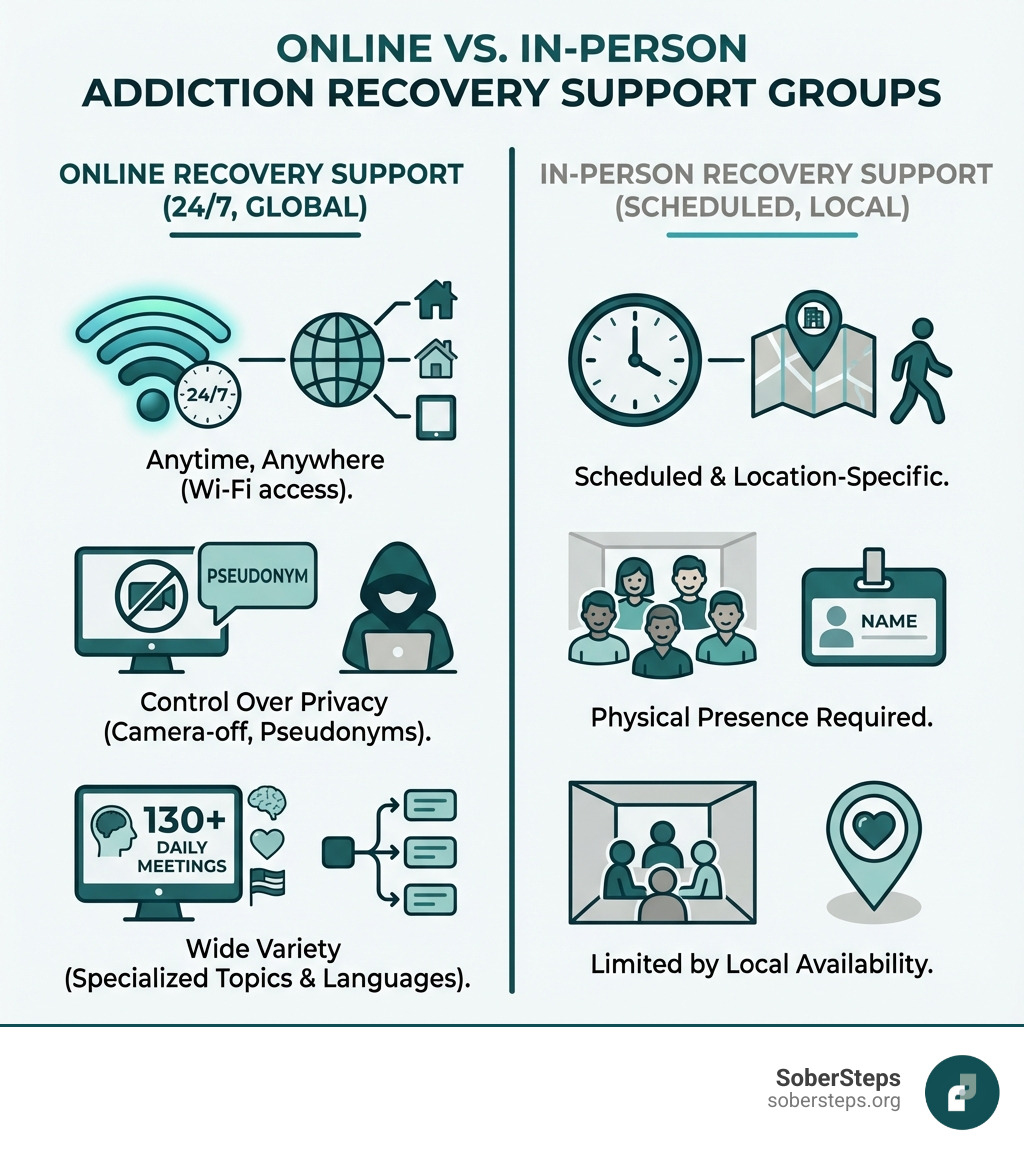
The benefits are compelling. Unparalleled accessibility lets you join meetings from anywhere in the United States with an internet connection—a game-changer for those in rural areas, with mobility issues, or with demanding schedules. Online groups also offer heightened anonymity; participating with your camera off or using a pseudonym can reduce social anxiety and make it easier to open up. With 24/7 availability on platforms offering over 130 meetings daily, help is just a click away, which is crucial for managing cravings or crises. Finally, the global community connects you with diverse perspectives, enriching your recovery journey.
At SoberSteps, we believe everyone deserves easy access to support. You can find a support group with SoberSteps custom to your situation, or call us at (844) 491-5566 for confidential help.
Benefits of Online Addiction Recovery Support Groups
Let’s dive deeper into why virtual support has become such a cornerstone of modern recovery:
- Breaking Isolation: Addiction thrives in isolation. Online groups provide a powerful antidote, instantly connecting you with others who understand your struggles and reminding you that you’re not alone.
- Consistent Support: Life happens. Online groups offer flexibility that allows for consistent engagement, ensuring you don’t miss out on vital support, even on your busiest days.
- Diverse Perspectives: Because online groups transcend geographical boundaries, you’ll encounter individuals from all walks of life, offering fresh perspectives on challenges and recovery strategies.
- No Travel Required: Forget about gas money, public transport, or traffic. The time and cost saved by eliminating travel can be reinvested into your recovery.
- Cost-Effective: Most online support groups, like AA, NA, and SMART Recovery, are free, relying on voluntary contributions. This removes a significant financial barrier to seeking help.
- Peer Support: At its core, recovery support is about peers helping peers. Online platforms facilitate this by creating spaces where individuals can share their experience, strength, and hope.
Online vs. In-Person: Understanding the Differences
While both online and in-person meetings share the goal of fostering recovery, their modalities present distinct experiences. Understanding these differences can help you decide which format is best for you.

- Flexibility vs. Structure: Online groups offer round-the-clock meetings accessible from anywhere, allowing you to fit recovery into your life. In-person meetings require adherence to fixed schedules and locations.
- Digital Communication vs. Physical Presence: Online communication via video, audio, and chat can be less intimidating. In-person meetings provide the tangible comfort of physical presence and non-verbal cues that can deepen connections.
- Local vs. Global Connections: In-person meetings build a local community for real-world support. Online groups create a global network, making it easier to find others with shared niche experiences and connect with a group that truly resonates.
The choice between online and in-person isn’t mutually exclusive. Many find a blended approach—leveraging online convenience for daily support and attending in-person meetings for deeper community building—to be the most effective strategy. Organizations like Alcoholics Anonymous (AA), Narcotics Anonymous (NA), and SMART Recovery all offer both online and in-person options.
Exploring Different Types of Online Addiction Recovery Support Groups
The beauty of the online recovery landscape is its vast diversity. There isn’t a one-size-fits-all solution, and thankfully, you don’t have to settle for one. We’ve compiled a table to give you a quick overview of the core philosophies that drive many of these invaluable communities:
| Group Type | Core Belief | Meeting Style | Key Goal |
|---|---|---|---|
| Peer-Support | Mutual aid, shared experience, belief in a higher power (often) | Sharing, sponsorship, 12 Steps | Abstinence, spiritual awakening, helping others |
| Science-Based | Self-empowerment, evidence-informed strategies | Discussion, skill-building (CBT), goal setting | Self-management, balanced life, emotional regulation |
| Faith-Inclusive | Spiritual principles, divine guidance, community of faith | Prayer, scripture, testimony, spiritual fellowship | Spiritual growth, freedom from addiction through faith |
| Specialized | Custom support for specific needs (e.g., MAT, internet) | Specific focus, targeted discussions, relevant resources | Targeted recovery, addressing unique challenges |
Peer-Support Programs
Peer-support programs are a bedrock of recovery, operating on the principle that people with similar challenges can best support one another. Globally recognized groups like Alcoholics Anonymous (AA) and Narcotics Anonymous (NA) offer a structured path, often linked to a higher power, with abundant online meetings. These groups foster a powerful bond through shared stories, reducing isolation and shame. Sponsorship, where an experienced member guides a newcomer, is a central concept. Beyond AA and NA, there are numerous other 12-step fellowships, including:
- Cocaine Anonymous (CA): www.ca.org
- Crystal Meth Anonymous: www.crystalmeth.org
- Gamblers Anonymous (GA): https://www.gamblersanonymous.org
- Heroin Anonymous (HA): https://www.heroinanonymous.org
- Marijuana Anonymous (MA): http://www.marijuana-anonymous.org/
- Nicotine Anonymous: http://www.nicotine-anonymous.org/
These groups provide a welcoming space for anyone with a desire to stop using. www.aa.org and www.na.org are excellent starting points. Additionally, platforms like In the Rooms serve as a hub for a wide array of recovery meetings. SoberSteps also facilitates access to various online peer groups. For confidential guidance, call us at (844) 491-5566.
Science-Based and Secular Approaches
For those preferring a path not centered on spirituality, science-based and secular approaches offer powerful alternatives. These programs use evidence-informed methods like cognitive behavioral therapy (CBT) to provide practical tools for managing cravings and behaviors.

A leading example is SMART Recovery (“Self Management and Recovery Training”), an evidence-based method that emphasizes self-empowerment. Its collaborative meetings help participants create personalized recovery plans to build a balanced, fulfilling life. You can learn more and find meetings at www.smartrecovery.org.
Other notable secular groups include:
- LifeRing Secular Recovery: http://www.lifering.org
- Secular Organizations for Sobriety (SOS): https://www.sossobriety.org
- HAMS (Harm Reduction, Abstinence, and Moderation Support): http://www.hamsnetwork.org
These groups offer strength rooted in personal responsibility and psychological strategies. At SoberSteps, we recognize the value of diverse approaches and can help you find science-based recovery meetings that align with your needs. For confidential guidance, call us at (844) 491-5566.
Faith-Inclusive and Spiritual Groups
For many, faith is integral to healing. Faith-inclusive online addiction recovery support groups integrate spiritual principles, prayer, and community support rooted in shared beliefs. They offer a space to connect with a higher power and draw strength from faith.
Examples include:
- Celebrate Recovery: A Christ-centered pathway to healing. Find groups at www.celebraterecovery.com.
- Millati Islami: An Islamic spiritual path for Muslims in recovery. Learn more at https://www.millatiislami.org/index.php/millati-islami-groups.
- Our Jewish Recovery: Support rooted in a Jewish context. Find meetings at https://www.ourjewishrecovery.com/meetings.
- Recovery Dharma: Uses Buddhist principles like meditation and mindfulness. Visit https://recoverydharma.org/find-a-meeting/.
- Refuge Recovery: Another Buddhist-inspired program focusing on compassion and wisdom. More at https://www.refugerecovery.org.
SoberSteps respects all paths to healing and can assist you in exploring faith-inclusive support options. For confidential guidance, call us at (844) 491-5566.
Specialized and Niche Groups
Recovery isn’t one-size-fits-all. Specialized and niche online addiction recovery support groups cater to specific needs, substances, or co-occurring conditions, providing targeted support for unique circumstances.
- Medication-Assisted Recovery Anonymous (MARA): For individuals using medications in their recovery, MARA offers a supportive, 12-step-based environment. Find out more at www.mara-international.org and Medication Assisted Recovery Anonymous.
- Dual Recovery Anonymous (DRA): For those with co-occurring mental health and substance use disorders, DRA provides a 12-step program addressing both. Visit www.draonline.org.
- Women for Sobriety (WFS): A self-help program exclusively for women, focusing on positive affirmations. Check out https://www.womenforsobriety.org.
- Internet and Technology Addicts Anonymous (ITAA): A 12-step fellowship for internet and technology addiction, offering daily online meetings in multiple languages. They are free, safe, and anonymous.
- National Alliance on Mental Illness (NAMI): NAMI holds support groups for individuals with substance use disorders and their loved ones. Find programs at National Alliance on Mental Illness (NAMI).
These specialized groups ensure that no one is left behind. SoberSteps is here to help you steer these options and find the specialized online groups that best fit your needs. For confidential guidance, call us at (844) 491-5566.
Your Path to Connection: Finding and Joining a Group
Finding the right support group can feel overwhelming, but we’re here to help you connect with a community that resonates with you.
How to Find the Right Online Addiction Recovery Support Group for You
Finding the right online addiction recovery support group requires self-reflection and a willingness to explore.
- Assess Your Personal Beliefs and Preferences: Do you prefer a faith-based or secular approach? Are you comfortable with the 12-step model or evidence-based methods like CBT?
- Consider Your Specific Needs: Are you dealing with a particular substance, a co-occurring mental health condition, or a behavioral addiction? Knowing your challenges helps you target specialized groups.
- Try Multiple Meetings: Don’t be discouraged if the first meeting isn’t a perfect fit. Keep exploring until you find a group where you feel comfortable and understood.
- Read Group Guidelines: Before joining, scan any available guidelines on the group’s website to get a sense of their philosophy and meeting etiquette.
- Ask for Recommendations: If you’re connected to a therapist or sponsor, ask them for recommendations for online groups.
- Seek Out Specialized Support: For instance, if you’re a woman seeking a safe environment, exploring resources like support for women in recovery can be incredibly beneficial.
The goal is to find a place where you feel safe, heard, and supported.
What to Expect in Your First Meeting
Attending your first online meeting can feel daunting, but these spaces are welcoming and non-judgmental. Here’s what to expect:
- Joining is Easy: Most meetings use platforms like Zoom. You can join by video or dial in by phone. Some platforms offer meetings in multiple languages with translated subtitles.
- Meeting Format and Script: Meetings are led by a chairperson, last about an hour, and often follow a structured format with opening statements or readings.
- Option to Listen: There is absolutely no pressure to speak. You are welcome to simply listen, observe, and absorb. Your presence is enough.
- No Pressure to Share: If you choose to share, it’s usually during an open sharing segment. Others are encouraged to listen without offering unsolicited advice.
- Anonymity is Respected: You can keep your camera off, use a pseudonym, and share only what you’re comfortable with. Hosts often have security measures in place to protect privacy.
- Closing Statements: Meetings typically conclude with closing statements and sometimes an opportunity for informal chat.
Our advice? Just show up. The hardest part is often the first step.
Resources for Family and Loved Ones
Addiction impacts the entire family. Many online addiction recovery support groups are designed for family members and loved ones, offering a safe space to share experiences, learn coping strategies, and understand addiction.
- Al-Anon/ALATEEN: For friends and family of problem drinkers. Visit https://al-anon.org/.
- Nar-Anon Family Groups: For those affected by someone else’s drug use. Learn more at www.nar-anon.org.
- Families Anonymous: A 12-step fellowship for relatives and friends concerned about drug use or other behavioral problems. Visit https://www.familiesanonymous.org.
- Mothers Against Addiction: Provides support for mothers whose children are struggling with addiction. http://www.mothersagainstaddiction.org.
- NAMI (National Alliance on Mental Illness): NAMI also holds support groups for the loved ones of individuals with substance use disorders.
At SoberSteps, we recognize the profound impact of addiction on families. We offer support resources to guide you and your loved ones. Call us at (844) 491-5566 for confidential assistance.
Navigating the Virtual Space Safely and Effectively
While online addiction recovery support groups offer incredible benefits, it’s important to know how to ensure your privacy, safety, and effective participation.
Ensuring Anonymity and Privacy
Anonymity is a cornerstone of recovery, and online settings offer unique ways to maintain it:
- Using a Pseudonym: Most platforms allow you to change your display name. Use a first name only or a pseudonym to remain anonymous.
- Camera-Off Participation: You are never required to turn on your camera. This maintains your visual anonymity, allowing you to focus on listening.
- Vetting Group Security: Reputable groups have security measures in place. Meeting hosts are often trained to handle disruptions and protect group safety.
- Understanding Meeting Rules: Pay attention to stated rules about confidentiality. What is said in the meeting, stays in the meeting.
- Private Space: Always try to join from a private space where you won’t be overheard.
Overcoming Common Challenges
Technology can present challenges. Here’s how to overcome common issues:
- Technology Requirements: You’ll need a stable internet connection and a device (computer, tablet, or smartphone). A Zoom account may be needed for video. Audio-only uses little data, but video uses more. If your connection is slow, consider turning off incoming video to save bandwidth.
- Finding a Private Space: Finding a private spot at home can be tricky. Try using headphones, joining from your car, or taking a walk during the meeting.
- Dealing with Disruptions: Disruptions like “Zoom-bombing” can happen. Reputable groups have hosts who can mute or remove disruptive participants. Report any problems to the host.
- Managing Screen Fatigue: Staring at a screen is tiring. Balance online meetings with other recovery activities, take breaks, and practice self-care to avoid burnout. As ITAA notes, these meetings can paradoxically help you spend less time on screens by providing tools to manage compulsive internet use.
Frequently Asked Questions about Online Recovery Groups
We understand you might have more questions as you explore online addiction recovery support groups. Here are some common ones:
Are online support groups free?
Yes, the vast majority are free. Groups like AA, NA, SMART Recovery, and ITAA are donation-based, so members can contribute voluntarily. This ensures financial barriers don’t prevent anyone from getting help. They are self-supporting through these contributions.
Do I have to speak or turn on my camera?
No. Participation is voluntary. You can join and just listen without turning on your camera or speaking. Many newcomers do this to get a feel for the group. This flexibility is a key benefit for those with social anxiety or a desire for anonymity. Listening is a valid form of participation.
How do I know if a group is legitimate?
It’s wise to ensure you’re connecting with a safe, legitimate group. Here’s how:
- Stick to Established Organizations: Look for groups affiliated with reputable organizations like Alcoholics Anonymous (AA), Narcotics Anonymous (NA), SMART Recovery, or the National Alliance on Mental Illness (NAMI).
- Check for Clear Guidelines: Legitimate groups usually have clear guidelines for conduct and confidentiality on their websites.
- Observe a Meeting First: The best way to vet a group is to attend and observe. Do the facilitators seem responsible? Is the environment respectful? Trust your gut. If something feels off, leave and try another group. SoberSteps connects individuals only with trusted resources. For help finding a group, call us at (844) 491-5566.
Conclusion: Your Next Step Towards Recovery
The recovery journey is personal but rarely walked alone. Online addiction recovery support groups have revolutionized connection, offering accessible, anonymous, and diverse communities for healing. These virtual spaces break down barriers, provide consistent support, and offer philosophies ranging from 12-step to science-based approaches.
Whether you’re battling addiction or supporting a loved one, an online community is ready to help. The flexibility to join from anywhere means hope is always within reach. Finding the right support is a powerful step forward on your journey.
At SoberSteps, we are committed to providing confidential and anonymous help for mental health and substance use disorders. We’re here to guide you to the resources that best fit your unique path. Take the first step today, knowing that a supportive community is waiting. You can also find specialized support for your journey through our comprehensive resources.
Help is available 24/7—call us at (844) 491-5566 for a confidential consultation.