Conquer Cravings: How to Overcome Drug Addiction and Reclaim Your Life
Discover hope and tools for overcoming drug addiction. Reclaim your life with our comprehensive guide to recovery and support.

Intensive Outpatient Programs (IOP) for Addiction Treatment provide structured, comprehensive care for individuals with substance use disorders while allowing them to live at home and maintain daily responsibilities like work or school.
Quick Answer: What You Need to Know About IOPs
IOPs serve as a critical bridge in the continuum of care, offering more support than standard outpatient therapy (1-3 hours weekly) but less oversight than inpatient programs requiring 24/7 supervision. For many, IOPs provide the perfect balance—intensive enough to be effective, yet flexible enough to allow real-world skill practice.
Research consistently shows that IOPs produce outcomes comparable to inpatient treatment for most individuals, with 50-70% of participants reporting abstinence at follow-up after completing the program and engaging in aftercare. The structured yet flexible nature of IOPs makes them ideal for:
At Sober Steps, we are dedicated to connecting individuals with the right level of care, including Intensive Outpatient Programs (IOP) for Addiction Treatment. Our mission is to provide confidential, anonymous guidance so no one has to face their challenges alone. For immediate, confidential help, call our 24/7 helpline at (844) 491-5566. Understanding if an IOP is the right fit is the first step toward lasting recovery.
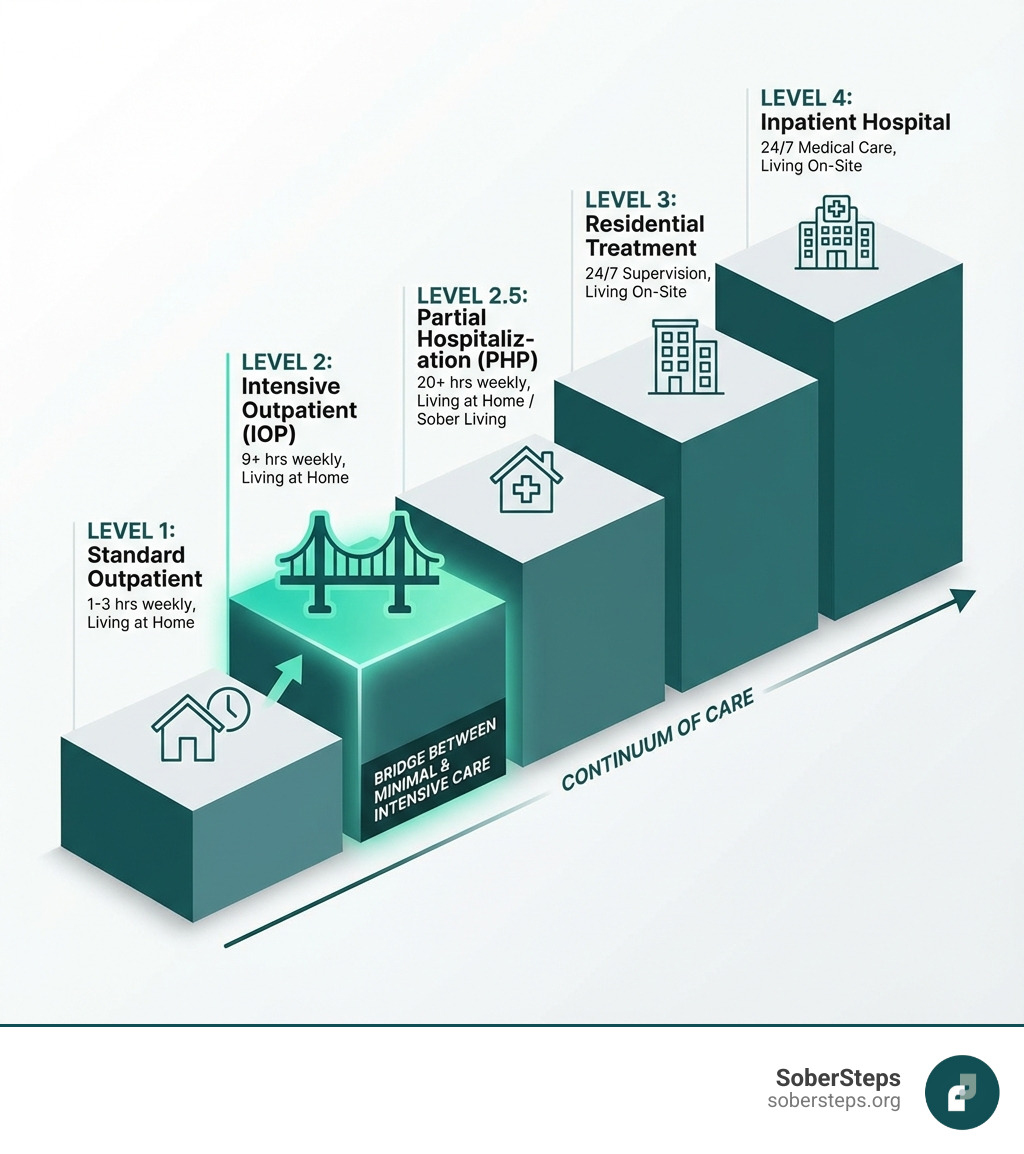
Addiction treatment exists on a continuum of care. Intensive Outpatient Programs (IOP) for Addiction Treatment hold a vital place in this spectrum, balancing robust support with real-world flexibility.
IOP vs. Higher-Intensity Treatment (Inpatient/Residential/PHP)
Higher levels of care like inpatient or residential programs require living at the facility 24/7 for constant supervision. Partial Hospitalization Programs (PHPs) are also highly intensive (20+ hours/week) but allow patients to return home at night. IOPs are a step down from these options, offering significant care without requiring you to live at the facility. This allows you to apply learned skills directly to your home environment, a distinct advantage for long-term recovery.
IOP vs. Standard Outpatient Therapy
Standard outpatient therapy is the least intensive level, typically involving 1-3 hours of counseling per week. It’s best for those with mild SUDs or who need maintenance support. In contrast, an Intensive Outpatient Program (IOP) for Addiction Treatment requires at least 9 hours per week. This increased intensity allows for deeper therapeutic work and more consistent support, making it ideal for those who need more than weekly therapy but not 24/7 supervision.
Here’s a quick comparison:
| Feature | Intensive Outpatient Program (IOP) | Standard Outpatient Program |
|---|---|---|
| Hours/Week | 9+ hours | 1-3 hours |
| Living Situation | At home or sober living | At home |
| Level of Supervision | Structured, but not 24/7 | Minimal, self-directed |
| Ideal Candidate | Needs significant support, but can maintain daily responsibilities; transitioning from higher care; mild-to-moderate SUD | Mild SUD; stable recovery; ongoing maintenance |
An Intensive Outpatient Program (IOP) for Addiction Treatment is a comprehensive experience built on structured activities and diverse therapies. It provides a supportive environment for healing without completely disrupting your life.
The defining feature of an IOP is its time commitment, requiring at least 9 hours of treatment per week. These hours are typically structured into three-hour sessions, three to five days a week. To accommodate work, school, or family care, many programs offer morning, afternoon, or evening options. This flexibility allows you to maintain crucial elements of a stable life while in recovery.
Here’s a sample IOP schedule, based on Substance Abuse and Mental Health Services Administration (SAMHSA) guidelines:
| Time Slot | Monday | Tuesday | Wednesday | Thursday | Friday |
|---|---|---|---|---|---|
| 5:30 – 7:00 PM | Check-in & Process Group | Multifamily Education | Early Recovery Skills | Psychoeducation | Relapse Prevention |
| 7:00 – 7:15 PM | Break | Break | Break | Break | Break |
| 7:15 – 8:45 PM | Individual Session Planning & Group Activity | Process Group | Life Skills Training | Therapeutic Activity | Aftercare Planning |
This sample shows how an IOP integrates various therapeutic elements into a manageable weekly schedule.
An effective Intensive Outpatient Program (IOP) for Addiction Treatment uses evidence-based therapies to provide the tools for lasting sobriety. Core approaches include:
Beyond therapy, IOPs emphasize skill development, including:
The duration of an Intensive Outpatient Program (IOP) for Addiction Treatment varies based on individual needs and progress. While some programs last 4-6 weeks, many extend to 90 days or more. The median length of stay is often around 81 days. Progress, not a fixed timeline, dictates the length of treatment.
Transitioning out of an IOP is a planned “step-down” into aftercare to maintain long-term sobriety. Aftercare often includes:
%20for%20Addiction%20Treatment%20IMAGE_compressed.png?alt=media&token=71fb572b-576c-4f78-8ca3-3fdf05560629)
Deciding on the right level of care is a significant decision. An Intensive Outpatient Program (IOP) for Addiction Treatment is a powerful option, but it’s not for everyone. A professional assessment can help determine your individual needs.
An IOP is a great option for those past acute withdrawal who are ready for intensive therapy while maintaining their daily lives. An ideal candidate typically has:
IOPs are also an excellent “step-down” for individuals leaving inpatient care or a “step-up” for those needing more than weekly therapy.
Choosing an IOP comes with many advantages that make it an effective and appealing option:
Intensive Outpatient Programs (IOP) for Addiction Treatment are backed by solid evidence of success in helping individuals achieve and maintain sobriety. These programs integrate various approaches to address both substance use and co-occurring mental health challenges.
IOPs are versatile and effective for a range of conditions, including:
The evidence for Intensive Outpatient Programs (IOP) for Addiction Treatment is strong and reassuring. Research consistently shows that for many individuals, IOPs are as effective as inpatient or residential programs.
Key research findings include:
While those with the most severe issues might benefit from starting with inpatient care, IOPs offer a viable and effective path to recovery for a large portion of the population. For a deeper dive, explore the research at Substance Abuse Intensive Outpatient Programs: Assessing the Evidence – NIH.
Understanding the financial aspects and finding a quality program are critical steps in accessing Intensive Outpatient Programs (IOP) for Addiction Treatment. Financial concerns shouldn’t stand in the way of getting help.
The cost of an IOP varies, but it is significantly more cost-effective than residential programs as it doesn’t include room and board. Without insurance, the out-of-pocket cost is typically between $250 and $600 per week.
Insurance Coverage:
Most insurance plans cover IOPs when medically necessary, thanks to the Mental Health Parity and Addiction Equity Act (MHPAEA). However, coverage levels vary. It’s crucial to contact your insurance provider to verify your specific benefits, copays, and deductibles for Intensive Outpatient Programs (IOP) for Addiction Treatment.
Medicare Part B Coverage:
Medicare Part B covers IOP services if your care plan requires at least 9 hours of therapy per week. After meeting your deductible, you typically pay 20% of the Medicare-approved amount. These services can be received at hospitals, community mental health centers, and other qualified facilities. Part B also covers IOP at Opioid Treatment Programs for Opioid Use Disorder.
Finding the right IOP is a critical step. Here are key factors to consider when looking for a reputable program:
Resources for Finding Help:
Yes, a primary benefit of IOPs is their flexibility. Many programs offer evening or weekend sessions specifically to accommodate work, school, and family schedules, allowing you to integrate treatment into your daily life. This means you can maintain employment and other responsibilities, which are crucial for stability and reintegration into the community.
For many people, yes. Research indicates that for individuals who do not require 24/7 medical supervision and have a stable home environment, IOPs can be just as effective as more intensive programs in achieving long-term recovery. Success rates of 50-70% are often cited for individuals who complete the full program and engage in aftercare. The key is finding the appropriate level of care for your specific needs and consistently participating.
Relapse is treated as a part of the recovery process, not a failure. If a relapse occurs, your clinical team will work with you to adjust your treatment plan, identify triggers, and strengthen your coping strategies to get you back on track. This might involve increasing the frequency of your sessions, adding individual therapy, or, in some cases, recommending a temporary step-up to a higher level of care if medically necessary. The goal is always to support your continued recovery.
Intensive Outpatient Programs (IOP) for Addiction Treatment offer a flexible, effective, and evidence-based path to recovery from addiction. They provide the structure and support needed to build a strong foundation for sobriety while allowing you to remain connected to your community and responsibilities. At SoberSteps, we believe in providing confidential, anonymous help to guide you on your journey. Your path to a healthier life can start today.
Find confidential help for addiction;
Take the first step by calling our free, 24/7 confidential helpline at (844) 491-5566.

Discover hope and tools for overcoming drug addiction. Reclaim your life with our comprehensive guide to recovery and support.

Find effective alcoholism treatment program options. Learn about detox, therapies, and recovery support. Start your journey today.
Explore inpatient drug rehab for lasting recovery. SoberSteps offers 24/7 care, expert therapies, and a path to a healthier life.