Connecting You to Trusted Mental Health and Addiction Treatment.
Trusted rehab center helping individuals take sober steps toward recovery

Beacon Health Insurance Coverage for Drug Rehab: Key Insights

Discover Beacon Health Insurance Coverage for Drug Rehab insights. Verify benefits, understand costs, and find effective SUD treatment.

Understanding Guide Health Insurance Coverage for Drug Rehab

Guide Health Insurance Coverage for Drug Rehab includes several key benefits that make addiction treatment more accessible:

  • Medical Detox: Supervised withdrawal management (typically 3-7 days)
  • Inpatient/Residential Treatment: 24/7 care, usually starting with 30-day authorization
  • Outpatient Programs: PHP, IOP, and standard outpatient therapy
  • Medication-Assisted Treatment (MAT): Coverage for medications like Suboxone, Vivitrol, and Methadone
  • Dual Diagnosis Care: Integrated treatment for co-occurring mental health conditions
  • Therapy Services: Individual, group, and family counseling

Important Note: Guide Health Options is now operating as Carelon Behavioral Health. They serve over 61 million members across all 50 states through partnerships with 100+ health insurance plans.

When you’re facing addiction, understanding your insurance coverage shouldn’t add to your stress. Yet many people struggle to figure out what their Guide Health plan actually covers for drug and alcohol rehab. The reality is that coverage varies significantly based on your specific plan, whether providers are in-network, and how your insurance defines “medically necessary” treatment.

Here’s what makes this confusing: Guide (now Carelon) doesn’t actually run insurance plans themselves. Instead, they provide behavioral health services for other insurance companies. This means your coverage depends on both Guide’s network and your specific insurance plan’s rules.

The good news? Most Guide-affiliated plans cover essential addiction services because of the Affordable Care Act’s requirements for mental health and substance use disorder treatment. Coverage typically includes detox, residential rehab, outpatient programs, and medications for addiction treatment.

At SoberSteps, we’ve helped thousands of individuals steer the complexities of Guide Health Insurance Coverage for Drug Rehab, working directly with treatment centers and insurance providers to ensure our community gets the care they need. Our experience has shown us that understanding your coverage is the critical first step toward recovery.

Ready to take the first step? Contact SoberSteps for a confidential insurance verification.
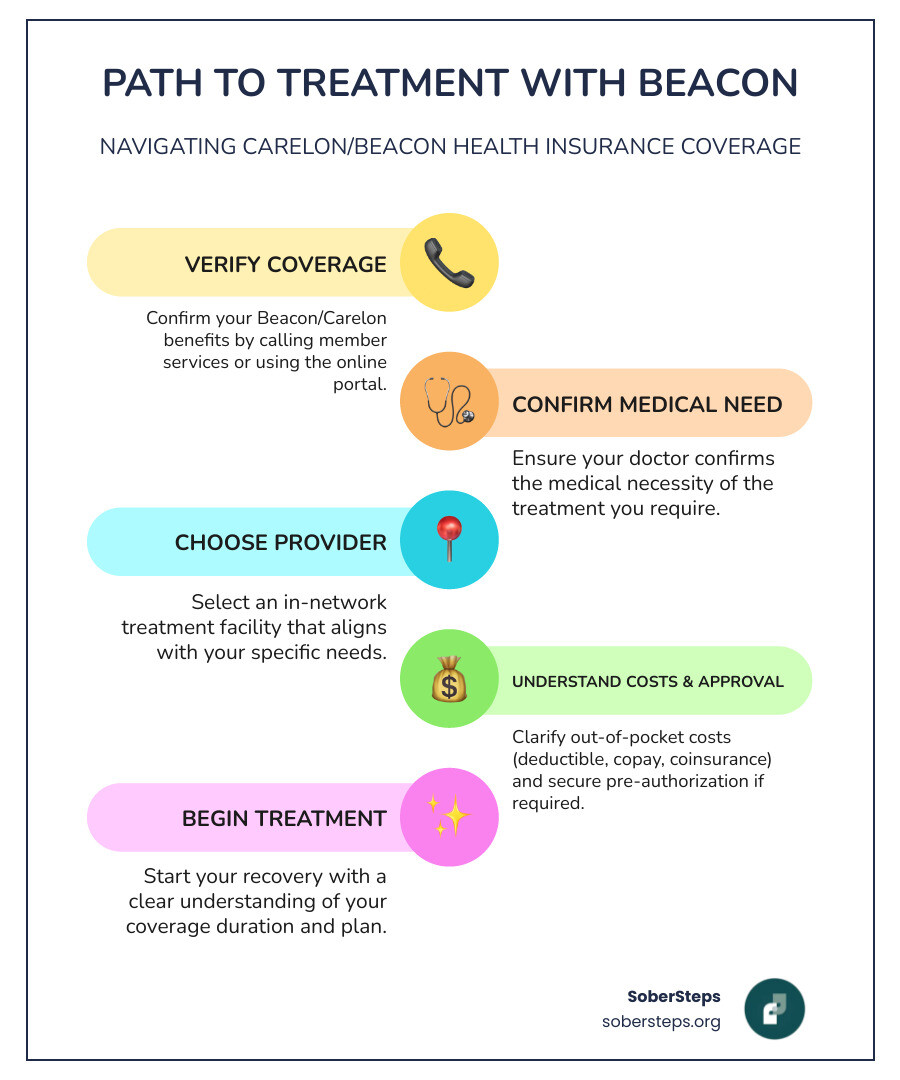
Infographic showing the path from insurance verification to treatment: Step 1 - Verify your Beacon/Carelon coverage by calling member services or using online portal; Step 2 - Confirm medical necessity with your doctor; Step 3 - Choose an in-network treatment provider; Step 4 - Understand your out-of-pocket costs (deductible, copay, coinsurance); Step 5 - Get pre-authorization if required; Step 6 - Begin treatment with clear understanding of coverage duration - Beacon Health Insurance Coverage for Drug Rehab infographic infographic-line-5-steps-colors

How to get started with SoberSteps

What is Guide Health Options (Now Carelon)?

Let’s clear up the confusion right away. What many people refer to as “Guide Health Insurance” is actually Guide Health Options, which has now transitioned and operates under the name Carelon Behavioral Health. This company emerged in 2014 through a merger between Guide Health Strategies and ValueOptions, bringing together extensive expertise in behavioral health management.

Carelon Behavioral Health isn’t an insurance company that issues plans directly. Instead, they specialize in managing behavioral health and substance use disorder benefits on behalf of over 100 external health plans, employers, and government programs. They are the largest privately-held company of their type in the U.S., serving a massive network of over 40-61 million people across all 50 states. This means that if you have health insurance through your employer, a marketplace plan, Medicare, or Medicaid, your behavioral health benefits—including drug and alcohol rehab—might be managed by Carelon.

This structure allows Carelon to focus its expertise on ensuring access to quality mental health and substance use disorder services. They work with an extensive network of over 115,000 medical providers, aiming to connect members with the right care.

More about the company’s values.

Learn more about how insurance works for rehab.

Ready to verify your Guide Health Insurance Coverage for Drug Rehab with us? Verify your Beacon insurance coverage with SoberSteps.

Why Guide Focuses on Addiction Treatment

Carelon Behavioral Health has a unique and strong commitment to addiction treatment. Unlike many general health insurance providers, Carelon’s core specialization is in behavioral health and substance use disorder management. This means they are designed from the ground up to address these complex needs with a dedicated focus.

Their integrated care model recognizes that mental health and substance use disorders are often intertwined and require comprehensive, coordinated treatment. They are committed to evidence-based treatment, which means they prioritize therapies and approaches that have been scientifically proven to be effective in helping people recover.

Furthermore, Carelon is a strong advocate for reducing the stigma associated with mental health and addiction through initiatives like their “Stamp Out Stigma” program. This commitment translates into tangible benefits for individuals seeking help, as they actively work to ensure that their managed plans provide significant coverage for mental health and substance use disorder treatment. Thanks to mandates like the Affordable Care Act (ACA), most long-term health insurance plans in the U.S. must cover treatment for substance use disorders as essential health benefits, provided the treatment is medically necessary. This legal requirement aligns perfectly with Carelon’s mission and specialization, making Guide Health Insurance Coverage for Drug Rehab a robust option for many.

Learn more about their commitment to mental health.

Ready to find out if your Guide plan covers your treatment needs? Find out if your Beacon plan covers your treatment needs at SoberSteps.

See how SoberSteps supports your recovery
Understanding Your Guide Health Insurance Coverage for Drug Rehab

sample insurance card with the member services number highlighted - Beacon Health Insurance Coverage for Drug Rehab

Navigating your insurance policy can sometimes feel like trying to solve a Rubik’s Cube blindfolded. But don’t worry, we’re here to help you understand the core components of your Guide Health Insurance Coverage for Drug Rehab. While Carelon Behavioral Health manages the benefits, the specifics of your coverage—what’s covered, how much, and for how long—ultimately depend on the individual insurance plan you have.

Key factors that influence your coverage include:

  • Policy Details: The specific type of plan (e.g., HMO, PPO, EPO, POS) you have.
  • State-Specific Plans: While Carelon operates nationwide, your plan’s benefits might be influenced by state regulations where you reside or where your plan was purchased.
  • Medical Necessity: This is a big one! Your insurance will only cover services deemed “medically necessary” by a healthcare professional and in accordance with their criteria. This is often determined using nationally recognized guidelines, like the ASAM (American Society of Addiction Medicine) criteria.
  • Prior Authorization: Many services, especially inpatient or higher levels of care, require “pre-authorization” or “pre-certification” from Carelon before you begin treatment. This is their way of confirming medical necessity and ensuring the service is covered.

Understanding these elements is crucial for maximizing your Guide Health Insurance Coverage for Drug Rehab and avoiding unexpected costs.

How to use your insurance for rehab at SoberSteps.

Let us help you untangle the complexities. Let SoberSteps help you understand your Beacon coverage.

Types of Addiction Treatment Programs Covered

The good news is that Guide Health Insurance Coverage for Drug Rehab (through Carelon) generally covers a comprehensive range of evidence-based addiction treatment programs. This aligns with their specialization in behavioral health and the ACA mandate for essential health benefits. Here’s a breakdown of the typical treatment levels and what they entail:

  • Medical Detoxification: This is often the first step in recovery, especially for substances like alcohol or opioids, where withdrawal can be dangerous. Carelon-managed plans typically cover medically supervised detox programs, which provide a safe environment for withdrawal management, often lasting 3 to 7 days. Medications may be used to ease withdrawal symptoms.
  • Inpatient Residential Rehab: For more severe addictions or when a highly structured environment is needed, inpatient rehab offers 24/7 care. Patients live at the facility and participate in intensive therapy and support. Coverage for inpatient stays usually requires prior authorization and a determination of medical necessity. Initial authorizations often cover around 30 days, with extensions possible based on clinical progress and continued medical need.
  • Partial Hospitalization Programs (PHP): These programs are a step down from inpatient care but are more intensive than traditional outpatient. Individuals attend treatment during the day for several hours, typically 5 days a week, but return home in the evenings. PHPs are often covered when someone needs a high level of support but doesn’t require 24/7 supervision.
  • Intensive Outpatient Programs (IOP): IOPs offer structured treatment for several hours per day, a few days a week. This allows individuals to maintain work, school, or family responsibilities while receiving significant support. It’s a popular option for those with less severe substance use disorder or as a step-down from higher levels of care.
  • Standard Outpatient Programs (OP): This is the least intensive level of care, involving weekly therapy sessions or group meetings. It’s suitable for individuals with mild substance use disorders, or as a long-term follow-up after completing more intensive programs.
  • Aftercare and Sober Living: Recognizing that recovery is a marathon, not a sprint, many Carelon-managed plans often provide coverage for aftercare services. This can include ongoing therapy, support groups, and follow-up care crucial for maintaining sobriety. Sober living homes, while not always fully covered, may have certain services within them that are reimbursable, depending on your plan.

The specific extent of coverage for each of these levels will depend on your individual plan’s benefits, deductibles, co-pays, and coinsurance.

Explore SoberSteps treatment options covered by your insurance.

Ready to find the right level of care for you? Find the right level of care with SoberSteps.

Coverage for Co-Occurring Disorders and Mental Health

It’s a stark reality that addiction rarely travels alone. Many individuals struggling with substance use disorder (SUD) also battle co-occurring mental health conditions, a phenomenon often referred to as “dual diagnosis.” In fact, approximately 50% of people with substance use disorders have dual diagnoses, including conditions like anxiety, depression, bipolar disorder, PTSD, and eating disorders. This makes integrated treatment—addressing both conditions simultaneously—absolutely crucial for lasting recovery.

The good news is that Guide Health Insurance Coverage for Drug Rehab (through Carelon Behavioral Health) places a heavy emphasis on mental health services and treatment for co-occurring disorders. This is a cornerstone of their behavioral health specialization and is also mandated by the ACA.

Coverage typically includes:

  • Integrated Treatment Programs: Facilities that offer comprehensive care for both SUD and mental health issues.
  • Therapy and Counseling: Individual, group, and family therapy sessions are generally covered, whether in an inpatient or outpatient setting. These therapies can address the underlying psychological factors contributing to addiction and help develop coping mechanisms for mental health challenges.
  • Psychiatric Evaluations: These assessments help diagnose mental health conditions accurately and guide treatment planning.
  • Medication Management: If medications are prescribed to manage mental health symptoms (e.g., antidepressants, anti-anxiety medications), the appointments for managing these prescriptions are typically covered.

Carelon understands that treating only the addiction without addressing co-occurring mental health issues is like trying to fix a leaky roof while the foundation is crumbling. They advocate for and manage plans that support holistic, integrated care, giving you the best chance at a full recovery.

Approximately 50% of people with SUD have a co-occurring mental health disorder.

Learn about dual diagnosis treatment at SoberSteps.

If you suspect you’re dealing with both, don’t hesitate. Speak with SoberSteps about dual diagnosis care.

Are Medications for Addiction Treatment (MAT) Included?

Absolutely! Medications for Addiction Treatment (MAT) are a critical component of modern, evidence-based addiction care, especially for opioid and alcohol use disorders. MAT combines FDA-approved medications with counseling and behavioral therapies to provide a “whole-patient” approach to recovery.

Guide Health Insurance Coverage for Drug Rehab (through Carelon) typically includes coverage for MAT programs. This is a significant benefit, as MAT has been shown to improve patient survival, increase retention in treatment, and decrease illicit opioid use.

Common FDA-approved medications covered under MAT may include:

  • Buprenorphine (often combined with Naloxone, e.g., Suboxone): Used for opioid use disorder.
  • Naltrexone (oral or injectable, e.g., Vivitrol): Used for both opioid and alcohol use disorders.
  • Methadone: Primarily used for opioid use disorder, typically administered in specialized clinics.

While MAT is widely covered for opioid and alcohol use disorders, coverage for MAT for stimulant addictions (like cocaine or methamphetamine) is generally not included. This isn’t a limitation of the insurance, but rather reflects the current scientific consensus that there are no FDA-approved medications specifically for treating stimulant use disorders. Treatment for these substances primarily relies on behavioral therapies and counseling.

Carelon even has specific programs, like “Changing Pathways,” which exemplify their commitment to MAT for opioid addiction, combining medication with essential support services. If MAT is part of your recommended treatment plan, chances are your Guide Health Insurance Coverage for Drug Rehab will help cover it.

See if MAT is right for you—speak with our SoberSteps team.

Learn about MAT at SoberSteps.

Comparing Inpatient and Outpatient Guide Health Insurance Coverage for Drug Rehab

When considering treatment, you’ll often encounter discussions about inpatient versus outpatient care. Both are vital, but they differ significantly in intensity, structure, and, of course, how your Guide Health Insurance Coverage for Drug Rehab might apply.

Inpatient (Residential) Rehab:

  • Intensity of Care: Provides 24/7 supervision, medical care, and intensive therapy in a live-in facility. It’s ideal for those needing to remove themselves from triggering environments or who require medical monitoring during withdrawal.
  • Authorization Requirements: Inpatient care almost always requires prior authorization from Carelon. This involves a clinical review to confirm medical necessity based on criteria like the severity of addiction, risk of withdrawal complications, and co-occurring conditions.
  • Coverage Duration: Initial authorizations are often for a specific period, such as 30 days. Extensions are possible but depend on ongoing medical necessity and regular clinical reviews. Your plan will have limits on how many days are covered annually.
  • Cost Differences: Generally, inpatient rehab is the most expensive option due to the comprehensive services, accommodation, and round-the-clock staffing.

Outpatient Rehab (PHP, IOP, Standard Outpatient):

  • Intensity of Care: Offers structured therapy and support while allowing you to live at home and continue with daily responsibilities. PHP and IOP are more intensive than standard outpatient.
  • Authorization Requirements: While some outpatient programs might require prior authorization, it’s often less stringent than for inpatient care. Individual therapy sessions usually require only a copay.
  • Coverage Duration: Outpatient programs can range from a few weeks to several months, depending on the intensity and your individual needs. Your plan may have limits on the number of sessions or hours covered per week or year.
  • Cost Differences: Outpatient programs are typically less expensive than inpatient care. Your out-of-pocket costs will usually involve co-pays or coinsurance per session or program.

Choosing between inpatient and outpatient depends on your clinical needs, personal circumstances, and, naturally, your insurance benefits. Carelon-managed plans aim to cover the most appropriate level of care based on medical necessity, ensuring you receive effective treatment without undue financial burden.

Find a treatment program that fits your needs and insurance plan.

Curious about which path is right for you? Compare inpatient vs. outpatient rehab at SoberSteps.

Let us help you sort through the options. Let SoberSteps help you choose the right program.

How to Use Your Guide Plan for Rehab Services

person talking on the phone with a helpful representative - Beacon Health Insurance Coverage for Drug Rehab

So, you have Guide Health Insurance Coverage for Drug Rehab (managed by Carelon), and you’re ready to get help. Fantastic! But how do you actually use your plan to access rehab services? It’s not always as simple as swiping a card, but with a few key steps, you can steer the process smoothly.

The journey generally involves:

  1. Verification Process: Confirming what your specific plan covers.
  2. Understanding Costs: Knowing your financial responsibilities.
  3. Finding a Facility: Locating a treatment center that accepts your insurance and meets your needs.

We know it can feel overwhelming, but that’s precisely why we’re here. We can guide you through each step, making sure you feel confident and informed.

Verify your Beacon insurance coverage now with SoberSteps.

Step-by-step guide to using your insurance at SoberSteps.

How to Verify Your Guide Health Insurance Coverage for Drug Rehab

Verifying your Guide Health Insurance Coverage for Drug Rehab is the most crucial first step. Without it, you’re essentially walking into treatment blindfolded when it comes to costs. Here’s how to do it:

  1. Calling Member Services: Look for the member services phone number on the back of your insurance card. This is your direct line to your insurance provider (or to Carelon, who manages the behavioral health benefits). When you call, have your policy number, group number, and the exact name of your plan ready. Ask specific questions about addiction treatment coverage, including:
    • What types of rehab (detox, inpatient, outpatient) are covered?
    • Are there any pre-authorization requirements?
    • What are my deductible, co-pay, and coinsurance amounts for these services?
    • What is my out-of-pocket maximum?
    • Do I need to use in-network providers, or is there coverage for out-of-network?
  2. Using the Online Member Portal: Many insurance companies offer an online portal where you can access your benefits summary, check claims, and sometimes even search for in-network providers. This can be a convenient way to get an overview of your plan.
  3. Contacting SoberSteps Admissions Team: This is where we come in handy! Our admissions specialists are experts at verifying insurance benefits. You can provide us with your insurance information, and we can contact Carelon (or your insurance provider) on your behalf. We’ll get all the nitty-gritty details, confirm your benefits, and explain what your Guide Health Insurance Coverage for Drug Rehab means for your treatment options and potential costs. This takes the burden off your shoulders during an already stressful time.

When verifying, always refer to your plan by its exact name, not just “Guide Health” or your insurance company’s name. This ensures you get the most accurate information.

Step-by-step guide to insurance verification at SoberSteps.

Ready to get started? Start your confidential insurance verification.

Understanding Your Out-of-Pocket Costs

Even with excellent Guide Health Insurance Coverage for Drug Rehab, you’ll likely have some out-of-pocket costs. Understanding these terms can save you from financial surprises down the road.

  • Deductible: This is the amount of money you must pay for covered services before your insurance plan begins to pay. For example, if your deductible is $1,000, you’ll pay the first $1,000 of your treatment costs before your insurance kicks in. High-deductible plans often have lower monthly premiums. Deductible
  • Copayment (Copay): A fixed amount you pay for a covered service after you’ve met your deductible. For instance, you might have a $25 copay for each therapy session or doctor’s visit. Copayment
  • Coinsurance: This is a percentage of the cost of a covered service you pay after you’ve met your deductible. For example, if your plan has 20% coinsurance, and a treatment costs $1,000 after your deductible is met, you’d pay $200 (20%), and your insurance would pay $800 (80%). Coinsurance
  • Out-of-Pocket Maximum: This is the most you will pay for covered medical costs in a year. Once you reach this limit, your insurance plan typically covers further eligible medical expenses at 100% for the remainder of the policy year. This provides a financial safety net.
  • Explanation of Benefits (EOB): This isn’t a bill, but a document sent by your insurance company explaining what medical services were covered, how much they paid, and what you might still owe. Always review your EOBs carefully.

We can help you steer these terms and estimate your potential costs. Contact SoberSteps for a cost estimate with your insurance.

How SoberSteps helps you understand costs.

In-Network vs. Out-of-Network Facilities

One of the biggest factors influencing your out-of-pocket costs for Guide Health Insurance Coverage for Drug Rehab is whether the treatment facility you choose is “in-network” or “out-of-network.” This largely depends on the type of insurance plan you have:

  • HMO (Health Maintenance Organization) Plans: These plans typically require you to choose providers and facilities within their specific network. If you go out-of-network, your plan generally won’t cover the costs, except in emergency situations.
  • PPO (Preferred Provider Organization) Plans: PPO plans offer more flexibility. You can choose providers both in-network and out-of-network, but you’ll pay less if you stick with in-network providers. Out-of-network services will usually come with higher deductibles, co-pays, or coinsurance.
  • EPO (Exclusive Provider Organization) Plans: Similar to HMOs, EPOs usually don’t cover out-of-network care unless it’s an emergency.
  • POS (Point of Service) Plans: These plans combine elements of both HMOs and PPOs, offering a choice between in-network and out-of-network care, with higher costs for the latter.

Preauthorization for Services: Even for in-network services, especially for higher levels of care like inpatient rehab, Carelon will often require pre-authorization. This is a process where they review the medical necessity of the treatment before you receive it. Failing to get pre-authorization can result in your claim being denied, even if the service would normally be covered.

While emergency services are typically covered regardless of network status, for planned addiction treatment, sticking to in-network providers is almost always the most cost-effective choice. Our team at SoberSteps can help you find facilities that are in-network with your specific Guide Health Insurance Coverage for Drug Rehab plan.

Preauthorization for services.

Find in-network rehab centers with SoberSteps.

Let us help you find a facility that works for you. Let SoberSteps help you find an in-network facility.

What to Do When Insurance Isn’t Enough

It’s an unfortunate truth that even with comprehensive Guide Health Insurance Coverage for Drug Rehab, there might be costs that aren’t fully covered. This can feel disheartening, but please know that financial concerns should never be a barrier to getting the help you need. There are always alternative solutions, and we’re here to help you explore every avenue.

Exploring Alternative Payment Options

If your Guide Health Insurance Coverage for Drug Rehab doesn’t cover all the costs, or if you have a significant deductible or coinsurance, don’t despair. Many treatment centers and organizations offer alternative payment methods to make recovery accessible:

  • Sliding Scale Fees: Some facilities adjust their treatment costs based on your income and ability to pay.
  • Payment Plans: Many rehab centers offer flexible payment plans, allowing you to pay off your balance in installments after you’ve completed treatment.
  • Scholarships and Grants: Various non-profit organizations and even some treatment centers offer scholarships or grants specifically for addiction treatment. These can significantly reduce your out-of-pocket burden.
  • State-Funded Programs: Depending on your income and residency, you might qualify for state-funded addiction treatment programs, which are often free or low-cost.
  • Health Savings Accounts (HSAs) and Flexible Spending Accounts (FSAs): If you have one of these, you can use pre-tax dollars to pay for qualified medical expenses, including addiction treatment costs.
  • Personal Loans or Medical Credit Cards: While these involve taking on debt, they can provide immediate access to necessary treatment.
  • Fair Health Calculator: Tools like the Fair Health Calculator can help you estimate treatment costs in your area, giving you a clearer picture of what you might need to cover.

The long-term costs of untreated addiction—including health complications, legal issues, job loss, and strained relationships—almost always far outweigh the upfront investment in quality rehab. It’s an investment in your future.

Learn about financial assistance for rehab at SoberSteps.

Don’t let finances hold you back. Ask SoberSteps about payment flexibility.

Leveraging Guide’s Additional Support Resources

Beyond direct coverage for treatment, Carelon Behavioral Health also offers additional resources that can be incredibly valuable on your recovery journey and for your support system:

  • Employee Assistance Program (EAP): If your employer offers a Carelon-administered EAP, this is a fantastic, often free, resource. EAPs provide confidential counseling sessions, assessments, and referrals to treatment providers. They can also offer support for family members and resources for work-life balance issues. It’s a great starting point for initial support and guidance. Employee Assistance Program (EAP)
  • 24/7 Crisis Hotlines: Carelon often provides access to crisis hotlines, offering immediate support for mental health and substance use emergencies.
  • Care Coordination: They may offer care coordination services, helping you steer the healthcare system, find appropriate providers, and manage your treatment plan.
  • Online Wellness Tools and Member Portals: Many of their managed plans offer online resources, educational tools, and mobile apps that can provide support, self-help resources, and ways to track your progress.
  • Family Support and Therapy Coverage: Recognizing that addiction impacts the entire family, many Carelon-managed plans include coverage for family therapy. This can include couples counseling or group family sessions, providing essential support for loved ones and helping to heal family dynamics affected by addiction.

These resources underscore Carelon’s holistic approach to behavioral health, extending support beyond just the individual in treatment.

Access support resources for you and your family at SoberSteps.

Family support at SoberSteps.

The Appeals Process for Denied Claims

Sometimes, despite your best efforts, a claim for Guide Health Insurance Coverage for Drug Rehab might be denied. This can be frustrating, but it’s not necessarily the end of the road. You have the right to appeal the decision.

Here’s a general approach:

  1. Understand the Denial Reason: The EOB (Explanation of Benefits) or denial letter from your insurance will state why the claim was denied. Common reasons include “not medically necessary,” “service not covered,” or “lack of pre-authorization.”
  2. Gather Documentation: Collect all relevant medical records, treatment plans, and letters of medical necessity from your doctors or treatment providers. These documents should clearly demonstrate why the treatment was (or is) essential for your health.
  3. Submit a Formal Appeal: Your denial letter will outline the steps for submitting an appeal. This usually involves writing a formal letter, attaching your supporting documentation, and sending it within a specific timeframe. You might have several levels of appeal (internal and external).
  4. Work with a Patient Advocate: This is where SoberSteps can really help. We can connect you with patient advocates who are experienced in navigating insurance appeals. They can help you understand the denial, gather the right information, and present a strong case to Carelon (or your insurance provider).
  5. Emphasize Medical Necessity: The core of most appeals for addiction treatment revolves around proving medical necessity. Your providers should clearly document how your condition meets accepted clinical criteria (like ASAM standards) for the level of care requested.

Don’t give up if your claim is initially denied. Many appeals are successful, especially with strong medical documentation and persistent effort.

How to appeal an insurance denial with SoberSteps.

Need help fighting for your coverage? Get help with your insurance appeal from SoberSteps.

Frequently Asked Questions about Guide Rehab Coverage

How long will Guide cover an inpatient rehab stay?

The duration of an inpatient rehab stay covered by Guide Health Insurance Coverage for Drug Rehab (managed by Carelon) depends heavily on your specific insurance plan and, crucially, on medical necessity.

Typically:

  • Initial Authorization: Most plans will authorize an initial period of stay, often around 30 days, based on the initial assessment of your condition and treatment plan.
  • Medical Necessity for Extensions: If continued inpatient care is recommended by your treatment team, extensions are possible. However, these require ongoing clinical reviews and a continued demonstration of medical necessity. Your progress, risk factors, and the appropriateness of the current level of care will be assessed.
  • Plan-Specific Limitations: Your individual insurance plan will have ultimate limitations on the total number of inpatient days covered per year or per lifetime. It’s vital to check your plan’s Summary of Benefits and Coverage (SBC) or call member services to understand these limits.

While the goal is always to provide the care needed for effective recovery, insurance coverage is tied to clinical justification. Your treatment team and Carelon will work together to ensure you receive appropriate care within your plan’s benefits.

Learn more about your specific plan’s coverage.

Curious about your specific plan? Ask SoberSteps about your coverage duration.

Does Guide cover treatment for specific substances like alcohol, opioids, or stimulants?

Yes, Guide Health Insurance Coverage for Drug Rehab (through Carelon) generally covers treatment for a wide variety of substance use disorders. The focus of coverage is on the diagnosis of a substance use disorder (SUD) rather than just the specific substance itself. This means that if you have a medically diagnosed:

  • Alcohol Use Disorder
  • Opioid Use Disorder (including heroin, prescription opioids)
  • Stimulant Use Disorder (including cocaine, methamphetamine)
  • Cannabis Use Disorder
  • Benzodiazepine Use Disorder
  • Prescription Drug Addiction

…your treatment would typically be covered. The key is that the treatment must be evidence-based and medically necessary for your specific diagnosis. This includes services like detox, various levels of therapy, and, for certain substances, Medication-Assisted Treatment (MAT). For example, MAT is commonly covered for opioid and alcohol use disorders, but generally not for stimulant use disorders as there are no FDA-approved MATs for them.

Carelon’s specialization in behavioral health means they are equipped to manage benefits for a broad spectrum of substance addictions.

See which substance use disorders SoberSteps treats.

Ready to confirm your coverage for your specific needs? Contact SoberSteps to confirm your coverage.

Will my employer find out I am seeking treatment through my Guide plan?

This is a very common and understandable concern, and we’re here to put your mind at ease. The short answer is: No, generally your employer will not find out you are seeking treatment through your *Guide Health Insurance Coverage for Drug Rehab plan.*

Here’s why:

  • HIPAA Regulations: Your health information is protected by federal laws, specifically the Health Insurance Portability and Accountability Act (HIPAA). This law mandates strict patient privacy and confidentiality for your protected health information (PHI). Your treatment providers are legally required to keep your information private.
  • Confidentiality: Carelon Behavioral Health, like all health care entities, adheres to these privacy regulations. They cannot disclose your medical information, including details about your addiction treatment, to your employer without your explicit written consent.
  • EAP Confidentiality: If you use an Employee Assistance Program (EAP) managed by Carelon, those services are also confidential. Information shared within an EAP context is generally not reported back to your employer, only aggregated data about program utilization (e.g., how many employees used the EAP for stress, but not who).
  • Limited Exceptions: There are very specific and rare exceptions to privacy rules, such as if there’s an immediate risk of harm to yourself or others, or if a court order legally compels disclosure. These are extreme circumstances and not typical.

Your employer may know you’ve used an insurance benefit if they are self-insured and process claims directly, but they would not have access to specific diagnoses or treatment details. For most people, the process of seeking addiction treatment through their insurance remains confidential. We understand the importance of privacy during this vulnerable time, and we ensure all your information is handled with the utmost discretion at SoberSteps.

Learn about privacy at SoberSteps.

Still have questions about confidentiality or anything else? Have more questions? Contact our team for answers.

Take the Next Step Towards Recovery

Navigating the complexities of Guide Health Insurance Coverage for Drug Rehab can feel like a daunting task, but as we’ve seen, it’s a powerful tool that can open up access to life-saving treatment. Carelon Behavioral Health, through the plans they manage, offers comprehensive coverage for a wide range of evidence-based addiction treatments, from detox and inpatient care to outpatient programs, MAT, and dual diagnosis support.

The key to maximizing your benefits is understanding your specific plan details, verifying your coverage, and knowing your out-of-pocket responsibilities. While insurance can sometimes be tricky, recovery is always possible, and financial problems don’t have to be roadblocks.

At SoberSteps, we believe that everyone deserves a clear path to recovery. We’re here to help you understand your options, verify your Guide Health Insurance Coverage for Drug Rehab, and connect you with a trusted treatment provider that accepts your plan. Don’t let confusion or fear hold you back from taking the most important step towards a healthier, happier life.

Don’t wait—verify your Beacon coverage and start your recovery journey with SoberSteps now!

Speak to addiction Specialist 100% Free and Confidential

Related Articles

Where Do Calls Go?

For anyone seeking help for addiction for themselves or a loved one calls to Sober Steps are completely confidential and available 24/7.

Please note: any treatment center listed on our site that receives calls is a paid advertiser.

  • Calls to a specific treatment center’s listing will be connected directly to that center.

  • Calls to our general helpline will be answered by treatment providers, all of whom are paid advertisers.

By calling the helpline, you agree to our terms and conditions. These calls are free of charge and carry no obligation to enter treatment. Neither Sober Steps nor anyone answering your call receives a commission or fee based on your choice of treatment provider.

If you’d like to explore additional treatment options or connect with a specific rehab center, you can browse our top-rated listings, visit our homepage, or call us at (844) 491-5566. You may also contact us for further assistance.