Health Insurance for Drug Rehab: Compare Major Providers
Navigating Your Path to Recovery: How Insurance Can Help
Health Insurance for Drug Rehab: Compare Major Providers is essential for anyone seeking addiction treatment. Here’s what you need to know:
Quick Answer: Major Insurance Coverage for Drug Rehab
Most insurance plans cover addiction treatment: Thanks to the Affordable Care Act (ACA), health insurance plans generally cover substance use disorder (SUD) treatment as an essential health benefit.
Coverage varies by plan type: HMO, PPO, POS, and EPO plans offer different levels of flexibility and costs for in-network vs. out-of-network care.
Typical costs: Without insurance, treatment ranges from $1,600 to $45,000. With insurance, you’ll pay deductibles, copays, and coinsurance based on your specific plan.
If you’re struggling with addiction, one of the biggest barriers to getting help is often the question: Can I afford treatment? The good news is that health insurance plans will generally cover the cost of treatment for substance use disorder and mental health conditions. The reality, however, is more complex.
The financial stress of seeking treatment is real. Without insurance, the average cost of addiction treatment can range anywhere from $1,600 to about $45,000, depending on the type and duration of care. Even with insurance, navigating coverage details—deductibles, copays, in-network providers, prior authorizations—can feel overwhelming when you’re already in crisis.
Here’s what matters most: your insurance likely covers more than you think. The Affordable Care Act mandates that insurance companies cover substance use disorder treatment, and federal parity laws require that mental health and addiction services be covered at the same level as medical and surgical care.
But not all insurance plans are created equal. Coverage varies significantly between providers like Blue Cross Blue Shield, UnitedHealthcare, Aetna, and Cigna. It also depends on your plan type (HMO, PPO, POS, or EPO), whether your chosen facility is in-network, and your state of residence. Some plans may waive deductibles for addiction-only services at preferred centers, while others may require substantial out-of-pocket costs.
At Sober Steps, we understand how confusing and frustrating it can be to figure out Health Insurance for Drug Rehab: Compare Major Providers while you’re struggling. Our mission is to cut through the complexity and help you understand your coverage options so you can focus on what matters most—your recovery. Need immediate help? Call our confidential 24/7 helpline at (844) 491-5566 to speak with someone who can verify your insurance coverage and guide you to treatment options right now.
Understanding Insurance Coverage for Addiction Treatment
When we talk about addiction treatment, it’s crucial to understand the foundational policies that ensure coverage. The landscape of mental health and substance use disorder (SUD) treatment has been significantly shaped by key legislation in the United States.
The Mental Health Parity and Addiction Equity Act (MHPAEA) of 2008 requires that if a health plan provides mental health and substance use disorder benefits, those benefits must be comparable to medical and surgical benefits. This means that financial requirements (like deductibles and copayments) and treatment limitations (like visit limits) for mental health and SUD services cannot be more restrictive than those for medical/surgical benefits. The goal is to ensure that individuals seeking help for addiction are not unfairly penalized compared to those seeking treatment for physical ailments.
Building on this, the Affordable Care Act (ACA) of 2010 brought about a monumental shift. It mandated that health insurance plans include mental health and substance use disorder services as one of the ten Essential Health Benefits (EHBs). This means that all plans sold on the ACA marketplace, as well as most employer-sponsored plans, must cover these services. The ACA’s impact on SUD treatment has been transformative, providing wider access to care and requiring existing health benefit plans to cover addiction treatment. This expansion has been critical, as historically, people with SUD had a higher probability of being uninsured compared to the general public. For a deeper dive into this change, you can read more about The Affordable Care Act’s transformation of substance use disorder treatment.
While the ACA and parity laws have made great strides, the promise of increased access has only been partially realized. We still see significant variation in what insurance covers among plans, even within the same state. This often leads to challenges related to prior authorization—where your insurance company requires approval before you can receive certain services—and substantial administrative burdens for treatment providers. Providers often express frustration with insurance companies that “try very hard to not pay you,” leading to a complex web of billing, claim denials, and lengthy appeals that can distract from patient care.
We distinguish between public insurance programs like Medicaid and Medicare, which are government-funded, and private insurance plans offered by employers or purchased individually. Both types of insurance are now generally required to cover SUD treatment, but the specifics of that coverage can differ.
Does Health Insurance Cover Substance Use Disorder Treatment?
Yes, absolutely! Health insurance plans will generally cover the cost of treatment for substance use disorder (drug and alcohol addiction) and mental health conditions. This is not just a courtesy but a mandate, largely thanks to federal legislation.
The general coverage mandate stems from the ACA listing SUD treatment as an Essential Health Benefit. This means that if you have health insurance in the United States, it should offer some form of coverage for addiction treatment.
Parity laws, specifically the MHPAEA, ensure that the coverage for mental health and SUD services is on par with medical and surgical care. This means that your plan cannot impose higher copayments, stricter deductibles, or more limited visit numbers for addiction treatment than it does for a broken arm or a heart condition. However, the implementation of parity can be imperfect, and we still see disparities in practice. To understand the evolving landscape of parity, this article provides valuable insights: Federal parity in the evolving mental health and addiction care landscape.
Despite these mandates, there’s still significant variation between plans. The particular health insurance plan you have will determine how much of your treatment is covered and how much you’ll be required to pay out-of-pocket. Factors like your specific plan (e.g., Bronze, Silver, Gold, Platinum on the marketplace), your coverage level (e.g., after meeting deductible), and the treatment provider all play a role.
A common hurdle is the concept of “medical necessity.” Insurance companies often use medical necessity as a criterion to approve or deny coverage. For SUD treatment, this can be particularly frustrating. For example, some providers have reported that opioid withdrawal is not considered “medically necessary” to treat because “you will not die from it,” unlike alcohol or benzodiazepine withdrawal, even though withdrawal symptoms can lead to relapse and overdose. This arbitrary application can delay or deny crucial care.
Finally, whether your chosen treatment center is in-network vs. out-of-network makes a big difference. In-network providers have contracts with your insurance carrier, meaning services are offered at a set, often lower, price. Out-of-network providers don’t have such contracts, and while some plans may still offer partial coverage, your out-of-pocket costs will almost certainly be higher. Some plans, like HMOs, may not cover out-of-network services at all, except in emergencies.
What Types of Addictions and Treatments Are Covered?
When exploring Health Insurance for Drug Rehab: Compare Major Providers, it’s natural to wonder what specific conditions and services are typically covered. We’re here to tell you that most major health insurance plans in the U.S. broadly cover treatment for substance-related addictions. This includes a wide array of substances, such as:
Essentially, if it’s a recognized substance use disorder, your insurance should offer coverage.
Beyond the substances themselves, a critical aspect of modern addiction treatment is addressing co-occurring mental health conditions. This is known as dual diagnosis treatment, and we’re pleased to report that it’s often covered by insurance. Since mental health conditions and SUDs frequently go hand-in-hand, integrated treatment is considered best practice, and insurance providers are increasingly recognizing its importance.
The types of treatments that may be covered by your insurance plan span a continuum of care, designed to meet varying needs:
Medical Detox: This is often the first step in treatment, involving medically supervised withdrawal from substances. It ensures safety and manages uncomfortable or dangerous withdrawal symptoms. Insurance typically covers this essential phase, especially if it’s deemed medically necessary.
Inpatient/Residential Rehab: These programs involve living at a treatment facility for an extended period (e.g., 28, 30, 60, or 90 days). They offer a highly structured and immersive environment with 24/7 care. Most major insurance providers, including UnitedHealthcare and Aetna, offer coverage for inpatient addiction treatment, though specific exclusions or limits may apply depending on your plan.
Outpatient Programs (PHP, IOP):
Partial Hospitalization Programs (PHP): Often referred to as “day treatment,” PHPs offer intensive therapy and support during the day, allowing patients to return home in the evenings.
Intensive Outpatient Programs (IOP): IOPs are less intensive than PHPs but still provide structured therapy and counseling several times a week. They allow individuals to maintain work, school, or family responsibilities. Insurance typically covers these outpatient levels of care, recognizing their effectiveness in supporting recovery while integrating back into daily life. The average cost of outpatient treatment is about $1,600, ranging from $1,500 to $2,900 or more for intensive outpatient treatment, but this can be significantly reduced with insurance.
Medication-Assisted Treatment (MAT): This approach combines medications (like buprenorphine, naltrexone, or methadone) with counseling and behavioral therapies. MAT is highly effective for opioid and alcohol use disorders, and insurance generally covers all MAT medications. However, some plans may require the medication to be deemed “absolutely necessary” for ongoing health. The research highlights that while MAT is widely accepted, some state Medicaid programs, at certain times, have had limitations on covering specific MAT medications like methadone, despite its proven efficacy.
Health Insurance for Drug Rehab: Compare Major Providers and Plan Types
Understanding the different types of health insurance plans is crucial when you’re trying to compare major providers for drug rehab coverage. Each plan type comes with its own rules, network restrictions, and cost structures, directly impacting your access to and expenses for addiction treatment.
The main types of health insurance plans we typically encounter in the U.S. are:
HMO (Health Maintenance Organization): These plans usually have lower monthly premiums but require you to choose a primary care physician (PCP) within their network. Your PCP then refers you to specialists or other services, including rehab, also within the HMO’s network. Out-of-network care is generally not covered, except in emergencies.
PPO (Preferred Provider Organization): PPOs offer more flexibility. You don’t usually need a PCP referral to see specialists, and you can choose providers outside the network. However, staying in-network will result in lower costs. If you go out-of-network, you’ll pay a higher percentage of the cost.
POS (Point of Service): These plans combine elements of both HMO and PPO. You typically need to choose a PCP from the network, but you can also go out-of-network for care, usually at a higher cost. Referrals from your PCP might be required for out-of-network services.
EPO (Exclusive Provider Organization): EPOs are similar to HMOs in that they generally don’t cover out-of-network care. However, they typically don’t require you to choose a PCP or get referrals for specialists within their network.
Beyond the plan type, there are key financial terms you’ll need to understand:
Deductibles: This is the amount you must pay out-of-pocket for covered healthcare services before your insurance plan starts to pay. For example, if you have a $2,000 deductible, you’ll pay the first $2,000 of covered services yourself.
Copayments (Copays): A fixed amount you pay for a covered healthcare service after you’ve paid your deductible. For instance, a $30 copay for a doctor’s visit.
Coinsurance: Your share of the cost of a covered healthcare service, calculated as a percentage (e.g., 20%) of the allowed amount for the service. You pay this after you’ve met your deductible. So, if your coinsurance is 20% and the allowed amount for a service is $100, you’d pay $20.
Out-of-pocket maximums: This is the most you’ll have to pay for covered services in a plan year. Once you reach this limit, your insurance plan pays 100% of the cost of covered benefits for the rest of the year.
Comparing Health Insurance Plan Types (HMO, PPO, POS, EPO)
Let’s break down how these common healthcare plan types compare, especially concerning Health Insurance for Drug Rehab: Compare Major Providers and how they might affect your access to addiction treatment.
Feature
HMO (Health Maintenance Organization)
PPO (Preferred Provider Organization)
POS (Point of Service)
EPO (Exclusive Provider Organization)
Network Flexibility
Very limited; must use in-network
High; can use in-network or out-of-network
Moderate; in-network with option for out-of-network
Limited; must use in-network
Referral Requirements
Required from PCP for specialists
Not typically required
Required from PCP for out-of-network
Not typically required
Typical Costs for Rehab
Lower premiums, lower out-of-pocket for in-network
Higher premiums, moderate out-of-pocket for in-network, higher for out-of-network
Moderate premiums, moderate out-of-pocket for in-network, higher for out-of-network
Moderate premiums, lower out-of-pocket for in-network
PCP Role
Required, gatekeeper for care
Not typically required
Required for in-network, can go without for out-of-network
Not typically required
Out-of-Network Coverage
None (except emergencies)
Yes, but at a higher cost
Yes, but at a higher cost
None (except emergencies)
In-network restrictions are a significant factor, particularly for HMO and EPO plans. If a rehab center isn’t part of your plan’s network, your treatment might not be covered at all. For PPOs and POS plans, while you have the option to go out-of-network, be prepared for out-of-network costs to be substantially higher. This could mean a higher coinsurance percentage, a separate deductible, or even penalties if pre-certification isn’t obtained.
The Primary Care Physician (PCP) role is also important. In HMOs and sometimes POS plans, your PCP acts as a gatekeeper, coordinating your care and providing referrals. If you need specialized addiction treatment, your PCP would need to refer you to an in-network specialist or facility. This can sometimes add an extra step to accessing care.
Coverage from Major Public and Private Providers
Navigating Health Insurance for Drug Rehab: Compare Major Providers means looking at both public and private options. Here’s a general overview of how some of the most prominent providers in the U.S. approach addiction treatment coverage:
Public Providers:
Medicaid: This state and federal program provides health coverage for low-income individuals and families, as well as those with certain disabilities. Thanks to the ACA, Medicaid expansion has significantly increased the number of insured individuals with SUD. Medicaid generally covers a wide range of addiction treatments, including detox, inpatient, outpatient, and MAT. However, coverage specifics can vary by state, and some states have historically had limitations (e.g., some state Medicaid programs not covering methadone at certain times). The article on Medicaid coverage in substance use disorder treatment after the Affordable Care Act offers more insight into this.
Medicare: Primarily for individuals aged 65 or older and younger people with certain disabilities, Medicare offers coverage for SUD treatment. This includes inpatient hospital stays, partial hospitalization, outpatient mental health services, and certain prescription drugs for MAT.
TRICARE: This is the healthcare program for uniformed service members, retirees, and their families. TRICARE typically provides comprehensive coverage for substance use disorder treatment, including detox, inpatient, outpatient, and MAT services.
Private Providers:
Blue Cross Blue Shield (BCBS): As a federation of 36 independent and locally operated companies, BCBS coverage can vary significantly by region and specific plan. However, most BCBS plans cover SUD treatment as an Essential Health Benefit, including detox, residential, and outpatient care. Many plans participate in the BlueCard program, which allows members to access in-network benefits when traveling or seeking care outside their home service area.
Aetna: Aetna offers various plans that cover addiction treatment. They emphasize a holistic approach, often including detox, inpatient, outpatient, and aftercare. Aetna’s policies may require pre-certification for certain programs, and costs can vary based on whether the facility is in-network. They also have continuing care programs to support individuals in recovery.
Cigna: Cigna provides health insurance to millions and generally covers substance abuse treatment. They often partner with rehab facilities to offer discounted rates to members. Cigna’s coverage typically includes detox, inpatient, PHP, IOP, and outpatient treatment. Like other providers, choosing an in-network facility usually leads to lower out-of-pocket expenses.
UnitedHealthcare (UHC): As one of the largest health carriers in the U.S., UHC offers comprehensive coverage for drug and alcohol rehab. They categorize substance misuse, behavioral health, and mental health treatment together, providing the same level of coverage. UHC has various plan types (Choice, Choice Plus, Options PPO) that affect in-network vs. out-of-network coverage. They also have a separate division, United Behavioral Health, dedicated to confidential services for substance abuse.
Regardless of your provider, we highly recommend asking these common questions to your insurance company:
What is my deductible, and has it been met?
What are my copayments and coinsurance for SUD treatment?
Is the treatment facility I’m considering in-network or out-of-network?
What percentage of out-of-network costs does my plan cover?
Are there any limits on the number of days or sessions for inpatient/outpatient treatment?
Is prior authorization required for any level of care (detox, inpatient, PHP, IOP)?
Does my plan cover Medication-Assisted Treatment (MAT)?
Does my plan cover dual diagnosis treatment?
The U.S. Healthcare System and Addiction Treatment
The U.S. healthcare system is a complex mix of public and private funding, which significantly impacts access to addiction treatment. Unlike some other developed nations with universal healthcare, our system primarily relies on private insurance, often provided through employers, supplemented by public programs like Medicaid and Medicare for specific populations.
This structure means that access to care for substance use disorders can vary widely depending on an individual’s insurance status and the specifics of their plan. While the ACA and parity laws have improved the situation, many challenges remain. For instance, wait times for publicly funded treatment centers can be long, and the availability of specialized addiction services, particularly in rural areas, can be limited due to a shortage of addiction specialists and psychiatrists.
The role of private insurance is paramount. Most Americans rely on private plans, which determine the network of providers they can access, their out-of-pocket costs, and the types of services covered. Public funding, through Medicaid and Medicare, plays a crucial role in filling gaps for vulnerable populations, but even these programs can have varying levels of benefits and administrative problems.
Addiction Treatment Coverage in the United States
In the United States, several avenues provide coverage for addiction treatment:
ACA Marketplace Plans: These are health insurance plans purchased through state or federal exchanges. They are required to cover SUD treatment as an Essential Health Benefit, ensuring a baseline level of care. Premiums for these plans can be based on income and household size, making them more accessible for many.
Medicaid Expansion: The ACA allowed states to expand Medicaid eligibility to more low-income adults. This expansion has been critical in increasing access to SUD treatment for millions who previously lacked coverage. However, not all states have expanded Medicaid, leading to disparities in coverage across the country. The research highlights how Medicaid coverage in substance use disorder treatment after the Affordable Care Act has expanded but also faced challenges.
Employer-Sponsored Plans: Many Americans receive health insurance through their employers. These plans are also typically subject to ACA and parity laws, meaning they must cover SUD treatment comparable to medical/surgical benefits. The specifics of these plans, including deductibles and network access, vary significantly by employer and plan choice.
Understanding the financial aspect is key. The average cost of addiction treatment with and without insurance underscores the importance of coverage:
Without insurance: The average cost of treatment for addiction can range anywhere from $1,600 to about $45,000, depending on the location, type, and duration of treatment.
With insurance: While insurance significantly reduces out-of-pocket expenses, you’ll still be responsible for deductibles, copays, and coinsurance until your out-of-pocket maximum is met.
Let’s look at statistics on inpatient/outpatient costs from our research:
Inpatient treatment: The average cost of an inpatient treatment program is around $7,000, ranging from about $4,000 to $15,500. This varies based on the facility, amenities, and length of stay.
Outpatient treatment: The average cost of outpatient treatment is about $1,600, ranging from around $1,500 to $2,900, or more for intensive outpatient treatment.
These figures illustrate why checking your insurance coverage is a vital first step in seeking help.
Frequently Asked Questions about Drug Rehab Insurance
We know that navigating insurance for addiction treatment can bring up many questions. Here, we address some of the most common ones to help you feel more confident about your path forward.
How do I find a drug rehab program that accepts my insurance?
Finding a rehab program that accepts your specific insurance plan is a crucial step. Here’s our recommended approach:
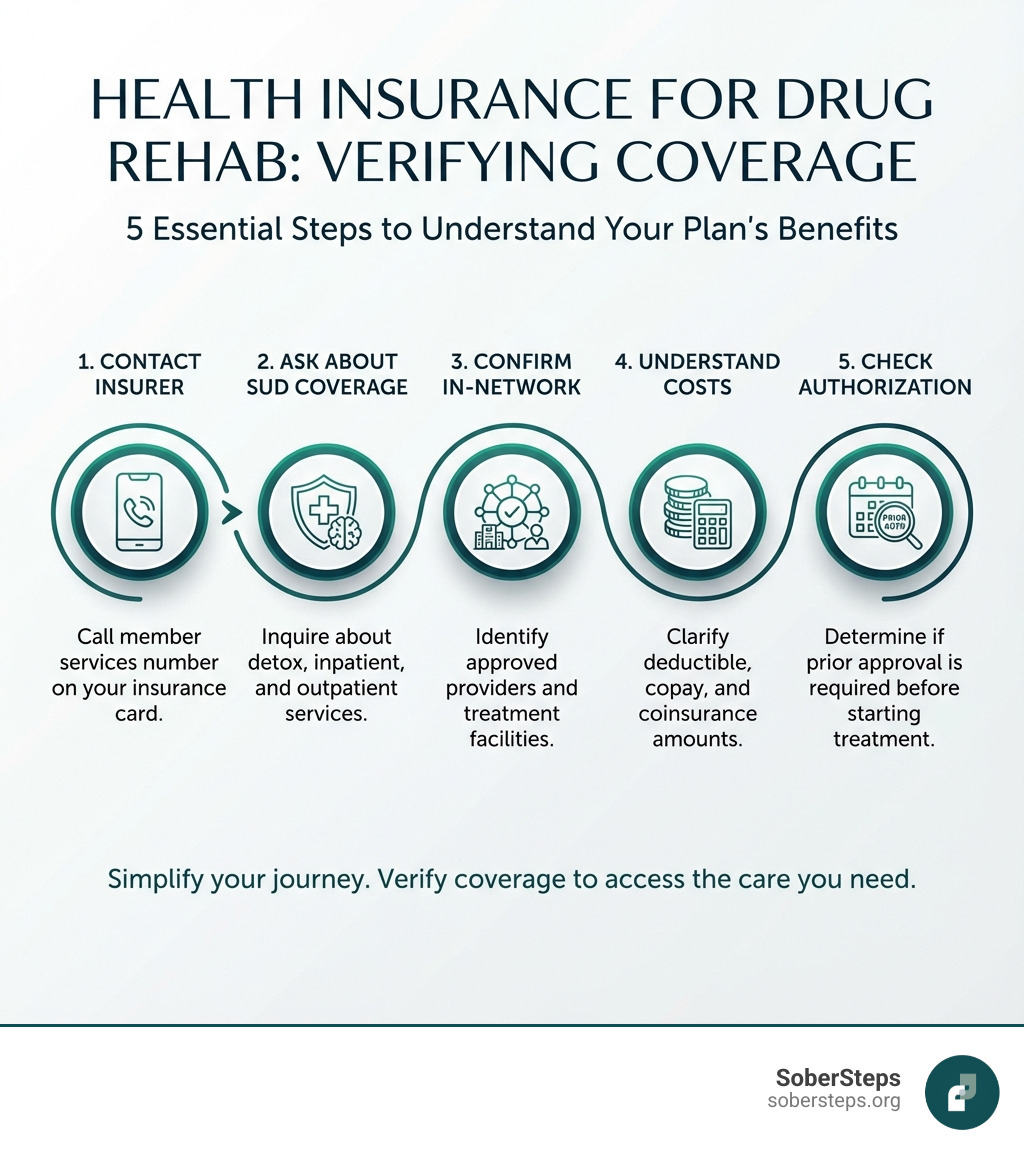
Verify Coverage Directly with Your Insurance Provider: This is the most reliable first step. Call the member services number on the back of your insurance card. Be prepared to ask specific questions about your benefits for substance use disorder treatment, including:
What types of treatment are covered (detox, inpatient, outpatient, MAT)?
What are my in-network and out-of-network benefits?
What is my deductible, copay, and coinsurance for these services?
Is prior authorization required for any level of care?
Do I have a lifetime maximum or annual limit on benefits for SUD treatment?
Use Online Portals: Many insurance providers offer online member portals where you can review your benefits, check claim status, and sometimes even find in-network providers.
Ask Treatment Centers Directly: Once you have a few rehab programs in mind, call their admissions offices. They often have dedicated staff who can verify your insurance benefits for you. They can tell you if they are in-network with your provider and what your estimated out-of-pocket costs might be.
Check for In-Network Facilities: Your insurance provider’s website usually has a “find a provider” tool. You can search for addiction treatment centers or behavioral health facilities that are in your network.
The staff at treatment facilities can be invaluable in helping you understand your benefits and steer the payment process. Don’t hesitate to lean on their expertise.
What if my insurance denies coverage for rehab?
It can be incredibly disheartening to have your insurance deny coverage for needed rehab. However, a denial is not necessarily the final answer. You have rights and options:
Understand the Denial Reasons: Your insurance company is required to provide a written explanation for the denial. Carefully review this document. Common reasons include:
Lack of “medical necessity” for the requested level of care.
The facility or provider is out-of-network.
Insufficient documentation from the treatment provider.
Failure to obtain prior authorization.
The treatment type is deemed “experimental” or not standard.
Gather Additional Medical Information: Work with your treatment provider to gather any medical records, clinical assessments, or letters of support that clearly demonstrate the medical necessity of the treatment. This might include information on your diagnosis, severity of addiction, previous treatment attempts, and co-occurring mental health conditions.
Initiate the Appeal Process: All insurance plans have an internal appeals process. You’ll typically start with an internal appeal, submitting your additional documentation and a letter explaining why you believe the decision should be overturned. If the internal appeal is denied, you can pursue an external review, where an independent third party reviews your case.
Seek Help from Patient Advocates: Many organizations, including state insurance departments, offer patient advocacy services that can help you steer the appeals process. Some treatment centers also have staff dedicated to assisting with insurance appeals. Don’t feel like you have to go it alone.
How does dual insurance work for addiction treatment?
Having dual insurance means you are covered by two different health insurance plans. This can offer significant advantages when seeking addiction treatment, potentially leading to greater coverage and lower out-of-pocket costs. However, it also requires understanding how these plans coordinate benefits.
Here’s how it generally works:
Primary vs. Secondary Insurance: One plan will always be designated as your primary insurance, and the other as secondary. Generally, the primary plan pays first, and then the secondary plan pays for any remaining costs, up to its coverage limits.
If you have employer-sponsored coverage and also qualify for Medicaid, your employer plan is typically primary.
If you have two employer plans (e.g., through your own job and your spouse’s), rules like the “birthday rule” (the plan of the parent whose birthday comes first in the year is primary for a child) often determine which is primary.
Coordination of Benefits (COB): This is the process by which your two insurance plans work together to determine who pays what. The goal is to ensure that you don’t receive more than 100% of the cost of care. Your primary insurer will process the claim first and pay its share. The remaining balance is then sent to your secondary insurer for them to pay according to their terms.
Maximizing Coverage: Dual insurance can be a powerful tool for reducing your financial burden for addiction treatment. It can help cover deductibles, copays, and coinsurance that your primary plan might leave you responsible for. In some cases, with careful coordination, dual insurance can cover nearly 100% of treatment costs.
Potential for 100% Coverage: While not guaranteed, dual insurance significantly increases the likelihood of comprehensive coverage. It’s essential to communicate clearly with both insurance providers and your treatment facility’s billing department to ensure proper coordination of benefits. They can help you understand the order of payments and maximize your benefits.
Taking the Next Step Towards Sobriety
We understand that seeking help for substance use disorder is a brave and critical step. One of the most significant problems can be navigating the financial aspects, but as we’ve explored, Health Insurance for Drug Rehab: Compare Major Providers shows that your health insurance is a powerful tool designed to make treatment accessible.
Key takeaways from our discussion are:
Health insurance generally covers SUD treatment, thanks to the ACA and parity laws.
Coverage varies significantly by plan type (HMO, PPO, POS, EPO) and provider (e.g., Blue Cross Blue Shield, Aetna, Cigna, UnitedHealthcare, Medicaid, Medicare, TRICARE).
Understanding terms like deductibles, copays, and coinsurance is vital.
You have rights if coverage is denied, and an appeal process is available.
Dual insurance can significantly reduce out-of-pocket costs.
Your insurance is a tool for recovery, not a barrier. The importance of verifying benefits cannot be overstated. Before you commit to a program, take the time to call your insurance provider or have the treatment facility verify your benefits. This proactive step can save you significant financial stress and allow you to focus entirely on your healing journey.
At SoberSteps, we believe everyone deserves access to quality care. We are dedicated to offering confidential and anonymous help for mental health and substance use disorders. If you or a loved one are ready to take that courageous next step, we are here to support you. Find confidential help for substance use disorders by visiting our website at https://sobersteps.org/.
Don’t let confusion about insurance hold you back. Call our 24/7 helpline at (844) 491-5566 for anonymous assistance. Our compassionate admissions navigators can help you understand your benefits, verify your insurance, and connect you with treatment options that fit your needs. Your journey to sobriety starts now, and we’re here to guide you every step of the way.
Speak to addiction Specialist 100% Free and Confidential
For anyone seeking help for addiction for themselves or a loved one calls to Sober Steps are completely confidential and available 24/7.
Please note: any treatment center listed on our site that receives calls is a paid advertiser.
Calls to a specific treatment center’s listing will be connected directly to that center.
Calls to our general helpline will be answered by treatment providers, all of whom are paid advertisers.
By calling the helpline, you agree to our terms and conditions. These calls are free of charge and carry no obligation to enter treatment. Neither Sober Steps nor anyone answering your call receives a commission or fee based on your choice of treatment provider.
If you’d like to explore additional treatment options or connect with a specific rehab center, you can browse our top-rated listings, visit our homepage, or call us at (844) 491-5566. You may also contact us for further assistance.