
The Cost of Treatment Shouldn’t Be a Barrier to Recovery
How Do I Pay For Addiction Treatment is one of the most common questions people ask when they’re ready to seek help—and it’s often the biggest obstacle standing between someone and recovery. The good news is that there are multiple ways to cover the cost, and treatment is more accessible than many people realize.
Quick Answer: Main Ways to Pay for Addiction Treatment
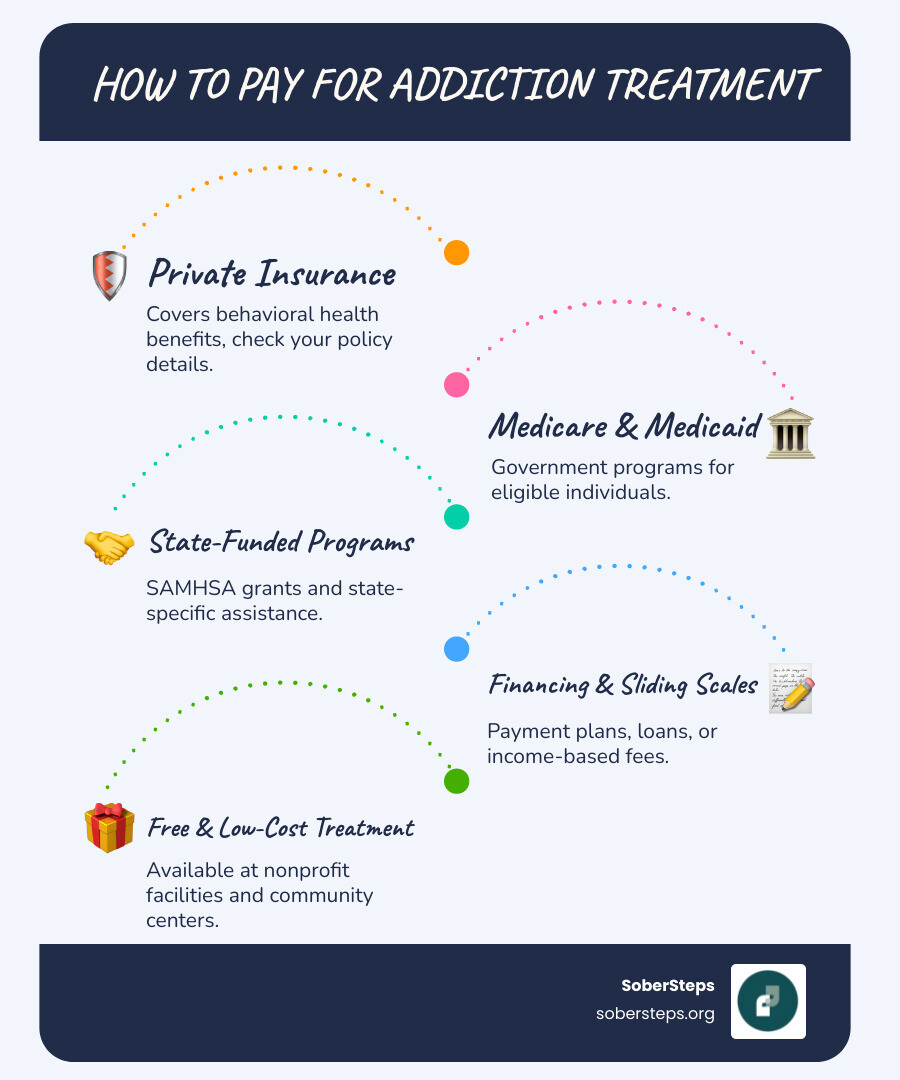
- Private Health Insurance – Most plans cover addiction treatment due to federal laws
- Medicare and Medicaid – Government programs for eligible individuals (6,000+ rehabs accept Medicare, 10,000+ accept Medicaid)
- State-Funded Programs – Free or low-cost options through SAMHSA grants (3,500+ facilities)
- Payment Plans and Sliding Scales – Income-based pricing at 2,000+ treatment centers
- Grants and Scholarships – Financial assistance from nonprofit organizations
- Free Treatment Options – Nearly 230 U.S. rehabs don’t require payment
The cost barrier is real and significant. According to the 2021 National Survey on Drug Use and Health, 46.3 million Americans aged 12 or older had a substance use disorder—yet only 4.1 million (just 1.5%) received treatment. Financial concerns keep too many people from getting the help they desperately need.
But here’s what you need to know: treatment costs typically range from under $10,000 to $80,000 depending on the type of care, location, and duration. Standard inpatient detox costs $250-$800 per day, while 30-day programs at private facilities run $25,000-$50,000 on average. Outpatient programs are more affordable, ranging from $3,500-$10,000.
These numbers might seem overwhelming, but don’t let them stop you. Your health and recovery are worth the investment, and there are proven ways to make treatment affordable—even if you have no insurance or limited resources.
At Sober Steps, we’ve helped countless individuals steer the financial challenges of How Do I Pay For Addiction Treatment by connecting them with resources, verifying insurance benefits, and finding affordable options that fit their unique situations. Our mission is to ensure that cost never prevents someone from accessing life-saving care. Call us confidentially at (844) 491-5566 to discuss your specific situation and explore all available payment options.
Understanding the Cost of Addiction Treatment
The first step in figuring out How Do I Pay For Addiction Treatment is to understand what influences its cost. Addiction treatment isn’t a one-size-fits-all service; its price tag varies widely based on several key factors.
Factors influencing cost include:
- Level of Care: The intensity of treatment (e.g., detox, inpatient, outpatient) directly impacts the cost. More intensive care generally means higher costs.
- Duration of Stay: Longer programs naturally cost more than shorter ones. A 30-day program will be less expensive than a 90-day program.
- Geographic Location: Treatment centers in major metropolitan areas or desirable locales may have higher overhead costs, which are passed on to the patient.
- Facility Amenities: Luxury facilities offering gourmet meals, private rooms, spa services, or holistic therapies will be significantly more expensive than standard programs.
- Staff Credentials: Facilities with highly specialized medical staff, renowned therapists, or a high staff-to-patient ratio may command higher fees.
Costs by Level of Care
Understanding the typical costs associated with different levels of care can help you budget and plan.
- Medical Detox Costs: This is often the first step in treatment, helping individuals safely withdraw from substances.
- Standard inpatient detox typically costs $250–$800 per day.
- Supervised detox with 24/7 medical care runs $500–$650 per day.
- Outpatient detox generally has lower overall costs as you return home each night. You can find more details on Medical detox costs.
- Inpatient/Residential Treatment Cost Ranges: These programs involve living at a facility 24/7.
- Most 30-day programs at private facilities cost between $25,000 to $50,000 per month.
- The prices of residential rehab programs can range from under $10,000 to upwards of $80,000, depending on the factors mentioned above.
- For 30 days of treatment, the average cost will range from $10,000 to over $30,000 per month.
- Outpatient Programs (IOP/PHP) Cost Ranges: These programs allow you to live at home while attending treatment during the day or evening.
- Intensive Outpatient Programs (IOPs) in the U.S. range from $3,500 to over $10,000, depending on the length and number of sessions.
- Partial Hospitalization Programs (PHPs) typically cost $3,500 to upwards of $10,000 at private facilities.
- Individual therapy with a private practitioner typically costs $65 to $250 per hour.
Hidden and Long-Term Costs to Consider
While the upfront cost of a treatment program is significant, it’s crucial not to overlook the hidden and long-term costs associated with addiction recovery. Planning for these can prevent financial surprises and support sustained sobriety.
- Aftercare Planning: After completing a primary treatment program, aftercare and continuing care are vital for long-term recovery but often aren’t included in primary treatment costs. This might involve ongoing therapy, support groups, or sober living.
- Sober Living Arrangements: For many, transitioning from residential treatment to sober living is a critical step. These arrangements can cost $1,500 to $2,000 or more per month.
- Ongoing Therapy: Individual therapy may cost $100 to $200 per session, and group therapy can range from $20 to $50 per session.
- Medication Costs: If medication-assisted treatment (MAT) is part of the recovery plan, medications like buprenorphine, methadone, or naltrexone may cost $200 to $500 monthly. Psychiatric medications for co-occurring mental health conditions can add $50 to $300 monthly.
- Lost Wages During Treatment: Time spent in inpatient treatment often means a temporary loss of income. Planning for this, perhaps through savings or support from family, is essential.
- Building Financial Stability in Recovery: Recovery is a journey that requires building a new life. This includes establishing a recovery budget, managing daily living expenses, and creating an emergency fund for unexpected recovery-related needs.
Thinking about these costs can feel overwhelming, but remember, investing in your health is an investment in your future. Don’t hesitate to call (844) 491-5566 to discuss affordable treatment options that fit your budget. Our team can help you understand the full financial picture and connect you with resources.
How Do I Pay For Addiction Treatment Using Insurance?
For many, health insurance is the primary method for covering the costs of addiction treatment. Thanks to landmark legislation, insurance coverage for substance use disorders is more robust than ever before.
The Affordable Care Act (ACA) mandates that addiction treatment is an essential health benefit, meaning all health insurance plans in the U.S. must cover mental health and addiction treatment to some extent. This includes plans purchased through the Marketplace, Medicaid expansion plans, and most private insurance plans.
The Mental Health Parity and Addiction Equity Act (MHPAEA) requires private insurers to cover substance use disorder (SUD) and mental health (MH) benefits at an equal cost to medical/surgical benefits. This means your coverage for therapy, rehab, or other treatment should be comparable to what you’d receive for a physical illness. All health insurance companies must cover addiction treatment to some extent.
Using Private Health Insurance
Navigating private health insurance can be complex, but it’s a powerful tool for paying for rehab.
- Verifying Benefits: The first step is to understand what your specific plan covers. You can do this by calling your insurance company directly or checking their online member portal. Many treatment centers also offer to help verify your insurance benefits as part of their admissions process. Let us help you Verify Insurance benefits for free by calling (844) 491-5566.
- In-network vs. Out-of-network: Your insurance company contracts with a “network” of providers who offer services at a set fee. Using an in-network provider typically results in lower out-of-pocket costs. If you choose an out-of-network provider, your costs will likely be higher, or your plan may not cover the services at all.
- Deductibles: This is the amount you must pay out-of-pocket before your insurance begins to cover costs.
- Copayments (Copays): A fixed amount you pay for a covered health service after you’ve met your deductible.
- Coinsurance: Your share of the cost of a covered health service, calculated as a percentage (e.g., 20%) of the allowed amount for the service. You pay coinsurance after you’ve met your deductible.
- Pre-authorization: Many insurance plans require prior authorization for certain treatments, especially for inpatient or residential care. This means the insurance company must approve the treatment before you begin, or they may deny coverage.
Key Questions to Ask Your Insurance Provider:
When you call your insurance provider, be prepared with these questions:
- What specific addiction treatment programs are covered (detox, inpatient, IOP, PHP)?
- What are my out-of-pocket costs, including my deductible, copayments, and coinsurance?
- How much of my deductible have I met for the current year?
- Are there limitations on the number of covered days for inpatient care or sessions for outpatient therapy?
- Does my plan cover medication-assisted treatment (MAT) and associated prescriptions?
- Do I need pre-authorization for the type of treatment I’m seeking?
- Are there specific in-network facilities or providers I must use?
Major insurers such as Aetna, Cigna, Blue Cross Blue Shield, and UnitedHealth Group may provide coverage—call (844) 491-5566 to check your specific plan with our specialists. We can assist you in verifying your benefits and understanding your coverage from companies like Aetna, UMR, Humana, UnitedHealth Group, Caresource, Highmark, Cigna, and Blue Cross Blue Shield.
Medicare and Medicaid Coverage
Government-funded health insurance programs like Medicare and Medicaid also provide crucial coverage for addiction treatment, particularly for specific populations.
- Medicare: This federal health insurance program primarily serves individuals aged 65 or older, younger people with certain disabilities, and people with End-Stage Renal Disease.
- Medicare Part A covers inpatient services you get when you’re admitted to a general or psychiatric hospital, including medically necessary detox and residential treatment.
- Medicare Part B covers outpatient services, such as doctor visits, intensive outpatient programs (IOPs), partial hospitalization programs (PHPs), and behavioral health integration services.
- Medicare Part D covers many outpatient prescription drugs you may need to treat a mental health condition or substance use disorder.
More than 6,000 U.S. rehabs accept Medicare, making it a viable option for many.
- Medicaid: This is a joint federal and state program that helps with medical costs for some people with limited income and resources.
- Medicaid covers a range of services, including inpatient treatment, outpatient rehab programs, medications, and counseling for people with low income.
- Eligibility and specific coverage details depend on your state, as each state administers its Medicaid program differently.
- Over 10,000 U.S. facilities take Medicaid payment, making it a widespread option for those who qualify.
If you are eligible for both Medicare and Medicaid, you may have even more comprehensive coverage. Call your State Medical Assistance (Medicaid) office to find out what other health services may be covered in your state.
What to Do If Your Insurance Claim is Denied
Receiving a denial for addiction treatment coverage can be disheartening, but it’s not always the final answer. Many denials can be successfully overturned through the appeals process.
- Common Reasons for Denial: Insurance claims are often denied because the insurer deems the treatment “not medically necessary,” or there might be issues with pre-authorization, provider network status, or documentation.
- The Appeals Process: You have the right to appeal your insurance company’s decision.
- Internal Appeals are your first step. You typically must file within 60 days of receiving a denial notice. Contact your insurance company to request appeal forms and gather all relevant medical documentation from your doctor, proving the medical necessity of the treatment.
- External Appeals become available if your internal appeal is denied. This involves independent medical reviewers not employed by your insurance company, who will assess your case.
- Importance of Medical Documentation: Detailed records from your healthcare provider, including diagnoses, treatment plans, and proof of medical necessity, are critical for a successful appeal. Your doctor’s support can make a significant difference.
Check out this useful guide on the appeals process for more in-depth information. For help navigating a denial, or if you feel overwhelmed by the process, call our specialists at (844) 491-5566. We can provide guidance and support.
What Are My Options Without Insurance?
“I don’t have insurance. How Do I Pay For Addiction Treatment?” This is a question we hear often, and we want you to know that treatment is absolutely still possible. Lack of insurance doesn’t mean lack of options. There are numerous avenues to explore for individuals without private health insurance or substantial financial resources.
How Do I Pay For Addiction Treatment with Government and State-Funded Programs?
Various government initiatives and state-level programs are designed to make addiction treatment accessible to those who need it, regardless of their ability to pay.
- SAMHSA Block Grants: The Substance Abuse and Mental Health Services Administration (SAMHSA) offers grants like the Substance Abuse Prevention and Treatment Block Grant (SABG). This federal funding is distributed to states to support prevention and treatment activities. Over 3,500 U.S. rehab centers accept this grant, offering a lifeline to many.
- State-Funded Programs: Many states offer funding for addiction and mental health care through grants and public programs. To learn about programs in your area, contact your state’s department of health or substance abuse agency. These programs often have income requirements and may have waiting lists, but they can provide crucial support. You can find your State agency for substance abuse services for more information.
- VA Benefits for Veterans: If you’re a veteran, you may qualify for treatment through the VA healthcare system. The U.S. Department of Veterans Affairs (VA) can help you find services near you. Visit the VA Substance Use Disorder Program Locator to search for programs.
We understand that finding these resources can be challenging. SoberSteps is committed to helping you find Free Rehab Centers Near Me and other state-funded options.
How Do I Pay For Addiction Treatment with Financing and Financial Assistance?
Even without insurance, there are many ways to finance your treatment, making the cost more manageable.
- Sliding-Scale Fees: Some treatment centers offer sliding-scale fees based on your household income and family size. This can significantly reduce treatment costs for people with limited financial resources. Roughly 2,000 U.S. treatment centers offer sliding fee scales and payment assistance.
- Payment Plans: Many treatment centers understand the financial burden and offer in-house payment plans. These allow you to spread treatment costs over several months or even years, making expensive residential programs more manageable for your budget. You’ll pay a fixed monthly amount until the full price of treatment is met.
- Personal Loans: Traditional banks offer personal loans with rates typically ranging from 6-15% for borrowers with excellent to good credit. Online lenders may charge 15-35% or higher for those with lower credit scores. The average personal loan rate across all credit types is around 21%, with some lenders charging rates up to 99% for the riskiest borrowers.
- Medical Credit Cards: These specialized credit cards are designed for healthcare expenses. They often offer promotional 0% interest periods, but be extremely cautious. If the balance isn’t paid off by the end of the promotional period, high retroactive interest rates (25% or higher) can be applied to the original balance.
- Predatory Lending Risks: Be cautious of predatory lending practices. Some lenders target people in crisis with high-interest loans, excessive fees, or unfavorable terms. Research lenders thoroughly and compare multiple options before committing. For guidance on avoiding predatory lending, visit the Federal Trade Commission’s consumer guidance.
- Grants and Scholarships: Many non-profit organizations, foundations, and even some treatment centers offer grants or scholarships to help individuals cover treatment costs. You can search online for “addiction treatment scholarships” or “mental health treatment grants.” Organizations like the Sobriety Foundation offer scholarship programs. Local community foundations often provide grants for healthcare needs, including addiction treatment.
- Crowdfunding: Online crowdfunding has become an increasingly popular way to raise money for medical expenses, including addiction treatment. Platforms like GoFundMe allow you to create campaigns that loved ones and even strangers can contribute to.
- Employee Assistance Programs (EAPs): If you’re employed, check if your company offers an EAP. An EAP is a confidential program that provides assessments, counseling, and referrals to help employees work through life challenges, including alcohol and drug addiction.
Don’t let financial concerns delay your path to recovery. Call (844) 491-5566 to learn about payment plans and other financial assistance options available to you.
Finding Free and Low-Cost Support
For those with very limited or no financial resources, free and low-cost options are available.
- Non-Profit Organizations: Many non-profit organizations offer addiction treatment services at little to no cost. Programs like The Salvation Army provide no-cost treatment options for drug and alcohol addiction.
- Community Health Centers: These centers are federally funded and provide comprehensive healthcare services, including mental health and substance use disorder treatment, often on a sliding-scale fee or free basis. You can Find a health center that provides free or low-cost care near you.
- Support Groups: Free peer-support groups are invaluable resources for recovery and often provide guidance on navigating treatment options.
- Alcoholics Anonymous (A.A.) helps people struggling with alcohol use. You can locate a meeting center or an online support group.
- Narcotics Anonymous (N.A.) helps people struggling with prescription or illicit drugs. You can find a meeting center near you.
- SMART Recovery helps people struggling with addiction by hosting group therapy sessions.
SoberSteps is dedicated to helping you explore options for Affordable Mental Health Care and finding the right support system for your journey.
Frequently Asked Questions About Paying for Rehab
Here, we address some of the most common questions people have when figuring out How Do I Pay For Addiction Treatment.
Can I go to rehab if I have no money and no insurance?
Yes, absolutely. Having no money or insurance should not prevent you from seeking life-saving addiction treatment. While it might require more effort to steer, many options exist:
- State-funded programs: As discussed, these can provide treatment at low or no cost based on income eligibility.
- SAMHSA grants: These federal grants support treatment centers that serve individuals who might otherwise not afford care.
- Non-profits: Organizations like The Salvation Army offer free programs.
- Sliding-scale fees: Many facilities adjust costs based on your ability to pay.
- Community health centers: Often provide free or low-cost services.
- According to SAMHSA’s FindTreatment.gov, almost 230 U.S. rehabs don’t accept payment at all.
You can find more information on Free & Low Cost Treatment Options. Many facilities offer payment assistance programs, and our team at SoberSteps can help you find them.
How do I verify my insurance benefits for addiction treatment?
Verifying your insurance benefits is a crucial step in understanding How Do I Pay For Addiction Treatment with your plan.
- Call your insurer directly: Look for the customer service number on the back of your insurance card. Be prepared with your policy number and ask specific questions about mental health and substance use disorder coverage.
- Check the provider portal online: Many insurance companies have online portals where you can view your benefits, deductible status, and covered services.
- Ask the treatment center’s admissions team for help: Most reputable treatment facilities have experienced admissions staff who can contact your insurance provider on your behalf and provide a detailed breakdown of your benefits.
Let us help you Verify Insurance confidentially and quickly. Our team can streamline this process for you.
What should I do if my insurance denies coverage?
If your insurance denies coverage for addiction treatment, don’t give up. You have the right to appeal the decision.
- File an internal appeal immediately: Your insurance company must provide you with the reasons for their denial and instructions on how to appeal. You typically have 60 days to file an internal appeal.
- Gather supporting medical documentation from your doctor: Request a letter from your doctor or treatment provider explaining why the denied treatment is medically necessary for your recovery. Include all relevant medical records.
- Request an external review if the internal appeal fails: If your internal appeal is denied, you can request an external review. An independent third party, not associated with your insurance company, will review your case.
- Seek help from a patient advocate or case manager: Many treatment centers employ patient advocates or case managers who specialize in navigating insurance appeals. Community organizations can also provide this support.
For help navigating a denial, or for guidance through the appeals process, call our specialists at (844) 491-5566.
Take the First Step: Get Help Now
The journey to recovery is a brave one, and figuring out How Do I Pay For Addiction Treatment shouldn’t be an impossible hurdle. We’ve explored a wide range of options, from utilizing private insurance, Medicare, and Medicaid to leveraging state-funded programs, financial assistance, and free community resources. Your health is an invaluable investment, one that yields returns in every aspect of your life.
At SoberSteps.org, we provide confidential and anonymous help for mental health and substance use disorders. Our unique selling proposition is offering a safe, private space for treatment seekers to find the support they need without fear of judgment.
Don’t let financial concerns stop you from seeking life-saving care. Our team is available 24/7 to confidentially discuss your options, verify your insurance benefits, and connect you with the right resources. Recovery is possible, and we’re here to help you take that crucial first step.
You can visit our Get Help Now page or explore our insurance resources for more information. Your future starts today.