Unpacking Rehab: Everything You Need to Know About Drug Rehabilitation
Unlock vital drug rehabilitation information. Learn about treatment, therapies, payment, and start your recovery journey with SoberSteps.

Attention Deficit Hyperactivity Disorder is one of the most common neurodevelopmental conditions in the United States, affecting how people focus, control impulses, and manage their energy levels.
Quick Facts About ADHD:
Many people with ADHD face additional challenges. The condition frequently occurs alongside other mental health issues like anxiety, depression, and substance use disorders. In fact, individuals with untreated ADHD are at higher risk for developing addiction as they may turn to substances to manage their symptoms.
The good news? ADHD is highly treatable when properly diagnosed. Whether you’re a parent noticing signs in your child, an adult who’s struggled for years without answers, or someone dealing with both ADHD and substance use, understanding this condition is the first step toward getting help.
At Sober Steps, we specialize in supporting individuals navigating the complex intersection of mental health conditions like Attention Deficit Hyperactivity Disorder and substance use disorders. Our team understands that effective recovery requires addressing all aspects of your mental health in a confidential, compassionate environment.
If you’re struggling with ADHD symptoms, co-occurring conditions, or need guidance on treatment options, our confidential helpline is available 24/7 at (844) 491-5566. You don’t have to face this alone.
Attention Deficit Hyperactivity Disorder is a developmental disorder characterized by an ongoing pattern of inattention, hyperactivity, and/or impulsivity that significantly interferes with functioning or development. These core symptoms are typically present in childhood, often before age 12, and can persist throughout a person’s life. However, how these symptoms manifest can change dramatically with age, often leading to different challenges for children versus adults.
The brain of someone with ADHD is wired a bit differently, particularly in the frontal lobe. This area is crucial for “directed attention”–the ability to focus on tasks that aren’t inherently interesting. This difference can make planning, multitasking, and problem-solving more challenging. It’s not that individuals with ADHD can’t pay attention; it’s that their brains are often better at “automatic attention,” which is why they can sometimes hyperfocus on things they find stimulating or engaging.

For confidential help, call (844) 491-5566 today.
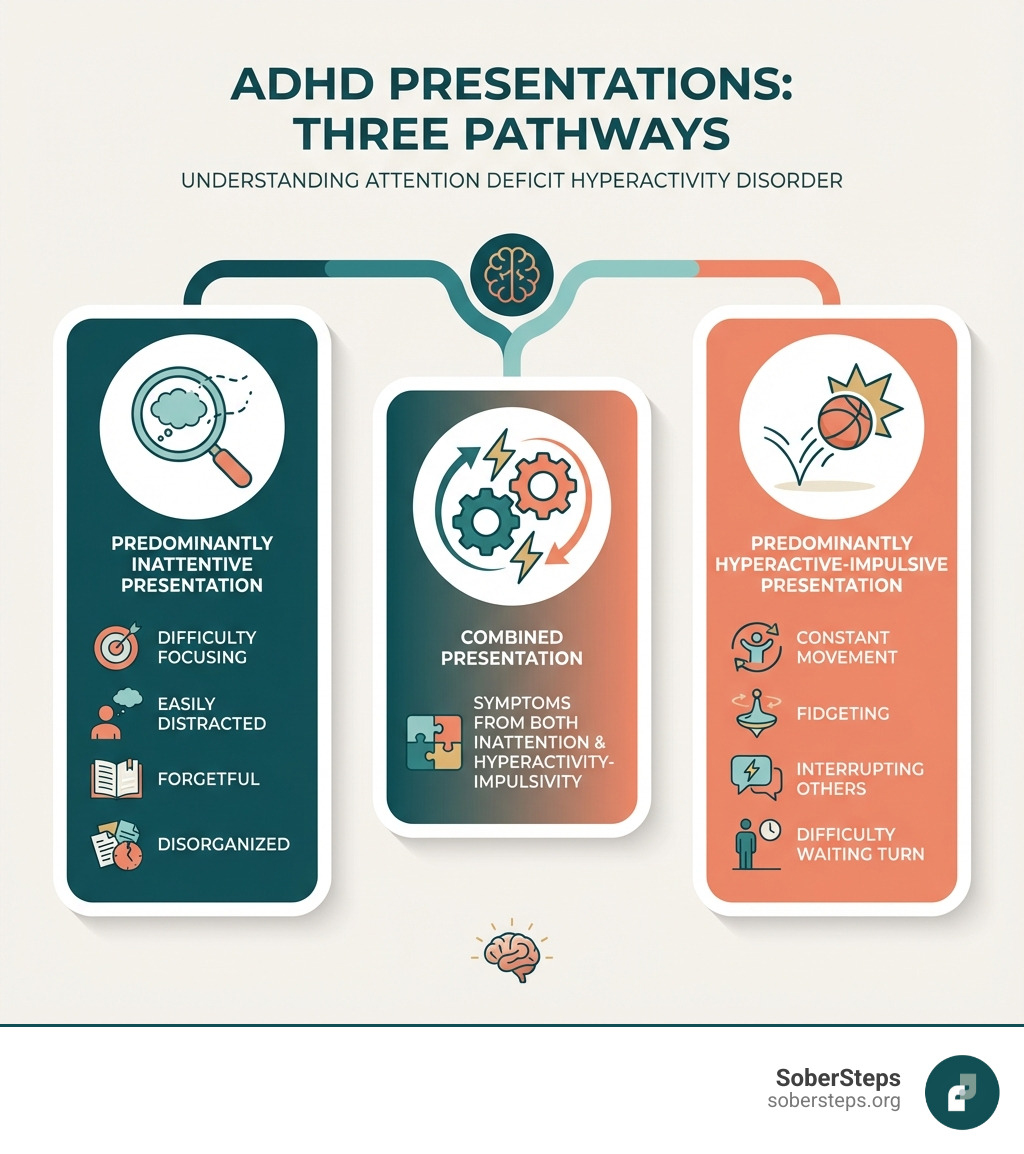
The diagnostic criteria outlined in the Diagnostic and Statistical Manual of Mental Disorders, Fifth Edition (DSM-5), recognize three primary ways Attention Deficit Hyperactivity Disorder can present. These presentations describe the types of symptoms that are most prominent in an individual.
In children and adolescents, Attention Deficit Hyperactivity Disorder symptoms are often quite visible and can significantly impact their development and daily life. We might see academic struggles, such as poor grades or difficulty completing assignments, as a child avoids tasks requiring sustained mental effort. Socially, children with ADHD may struggle with peer relationships due to interrupting, difficulty waiting their turn, or perceived bossiness, sometimes leading to peer rejection. Emotional dysregulation, like intense mood swings or difficulty managing frustration, can also be prominent.
Symptoms can look different depending on the setting. At school, a child might be disruptive, unable to stay in their seat, or frequently miss instructions. At home, they might struggle with chores, forget homework, or constantly be “on the go.” Girls with ADHD, however, may present differently, often exhibiting more inattentive symptoms like daydreaming, disorganization, and forgetfulness, which can be less obvious than the overt hyperactivity often seen in boys. This can sometimes lead to underdiagnosis in girls.

While Attention Deficit Hyperactivity Disorder is often associated with childhood, it’s a lifelong condition. About half of adults with ADHD in the U.S. received their diagnosis in adulthood, highlighting how symptoms can evolve and become more apparent or disruptive later in life. In adults, the hyperactivity often internalizes, manifesting as extreme restlessness, an inner sense of agitation, or difficulty relaxing.
Adults with ADHD may face a unique set of challenges:
While the outward signs of hyperactivity might lessen, the inattentive and impulsive aspects often persist and can become more problematic as adult responsibilities increase. The good news is that an adult diagnosis can be a turning point, providing understanding and access to effective management strategies.
Receiving a diagnosis of Attention Deficit Hyperactivity Disorder can be a life-changing moment, offering clarity and a roadmap for treatment. The diagnostic process is comprehensive and involves a thorough medical evaluation to rule out other conditions that might mimic ADHD symptoms, such as anxiety, depression, sleep problems, or learning disabilities. It’s not a simple checklist; it’s a careful assessment by trained professionals.
For a free, confidential assessment, call our team at (844) 491-5566.
There is no single test, like a blood test or brain scan, that can definitively diagnose Attention Deficit Hyperactivity Disorder. Instead, diagnosis is a multi-step process that relies on careful clinical evaluation and gathering information from multiple sources.
A diagnosis is typically made by a mental health professional (like a psychologist or psychiatrist) or a primary care provider (such as a pediatrician). They will:
Misdiagnosis can occur if the evaluation isn’t thorough, underscoring the importance of seeking a professional experienced in diagnosing ADHD.
While the exact causes of Attention Deficit Hyperactivity Disorder are not fully understood, research points to a combination of genetic and environmental factors.
The Centers for Disease Control and Prevention (CDC) provides further information on these risk factors. You can learn more from the CDC information on risk factors.
It’s common for individuals with Attention Deficit Hyperactivity Disorder to experience other mental health conditions alongside it, a phenomenon known as comorbidity or dual diagnosis. These co-occurring conditions can complicate diagnosis and treatment, but addressing both simultaneously is crucial for effective management and improved quality of life. In fact, ADHD frequently co-occurs with conditions such as conduct problems, learning disorders, anxiety, or depression.
Untreated ADHD can significantly increase the risk of developing these co-occurring conditions, and the overlapping symptoms can create a complex web of challenges. This is why integrated treatment approaches are so vital.
If you’re struggling with co-occurring disorders, support is available 24/7 at (844) 491-5566.
We often see Attention Deficit Hyperactivity Disorder alongside a range of other mental health and developmental conditions:
Finding support for mental health challenges is a critical step towards overall well-being. We encourage you to explore resources to learn how to find help for yourself or someone else and locate mental health services in your area.
The connection between Attention Deficit Hyperactivity Disorder and Substance Use Disorders (SUD) is a significant concern. Untreated ADHD dramatically increases the risk of developing SUD. This link is often explained by the “self-medication hypothesis,” where individuals may turn to substances to manage their distressing ADHD symptoms, such as restlessness, anxiety, or difficulty concentrating.
The impulsivity inherent in ADHD can also lead to increased risk-taking behaviors, making individuals more vulnerable to experimenting with substances and developing addictive patterns. There’s also evidence of shared neurological pathways implicated in both ADHD and addiction, suggesting a biological predisposition.
The complications of an untreated dual diagnosis of ADHD and SUD are profound, often leading to more severe addiction, poorer treatment outcomes, and greater life impairment. This highlights the critical importance of addressing both conditions simultaneously in an integrated treatment approach.
Call (844) 491-5566 for anonymous help with SUD and ADHD.
Leaving Attention Deficit Hyperactivity Disorder untreated, particularly when co-occurring conditions like SUD are present, can lead to a cascade of negative long-term outcomes. We see significant impacts across various aspects of a person’s life:
These complications underscore why early diagnosis and comprehensive treatment are so important for improving long-term outcomes and quality of life.
The good news is that Attention Deficit Hyperactivity Disorder is a highly treatable condition. The most effective approach is typically multimodal, meaning it combines several different strategies custom to the individual’s specific needs, age, and co-occurring conditions. An individualized treatment plan is key, as what works for one person may not work for another. We believe in empowering individuals with the tools and support they need to manage their symptoms effectively.
Ongoing research in the U.S. continues to refine our understanding of ADHD and develop new treatment options. You can explore current studies by visiting Current Studies on ADHD Clinicaltrials.gov: List of clinical trials funded by the National Institutes of Health (NIH) being conducted across the country.
Behavioral therapies play a crucial role in managing Attention Deficit Hyperactivity Disorder, especially for children, where parent training in behavior management is often recommended as the first line of treatment for preschool-aged children (4-5 years) before medication.
The CDC provides valuable resources and fact sheets on ADHD signs, symptoms, and treatment options, which can be found at ADHD (Centers for Disease Control and Prevention).
Medication is often an effective component of Attention Deficit Hyperactivity Disorder treatment, particularly for moderate to severe symptoms. These medications work by affecting neurotransmitters in the brain, improving attention, reducing impulsivity, and controlling hyperactivity.
It’s crucial that medication is prescribed and monitored by a medical professional. Finding the right medication and dosage often involves a process of trial and error, working closely with your doctor to manage potential side effects and optimize benefits.
Beyond therapy and medication, integrating healthy lifestyle strategies into daily routines can significantly help manage Attention Deficit Hyperactivity Disorder symptoms and improve overall well-being.
For more tips on healthy digital media use and other healthy habits, you can refer to healthy digital media use habits for babies, toddlers, preschoolers.
No, current research does not support the theory that sugar directly causes or significantly worsens Attention Deficit Hyperactivity Disorder symptoms. While a sugar rush might temporarily increase energy in any child, it’s not the underlying cause of ADHD. However, maintaining a balanced diet with plenty of fruits, vegetables, and whole grains, and limiting processed foods, is important for overall health and can help stabilize energy levels and mood, which indirectly supports symptom management.
While some symptoms, particularly overt hyperactivity, may lessen with age, Attention Deficit Hyperactivity Disorder is generally considered a lifelong condition. Many adults continue to experience significant symptoms of inattention and impulsivity that require ongoing management and strategies. It’s more accurate to say that individuals learn to manage their symptoms more effectively over time, or the symptoms change in how they manifest, rather than completely outgrowing the disorder.
Yes, Attention Deficit Hyperactivity Disorder is recognized as a disability under federal laws in the United States, specifically the Americans with Disabilities Act (ADA) and the Rehabilitation Act of 1973. This means that individuals with ADHD may be eligible for reasonable accommodations in educational settings (K-12 and higher education) and in the workplace to ensure equal access and opportunities. These accommodations can include extended time on tests, a quieter workspace, or modified task management.
Attention Deficit Hyperactivity Disorder is a complex neurodevelopmental condition that affects millions of children and adults across the United States. While its symptoms of inattention, hyperactivity, and impulsivity can present unique challenges throughout life, we’ve seen that ADHD is a highly treatable condition. With accurate diagnosis and a comprehensive, individualized treatment plan that may include behavioral therapies, medication, and lifestyle adjustments, individuals with ADHD can lead fulfilling and successful lives.
It’s particularly important to recognize the high prevalence of co-occurring conditions, especially Substance Use Disorders. For those navigating the intricate paths of ADHD and addiction, integrated treatment is not just beneficial, but often essential. Addressing both conditions simultaneously provides the most robust foundation for recovery and long-term well-being.
At SoberSteps, we understand these complexities. Our mission is to offer confidential and anonymous help, guiding you toward effective treatment options custom to your unique situation. You don’t have to steer these challenges alone. There is hope, and there is help.

Unlock vital drug rehabilitation information. Learn about treatment, therapies, payment, and start your recovery journey with SoberSteps.

Crisis? Get help now for suicide & addiction. Call 988 or SoberSteps for immediate, confidential support and treatment referrals. You’re not alone.

Find hope in stimulant addiction recovery. Explore effective treatments, detox, therapies, and support for a life beyond the buzz. Get help today.