Drug Rehab in Jefferson County, Alabama: What You Need to Know Right Now
Drug rehab in Jefferson County, Alabama is available through multiple programs — from free state-funded residential care to outpatient services with sliding-scale fees. Here’s a quick look at your options:
| Type of Help | Example Resources | Cost |
|---|---|---|
| Free/low-cost residential | Pearson Hall | Medicaid, state-funded |
| Outpatient treatment | UAB Beacon Recovery | $0–$100/month sliding scale |
| 24/7 crisis & referrals | Recovery Resource Center | Free |
| Immediate helpline | Call (844) 491-5566 | Free |
If you or someone you love needs help right now, call (844) 491-5566 — confidential support is available 24/7.
Jefferson County is facing one of the most serious addiction crises in Alabama. In 2023, accidental drug-related deaths in the county reached 483 — more than double the local homicide count that same year. Drug overdose is now the number one cause of accidental death in Jefferson County.
The good news? Help is here.
Whether you need medically supervised detox, intensive outpatient care, or just someone to talk to, Jefferson County has real resources. And the first step doesn’t have to be complicated.
This guide walks you through the top 10 drug rehab centers in Jefferson County, AL — plus how to pay for treatment, what the intake process looks like, and where to find support after rehab.
Understanding Addiction Statistics and Drug Rehab in Jefferson County, Alabama
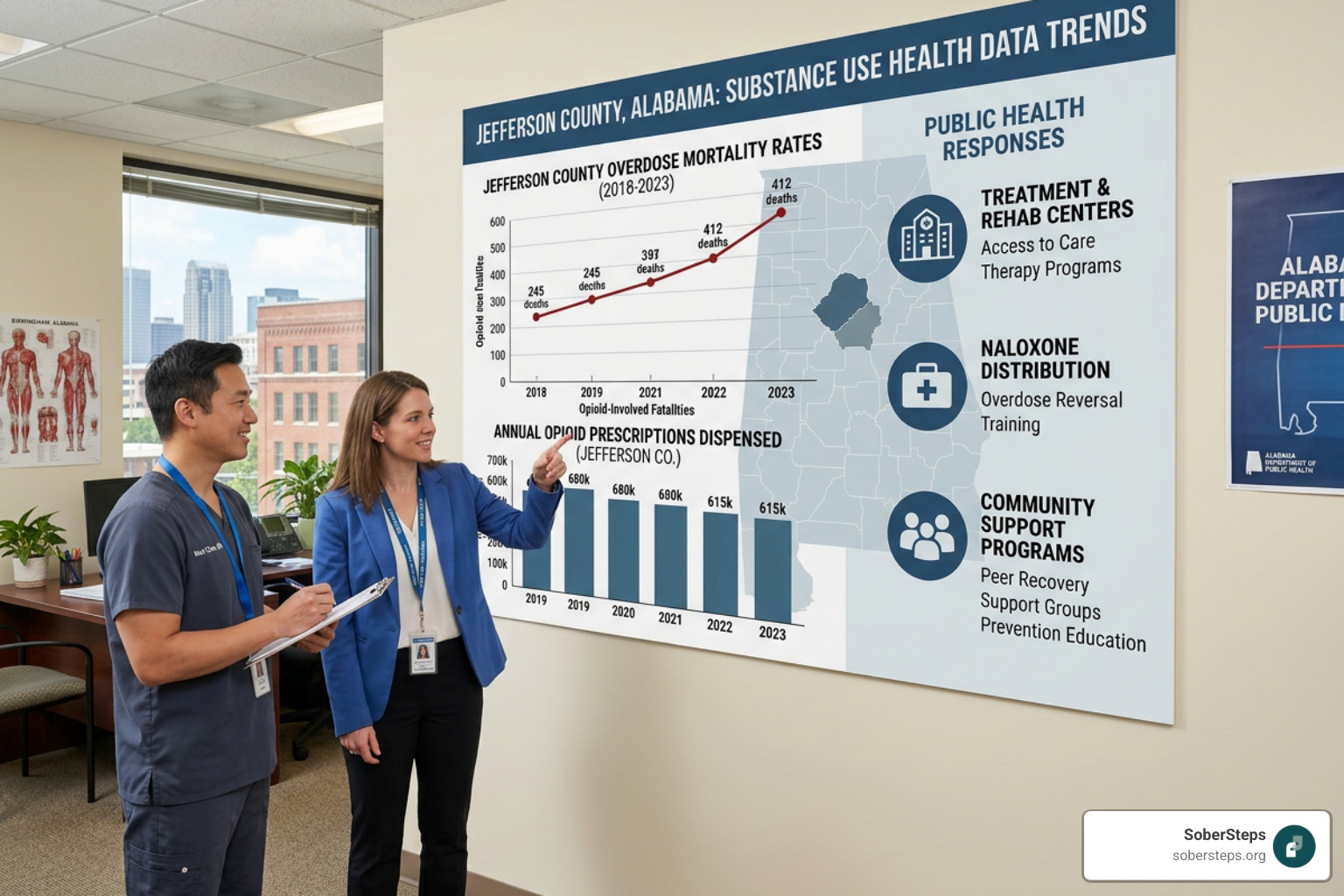
To understand the landscape of drug rehab in Jefferson County, Alabama, we first have to look at the numbers. They tell a story of a community that has been hit hard but is fighting back with everything it has. For many years, Jefferson County has held the somber distinction of having the highest opioid prescription distribution in the state. In 2020, there were 139 prescriptions for every 100 people in the county.
This high availability of prescription pills often served as a gateway to more dangerous substances. By 2021, fatal overdoses in the county rose to 401, with a staggering 86% involving opioids. The primary driver today is fentanyl—a synthetic opioid so potent that even a tiny amount can be fatal. It is frequently mixed into other drugs like cocaine or counterfeit pills, leading to “polydrug” overdoses where the user may not even know they are consuming an opioid.
However, there is a glimmer of hope. Recent data from 2024 suggests that overdose deaths in the county have dropped by more than a third compared to the 2023 peak. This shift is largely due to increased awareness and the massive expansion of local resources. If you are struggling, you are not just a statistic; you are part of a community that is actively building a safety net for your recovery.
Need help navigating these statistics or finding a bed? Call (844) 491-5566 for immediate support.
Local Overdose Trends and Impact
The impact of addiction in Birmingham and surrounding areas like Bessemer, Hoover, and Trussville cannot be overstated. When accidental drug deaths outpace homicides by two-to-one, it signals a public health emergency. The Jefferson County Department of Health has identified that synthetic opioids and stimulants (like methamphetamine) are the primary substances causing these tragedies.
The Role of Public Health Initiatives
Jefferson County has been proactive in harm reduction. In 2021 alone, the Department of Health distributed nearly 4,900 Narcan (naloxone) kits. This effort resulted in at least 59 documented overdose reversals—59 lives saved because someone had the right tool at the right time. Programs like the Jefferson County Resource Recovery Center act as a central hub, offering free assessments and helping residents navigate the often-confusing world of health insurance and treatment waitlists.
Top-Rated Treatment Facilities and Programs
Choosing the right facility is the most critical decision you’ll make. In Jefferson County, the “Top 10” list includes a mix of long-standing non-profits, university-backed programs, and specialized residential centers.
| Program Name | Primary Level of Care | Key Feature |
|---|---|---|
| Pearson Hall | Residential & Detox | State-funded, ASAM Level III.5/III.7 |
| UAB Beacon Recovery | Outpatient & IOP | Sliding scale fees, MISSION program |
| Aletheia House | Residential & Outpatient | Specialized care for women/pregnant women |
| Fellowship House | Residential | Focus on long-term transitional living |
| JBS Mental Health | Outpatient | Integrated mental health services |
| Recovery Resource Center | Assessment/Referral | Central entry point for all county residents |
| Zukoski Center | Outpatient | Part of the Aletheia House network |
| St. Anne’s Home | Residential | Specialized for women |
| Olivia’s House | Residential | For chemically dependent women and their children |
| The Bridge | Adolescent | Specialized youth substance use treatment |
For more information on these facilities or to check current availability, call (844) 491-5566.
High-Intensity Residential Care
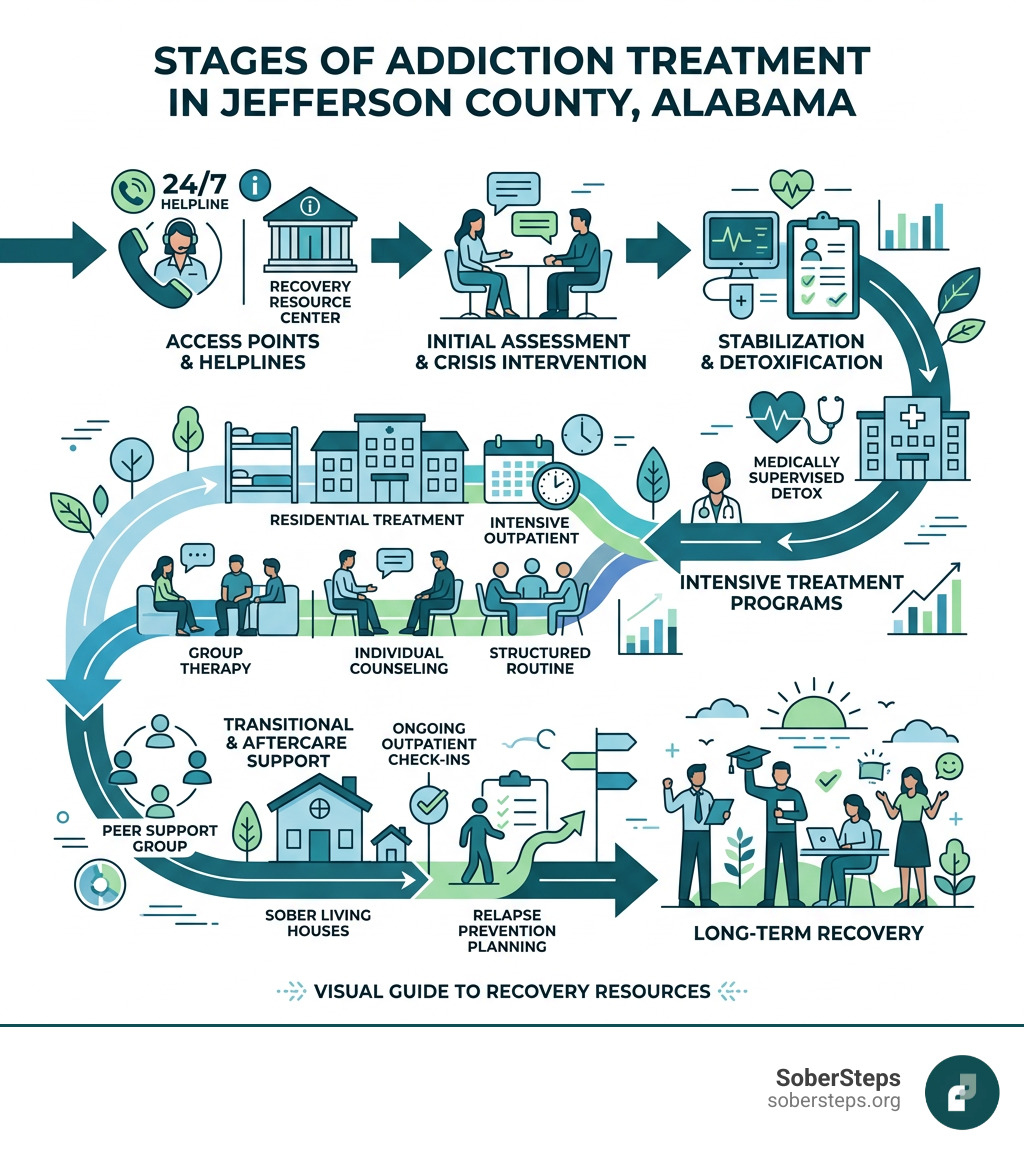
For those who need a break from their current environment to stay sober, residential care is often the best path. Pearson Hall is a cornerstone of drug rehab in Jefferson County, Alabama. They offer ASAM Level III.7-D (Medically Monitored Residential Detox) and Level III.5 (High-Intensity Residential Treatment). This means you have 24/7 clinical supervision and a structured environment designed to stabilize both the body and the mind.
Comprehensive Outpatient Services
Not everyone can leave work or family for 30 days. This is where outpatient programs shine. UAB Beacon Recovery offers Intensive Outpatient Programs (IOP) that require about 9 hours of therapy per week. They also feature the MISSION program, which provides specific support for individuals facing homelessness alongside addiction.
Learn more about Alabama recovery options to see which level of care fits your life.
Navigating the Intake Process and Specialized Care
Entering rehab can feel like a mountain of paperwork, but it’s actually a structured process designed to keep you safe. Most facilities in Jefferson County use the ASAM (American Society of Addiction Medicine) criteria. This isn’t just a test; it’s a conversation about your health history, your home environment, and your readiness for change.
Call (844) 491-5566 for a confidential consultation to start your assessment process today.
The Intake Process for Drug Rehab in Jefferson County, Alabama
The first step is usually a phone screening. At places like UAB Beacon Recovery, this evaluation can take 1 to 2 hours. You’ll talk about what substances you’re using, any mental health struggles you have, and what your goals are. If you don’t have insurance, the Recovery Resource Center is your best friend. They provide free assessments and can link you to state-funded beds at Pearson Hall or other non-profit partners.
For younger residents, the Adolescent Substance Abuse Program (ASAP) works directly with the Jefferson County Family Court to provide screening and triage for juveniles. They focus on the “least intrusive” intervention possible, helping teens get back on track before addiction takes a permanent hold.
Specialized Programs at Drug Rehab in Jefferson County, Alabama
Addiction doesn’t look the same for everyone, and neither should treatment. Jefferson County offers several specialized pathways:
- Pregnant and Postpartum Women: Programs like Olivia’s House and Aletheia House allow women to seek treatment without being separated from their children.
- Veterans: Many local centers have specialized tracks for trauma and PTSD, recognizing the unique challenges faced by those who served.
- Medication-Assisted Treatment (MAT): Facilities like Pearson Hall and specialized clinics offer buprenorphine (Suboxone), methadone, and naltrexone (Vivitrol). These medications help “level the playing field” by reducing cravings and preventing withdrawal symptoms, allowing you to focus on therapy.
Financial Assistance and Insurance for Recovery
One of the biggest myths about rehab is that it’s only for the wealthy. In Jefferson County, there are numerous ways to access care regardless of your bank balance.
If you’re worried about the cost of care, call (844) 491-5566 for a free insurance verification and cost analysis.
Accessing Low-Cost Treatment
If you are uninsured or have a low income, you may qualify for:
- Medicaid: Many top facilities, including Pearson Hall and UAB Beacon, accept Alabama Medicaid.
- Sliding Fee Scales: UAB Beacon Recovery, for example, offers a sliding scale where monthly fees range from $0 to $100 based on your household income. They have a policy that no one is turned away due to an inability to pay.
- State and Federal Grants: The Alabama Department of Mental Health (ADMH) provides block grants that fund beds for residents who meet certain criteria.
You can even access the UAB Beacon payment portal online to manage program fees conveniently. Find affordable rehab in Alabama through our directory of state-funded providers.
Navigating Insurance Benefits
If you have private insurance (like Blue Cross Blue Shield of Alabama), your treatment might be covered at 80% to 100%. The key is finding “in-network” providers. Most facilities have an admissions team that will call your insurance company for you to find out exactly what your out-of-pocket costs will be.
Local Support Resources and Long-Term Aftercare
Rehab is just the beginning. The real work of recovery happens in the weeks, months, and years after you leave a facility. Jefferson County has a robust “Recovery Ecosystem” designed to support you for the long haul.
Call (844) 491-5566 to speak with someone about building a personalized aftercare plan.
Peer-Led Recovery Networks
Sometimes the best person to talk to is someone who has been exactly where you are. The Recovery Organization of Support Specialists (ROSS) provides peer support from individuals in long-term recovery. These “Certified Recovery Support Specialists” help you navigate the barriers of early sobriety—like finding a job, getting to meetings, or dealing with family stress.
The Recovery Resource Center also hosts various self-help groups and provides a safe space for people to connect. Whether you prefer 12-step programs like AA/NA or non-12-step alternatives, there is a community waiting for you in Birmingham.
Sustaining Long-Term Sobriety
Aftercare often includes:
- Transitional/Sober Living: Houses where you can live with others in recovery while you transition back to work.
- Alumni Programs: Staying connected with your rehab facility through events and meetings.
- Telehealth: Many programs now offer therapy via secure video calls, making it easier to keep your appointments even with a busy schedule.
Frequently Asked Questions about Addiction Treatment
How do I start the process of entering drug rehab in Jefferson County, Alabama?
The best first step is to call a professional for a screening. You can call the Recovery Resource Center at (205) 458-3377 or our 24/7 helpline at (844) 491-5566. They will guide you through a brief assessment and tell you which programs currently have openings.
Are there free or low-cost rehab options available for those without insurance?
Yes. Jefferson County has several state-funded facilities like Pearson Hall and Aletheia House. Additionally, UAB Beacon Recovery offers a sliding fee scale based on income. If you have no income, your cost may be $0.
What is the difference between inpatient and intensive outpatient (IOP) programs?
Inpatient (residential) means you live at the facility 24/7 and receive constant supervision. This is best for detox or severe addictions. Intensive Outpatient (IOP) allows you to live at home but requires you to attend therapy sessions (usually 3 hours a day, 3 days a week).
Conclusion
Recovery is not a destination; it is a journey that begins with a single, courageous decision. In Jefferson County, Alabama, you are surrounded by a community that understands the weight of addiction and is ready to help you carry it. From the high-intensity medical care at Pearson Hall to the accessible outpatient support at UAB Beacon, the resources are here.
You don’t have to wait until you hit “rock bottom” to ask for help. Whether you are looking for yourself or a loved one, the path to a healthier life is open. Take that first step today.
Call (844) 491-5566 right now for 24/7, confidential help. Our team at SoberSteps is here to connect you with the treatment you deserve.