
More Than Just Words: Understanding Dual Diagnosis and Co-Occurring Conditions
Understand dual diagnosis vs co-occurring disorders. Learn why the distinction matters for integrated treatment and find support today.

Medical Mutual of Ohio drug rehab coverage options can be confusing. Here’s a quick overview:
Quick Coverage Overview:
When a loved one agrees to get help, figuring out insurance shouldn’t add to the stress. For the over 1.6 million Medical Mutual members, understanding your coverage is the first step. As Ohio’s largest health insurer, Medical Mutual offers comprehensive addiction treatment options, but the details can be complex.
Federal laws like the Affordable Care Act (ACA) and the Mental Health Parity and Addiction Equity Act (MHPAEA) mandate that Medical Mutual cover substance use disorder treatment similarly to other medical conditions. However, your specific plan, provider choice, and the authorization process will determine your final costs.
At Sober Steps, we specialize in breaking down these complex insurance details. Our team helps families understand their Medical Mutual of Ohio drug rehab coverage options and connect with quality treatment, so you can focus on recovery, not paperwork.
Verify your Medical Mutual coverage now to get started, or contact SoberSteps for personalized help.
Understanding your Medical Mutual plan is the first step to accessing addiction treatment. Federal laws have made care more accessible than ever before.
The Affordable Care Act (ACA) designated mental health and substance use disorder services as essential health benefits. This means any ACA-compliant Medical Mutual plan must provide coverage for rehab, treating addiction as a medical condition.
Additionally, the Mental Health Parity and Addiction Equity Act (MHPAEA) requires insurers like Medical Mutual to offer benefits for mental health and substance use that are on par with medical and surgical care. This ensures comparable deductibles, copays, and limits. You can learn more at CMS.gov – The Mental Health Parity and Addiction Equity Act (MHPAEA).
Medical Mutual offers various plan structures, primarily HMO and PPO plans, which dictate how you access care and what you’ll pay.
Ready to explain your plan? Learn more about insurance coverage for rehab or let us help you verify your coverage today.
The type of Medical Mutual plan you have—typically an HMO or a PPO—plays a huge role in how you access and pay for addiction treatment.
Understanding which type of plan you have is essential. What is the difference between HMO and PPO? We can help you check your plan type now to ensure you’re making the most informed decisions about your treatment options.
Choosing between an in-network and an out-of-network provider can lead to vastly different financial outcomes.
To avoid sticker shock and maximize your benefits, prioritizing in-network providers is generally the best approach. Find out more about your Medical Mutual of Ohio plan and how to choose an in-network provider.
Recovery involves a continuum of care custom to individual needs. Medical Mutual of Ohio plans typically cover a broad spectrum of addiction treatment services, as long as they are deemed “medically necessary.” This is often determined using criteria from the American Society of Addiction Medicine (ASAM) to place patients in the right level of care.
Coverage is not based on the specific substance but on the disorder itself. This includes addictions to alcohol, opioids, cocaine, benzodiazepines, methamphetamines, and other prescription drugs.
For effective treatment, we believe in following Principles of effective addiction treatment. Our team can help you steer these options. Verify your benefits now to see what’s available for your specific situation, and explore the types of addiction we treat.

Detoxification, or “detox,” is often the first step in recovery. It’s the process of safely managing withdrawal symptoms, which can be dangerous without medical supervision.
Medical Mutual typically covers medically supervised detox, including 24/7 inpatient care and some outpatient programs. Coverage is crucial for substances with severe withdrawal risks like alcohol, benzodiazepines, and opioids. The goal is physical stabilization to prepare you for further treatment. Initial authorization usually covers 3-7 days, depending on clinical need.
To learn more about what this entails, learn about detox programs. We can also help you see if detox is covered for you.
After detox, many people enter inpatient or residential rehab for 24/7 care in a structured, supportive environment away from daily triggers.
For example, some plans may have a manageable daily copay for in-network inpatient stays, such as $385 per day for the first six days.
If you’re considering this level of care, explore inpatient rehab options and let us help you check your inpatient rehab coverage.
Outpatient programs offer flexible yet structured support, serving as a primary treatment option or a step-down from inpatient care. Medical Mutual covers several levels:
Choosing an in-network outpatient provider can be very affordable, with some plans requiring you to pay only about 40% of the cost.
To understand these options better, check out our guide on outpatient rehab explained. We can also help you find out if outpatient rehab is right for you.
Addiction often co-occurs with mental health conditions like depression, anxiety, or PTSD—this is called a dual diagnosis. Treating both simultaneously is critical for lasting recovery.
Federal laws (MHPAEA and ACA) require Medical Mutual to cover dual diagnosis treatment at the same level as other medical care. This integrated approach addresses both the substance use disorder and mental health condition together, leading to more effective healing.
For more insights, read Understanding co-occurring disorders and our dedicated page on dual diagnosis treatment. We can help you verify dual diagnosis coverage with your plan.
Medication-Assisted Treatment (MAT) is an evidence-based approach that combines FDA-approved medications with counseling to treat substance use disorders, particularly for opioid and alcohol addiction. MAT helps reduce cravings and manage withdrawal, preventing relapse.
Medical Mutual typically covers MAT medications like buprenorphine (Suboxone), naltrexone (Vivitrol), and acamprosate, along with the associated therapies. Depending on your plan, these may fall under your medical or pharmacy benefits.
To dig deeper into this treatment approach, explore our medication-assisted treatment options. We’re here to help you check if MAT is covered for you.
The cost of rehab can be daunting, but Medical Mutual plans are designed to help manage these expenses. Understanding your share of the cost—your deductible, copayments, and coinsurance—and processes like pre-authorization is key. We’re here to break down these insurance terms for you.
Your Medical Mutual of Ohio drug rehab coverage options are tied to these financial factors. Get a free, confidential insurance check with us today, and learn more about how much rehab costs.
Even with insurance, you’ll have some out-of-pocket costs. These typically include:
Here’s a hypothetical comparison to illustrate the difference between in-network and out-of-network costs for a 30-day inpatient stay (these are illustrative and not actual plan benefits):
| Cost Factor | In-Network (Example) | Out-of-Network (Example) |
|---|---|---|
| Deductible | $500 (met) | $1,500 (met) |
| Daily Copay | $385/day for first 6 days | N/A |
| Coinsurance | 10% after deductible/copay | 30% after deductible |
| Estimated Total | $3,500 – $7,000 | $10,000 – $20,000+ |
Note: These figures are examples and actual costs will vary based on your specific plan, the facility, and the length/type of treatment.
To get a clearer picture, check our guide on how much rehab costs, and let us help you estimate your rehab costs.
Pre-authorization is Medical Mutual’s process for confirming that your proposed treatment is medically necessary. It’s required for most inpatient, residential, and some intensive outpatient services. The process involves a clinical assessment by the provider, who then submits documentation to Medical Mutual for review.
Navigating this can be tricky, but we’re here to guide you. Learn more about our insurance verification process and let us help with pre-authorization.
Costs vary by plan, but here are some examples from a MedMutual PPO plan to give you an idea:
These examples show how costs differ by service and network. Verifying your specific benefits is the only way to know your exact costs. In-network services almost always have lower, more predictable copays.
Don’t guess your costs. Contact us to estimate your rehab costs and get precise figures custom to your plan. We’re here to help you every step of the way, so contact SoberSteps for help.
Verifying your Medical Mutual of Ohio drug rehab coverage options is a crucial step to avoid financial stress and find the right care. It can feel overwhelming, but we’re here to help you steer the process.
Many people find themselves overwhelmed trying to find a rehab center that accepts their insurance. That’s why we exist! Let us help you navigate your insurance options and make this process smooth. For a detailed walkthrough, check out our step-by-step insurance verification guide.
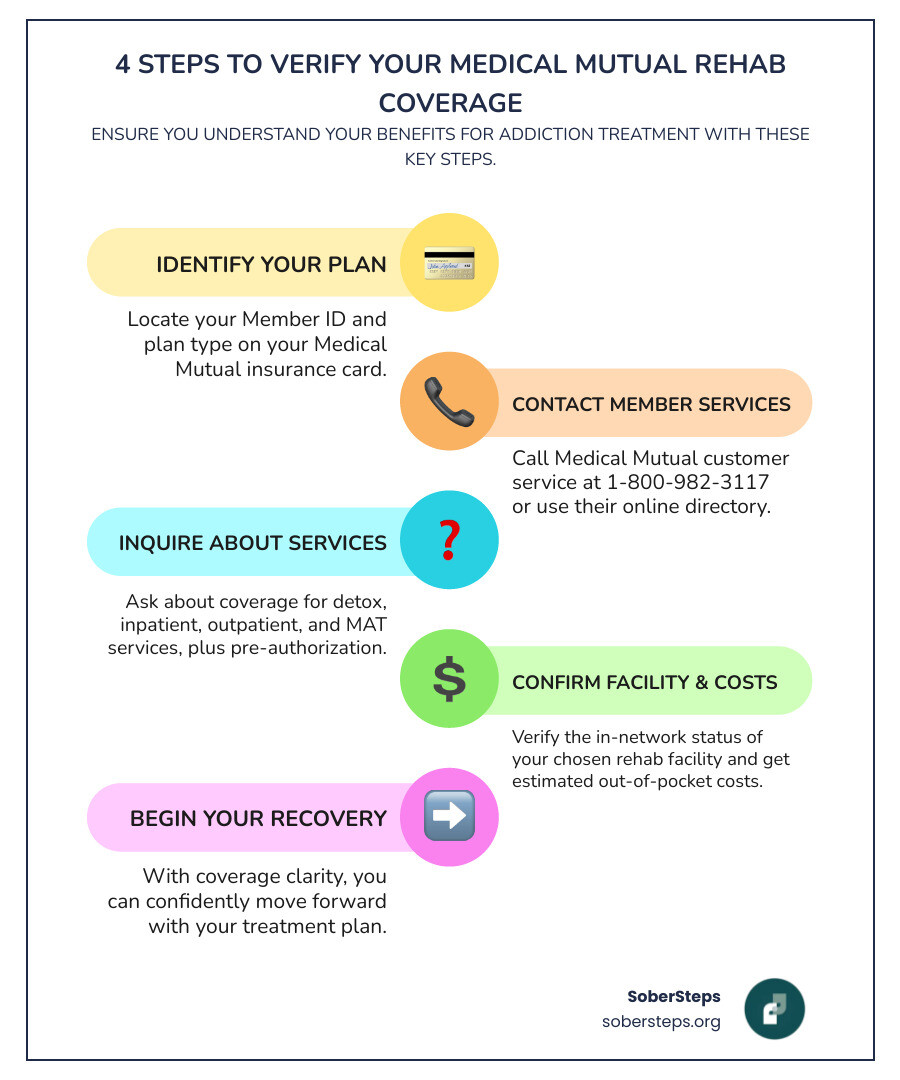
Follow these steps to verify your coverage:
The more information you gather, the better prepared you’ll be. For a comprehensive guide, see our step-by-step insurance verification. Or, simply let us do the heavy lifting: verify your coverage with our team today!
After verifying your benefits, find a rehab center that accepts your plan:
Ready to start your search? Find a rehab center near you or let us help you find a Medical Mutual-approved rehab.
Once you’ve found a rehab center, it’s time to use your coverage:
We believe that no one should delay getting help due to insurance confusion. Start your recovery today and let us help you every step of the way. You can always contact SoberSteps for help if you have further questions or need assistance.
We hear a lot of questions about Medical Mutual of Ohio drug rehab coverage options, and we’re always happy to provide clear answers. Here are some of the most common inquiries we receive:
Yes. Medical Mutual covers treatment for a wide range of substance use disorders, including alcohol, opioids (heroin, fentanyl), cocaine, methamphetamines, benzodiazepines, and other prescription drugs. Coverage is based on a “medical necessity” diagnosis from a clinical assessment, not the specific substance.
To learn more about the conditions we help treat, explore our types of addiction we treat. If you have questions about your specific situation, ask us about your specific coverage.
The main difference is a trade-off between flexibility and cost.
For a deeper dive, read our article on HMO vs. PPO for rehab. We can also help you find out which plan you have.
Yes. Federal laws like the Mental Health Parity and Addiction Equity Act (MHPAEA) require Medical Mutual to cover dual diagnosis treatment. This integrated care addresses both a substance use disorder and a co-occurring mental health condition (like depression or anxiety) at the same time, which is the most effective approach for lasting recovery.
For more information on this vital area of treatment, we recommend reading More on dual diagnosis and our own guide on dual diagnosis explained. We can help you verify dual diagnosis coverage with your Medical Mutual plan.
We hope this guide has clarified your Medical Mutual of Ohio drug rehab coverage options. Knowing your benefits is a powerful first step on the brave journey to recovery.
Key takeaways:
You don’t have to steer this alone. At SoberSteps, we connect you with the resources you need to focus on healing. Understanding your insurance is a crucial step, and there is always hope for recovery.
Don’t let confusion about insurance stop you. Verify your coverage today. We’re here to help you take that crucial next step. If you need any further assistance or have more questions, please don’t hesitate to contact SoberSteps for help.

Understand dual diagnosis vs co-occurring disorders. Learn why the distinction matters for integrated treatment and find support today.
Find confidential addiction helpline support. Get free, private help & affordable treatment options 24/7. Your recovery starts now!
Need medical detox programs? Discover the safe, supervised path to recovery, withdrawal management, and how to get help today.