From Crisis to Calm: A Guide to Family Addiction Resources
Find support & healing with comprehensive resources for families facing addiction. SoberSteps guides you from crisis to calm. Get help now!

Dialectical Behavior Therapy (DBT) is an evidence-based form of talk therapy designed to help people manage intense emotions, reduce self-destructive behaviors, and improve relationships. Developed in the 1970s by psychologist Dr. Marsha Linehan, DBT was originally created to treat individuals with borderline personality disorder (BPD) who experienced chronic suicidal thoughts, but it has since proven effective for a wide range of mental health conditions.
What makes DBT unique:
The word “dialectical” refers to finding balance between two opposing ideas – in this case, accepting your current situation while also working to change it. This approach can feel less invalidating than other therapies for people who experience emotions very intensely.
DBT has been shown to be effective for more than just BPD. Research demonstrates its benefits for substance use disorders, PTSD, eating disorders, depression, anxiety, and other conditions involving difficulty regulating emotions. Over 71% of those with BPD have experienced trauma, and DBT’s focus on both acceptance and practical skills makes it particularly helpful for individuals with complex mental health challenges.
If you’re struggling with overwhelming emotions, self-harm, relationship difficulties, or substance use, help is available. Call our confidential helpline at (844) 491-5566 to speak with someone who understands what you’re going through.
At Sober Steps, we connect individuals with evidence-based treatment options like Dialectical Behavior Therapy (DBT) that can truly make a difference in recovery from mental health and substance use disorders. Our team has extensive experience guiding people toward the right therapeutic approaches for their unique needs.
Dialectical Behavior Therapy (DBT) is a specialized form of talk therapy, or psychotherapy, rooted in cognitive behavioral therapy (CBT). However, it’s uniquely adapted for individuals who experience emotions with exceptional intensity. Imagine feeling every joy, every sorrow, and every frustration much more deeply than those around you. This emotional intensity, often termed emotional dysregulation, is a hallmark of many mental health conditions.
DBT’s approach is both profound and practical. It operates on what’s known as the biosocial theory, which suggests that emotional dysregulation arises from a biological predisposition to emotional vulnerability interacting with an invalidating environment. Essentially, some people are born with a more sensitive emotional system, and if their environment consistently dismisses or punishes their emotional responses, they struggle to learn healthy ways to manage them.
How does DBT work? It’s a journey of balancing two seemingly opposite, but equally important, concepts: validation and problem-solving. Validation in DBT isn’t about agreeing with unhelpful behaviors; it’s about acknowledging that a person’s thoughts and feelings make sense given their experiences. It’s saying, “We understand why you feel this way,” before moving on to, “Now, let’s find healthier ways to cope.” This acceptance-based foundation helps individuals feel understood, reducing the invalidation they might have experienced throughout their lives.
Once a person feels accepted, DBT then moves into problem-solving, teaching concrete skills to replace problematic behaviors with more effective ones. It’s a present-oriented, skills-based approach designed to empower individuals to build “a life worth living.”
For more information on our comprehensive mental health services, please visit our Mental Health Clinic. If you’re seeking confidential help, don’t hesitate to call us at (844) 491-5566.
The term “dialectical” is at the very heart of Dialectical Behavior Therapy (DBT). In philosophy, a dialectic involves the synthesis of two opposing ideas. In DBT, this means finding a balance between acceptance and change. We recognize that two seemingly opposite things can be true at the same time: “I am doing the best I can,” and “I need to do better.”
This “walking the middle path” philosophy is crucial for individuals who often feel trapped in black-and-white thinking. Instead of being forced to choose between self-acceptance or behavioral change, DBT encourages us to accept both simultaneously. We learn to accept ourselves, our current situation, and our intense emotions as they are, without judgment. This is a powerful act of radical acceptance – acknowledging reality without trying to fight it. At the same time, we actively work on changing unhelpful thoughts, feelings, and behaviors that cause distress or interfere with our goals. It’s a delicate dance, but one that leads to profound and lasting change.
While Dialectical Behavior Therapy (DBT) is derived from cognitive behavioral therapy (CBT), it’s important to understand how these two powerful approaches differ. Think of it this way: DBT is like CBT’s highly specialized cousin, specifically custom for individuals with intense emotional experiences.
CBT primarily focuses on identifying and changing negative thought patterns and behaviors. It often works on the premise that if we can change our thinking, our feelings and actions will follow. CBT is typically shorter-term, with results often seen in 5-20 sessions, and usually focuses on individual therapy.
DBT, on the other hand, begins with validation and acceptance. It acknowledges that a person’s thoughts and feelings, however intense or problematic, often make sense given their past experiences. This can feel less invalidating for someone who has been told their emotions are “wrong” or “too much.” Only after this crucial step of validation and acceptance does DBT introduce strategies for change.
DBT also incorporates a more comprehensive treatment package. Unlike CBT’s typical focus on individual sessions, DBT often includes weekly individual therapy, weekly group skills training, and phone coaching between sessions. This multi-modal approach provides a robust support system for learning and applying skills in real-time. As the National Alliance on Mental Illness (NAMI) highlights, DBT is focused on the validation and acceptance of uncomfortable thoughts, feelings, and behaviors, making it distinct while still leveraging CBT’s foundational principles.
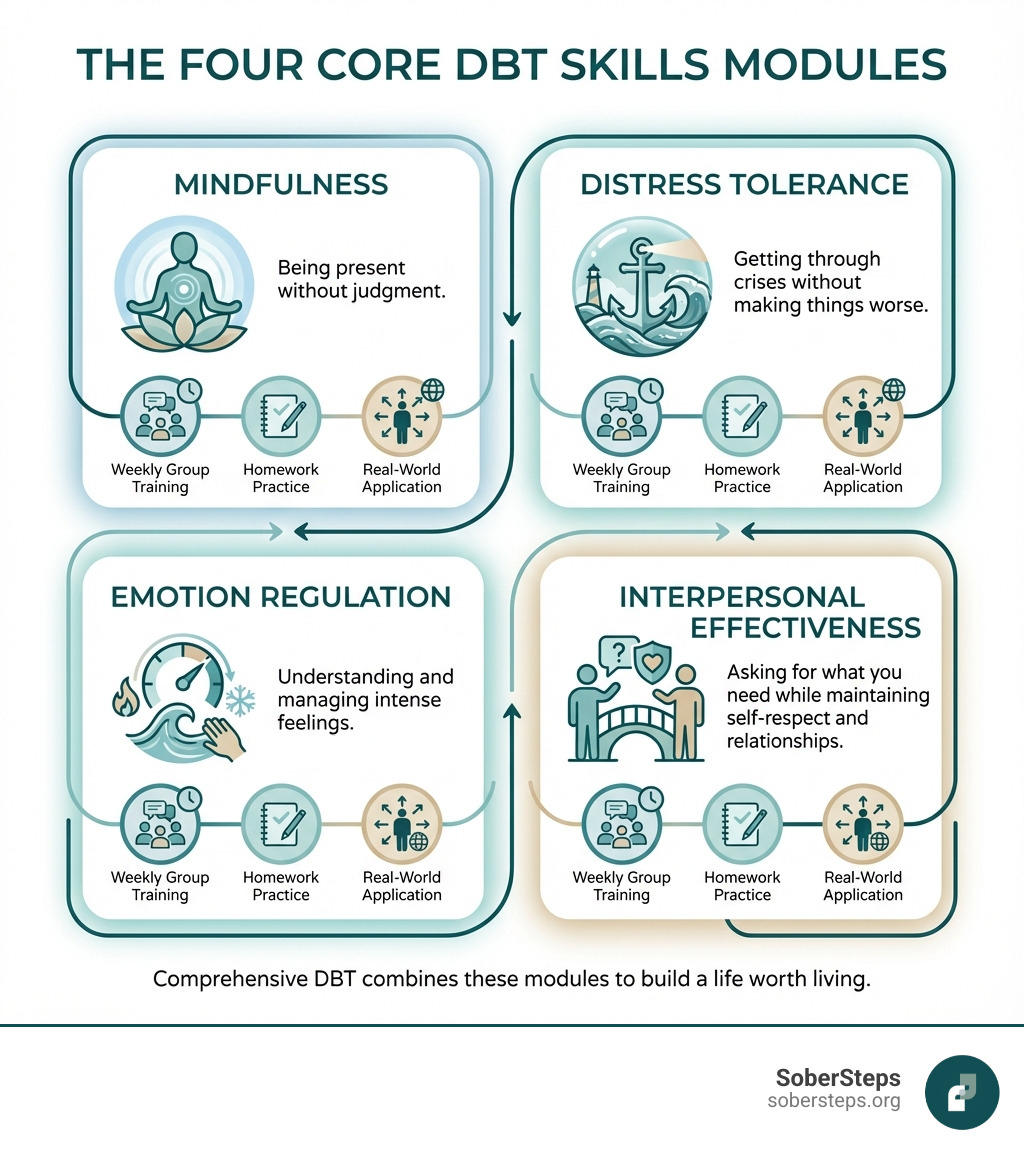
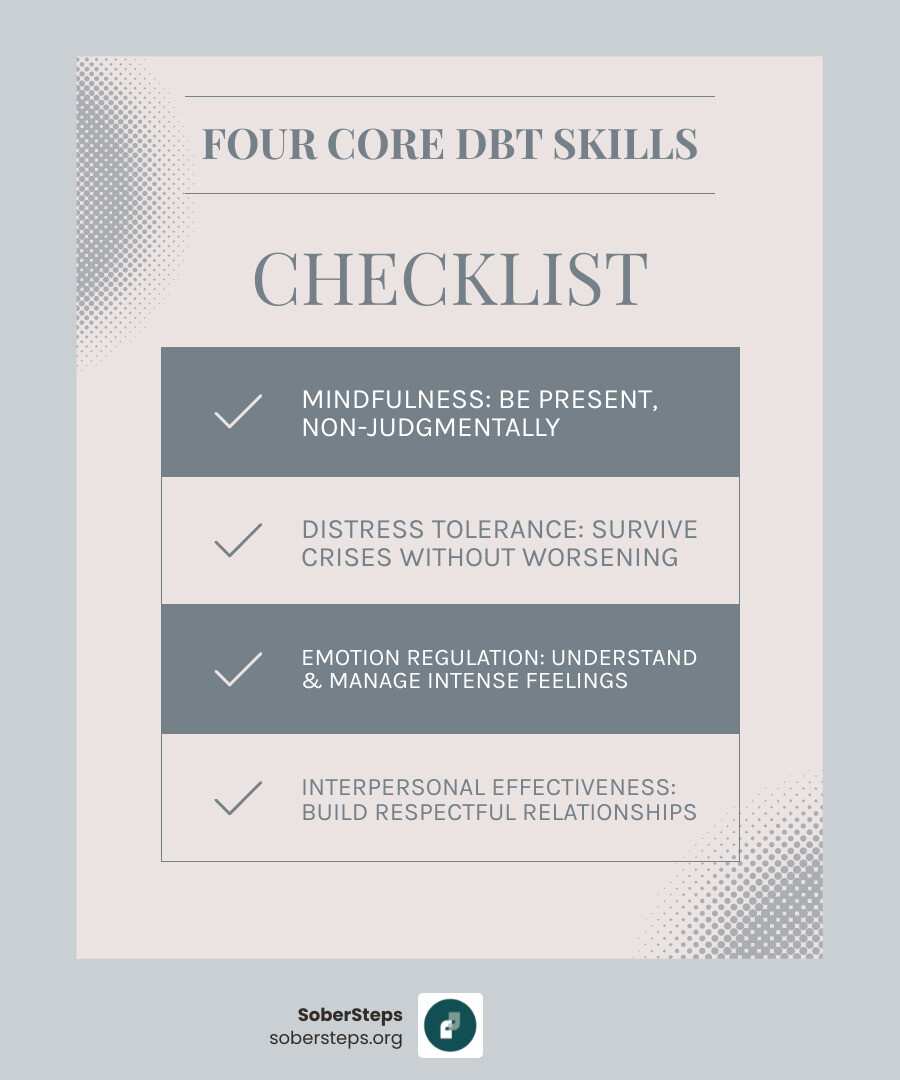
The heart of Dialectical Behavior Therapy (DBT) lies in its comprehensive skills training, designed to equip individuals with practical tools for navigating life’s challenges. These skills are typically taught in weekly group sessions, where participants learn, discuss, and practice new techniques. Homework assignments are a critical part of the process, encouraging us to apply these skills in our daily lives. Many people also use ‘diary cards’ to track their emotions, behaviors, and skill usage between sessions, fostering self-awareness and helping therapists tailor treatment. The ultimate goal? To replace unhelpful and often self-destructive behaviors with effective coping mechanisms, paving the way for “a life worth living.”
_compressed.png?alt=media&token=09c05a97-d193-46a8-ab64-d74c0229756b "image illustrating the four quadrants of DBT skills - Dialectical Behavior Therapy (DBT)")
At SoberSteps, we believe in empowering individuals with the tools they need for lasting change. Learn more about how we support mental well-being through our Behavioral Health Support programs.
Mindfulness is the foundational skill in Dialectical Behavior Therapy (DBT), borrowed from Eastern contemplative practices like Zen Buddhism. It’s about learning to be fully aware and present in the moment, observing our thoughts, feelings, and sensations without judgment. This skill helps us to slow down our emotional reactions and create a space between a trigger and our response.
In DBT, mindfulness is taught through “what” skills and “how” skills:
By practicing mindfulness, we can reduce our reactivity to intense emotions and gain a greater sense of control over our internal experience. It’s like learning to watch the waves of the ocean rather than being swept away by them.
Life inevitably throws curveballs, and sometimes, we can’t immediately change or solve a painful situation. That’s where distress tolerance skills come in. This module in Dialectical Behavior Therapy (DBT) teaches us how to cope with intense, overwhelming emotions and difficult circumstances without resorting to destructive behaviors like self-harm, substance use, or lashing out. It’s about surviving a crisis without making things worse.
Key distress tolerance skills include:
Research indicates that Studies show DBT can be effective in reducing incidents of self-harm, a testament to the power of distress tolerance techniques in managing urges during crises.
Understanding and managing our emotions is a cornerstone of mental well-being, and it’s a central focus of Dialectical Behavior Therapy (DBT). This module helps us identify, understand, and learn to respond to our emotions more effectively, rather than being controlled by them.
Emotion regulation skills teach us to:
By mastering emotion regulation, we gain a sense of agency over our internal experience, allowing us to steer life’s ups and downs with greater resilience. For immediate support with overwhelming emotions, please call us at (844) 491-5566.
Humans are social creatures, and our relationships significantly impact our well-being. The interpersonal effectiveness module in Dialectical Behavior Therapy (DBT) provides skills to steer social situations with grace, build healthy relationships, and maintain self-respect. It’s about getting our needs met while preserving important relationships.
These skills help us:
DBT offers specific acronyms to remember these skills, such as:
By practicing interpersonal effectiveness, we can foster more fulfilling connections, reduce relationship stress, and feel more confident in our interactions with others.
Dialectical Behavior Therapy (DBT) was initially developed for individuals experiencing severe emotional intensity, often leading to self-destructive behaviors and unstable relationships. Its effectiveness, however, has proven to extend far beyond its original scope. If you are struggling with these challenges, don’t face them alone. Call our confidential line at (844) 491-5566.
Research shows that DBT is a highly versatile and efficacious treatment for a wide range of mental health conditions. It has been DBT has proven to be very effective in treating individuals with borderline personality disorder, and its benefits span across various age groups, from adolescents to older adults.
While Dialectical Behavior Therapy (DBT) gained prominence for its remarkable success in treating Borderline Personality Disorder (BPD), its application has broadened significantly. We’ve seen its effectiveness across a spectrum of conditions where emotional dysregulation, impulsive behaviors, and relationship difficulties are central concerns.
Here’s a list of conditions where DBT has shown proven efficacy:
The efficacy of Dialectical Behavior Therapy (DBT) isn’t just anecdotal; it’s backed by extensive research, including numerous randomized clinical trials (RCTs) in the United States. These studies consistently demonstrate significant, life-changing benefits for those who engage in a comprehensive DBT program.
Key research-backed benefits include:
These outcomes highlight DBT’s power to not only alleviate distressing symptoms but also to help individuals build a more stable, fulfilling, and “life worth living.”
Engaging in a comprehensive Dialectical Behavior Therapy (DBT) program is a significant commitment, but one that offers profound rewards. It’s a structured and intensive treatment package designed to provide maximum support and skill-building. The typical duration for a full DBT program often ranges from 6 to 12 months, although some individuals, especially those with more complex needs, may benefit from several years of therapy. We often see significant behavioral control, such as the absence of life-threatening behaviors, achieved within four to eight months of starting comprehensive DBT.
The cost of DBT can vary, with a year-long program averaging around $6000, which typically includes skills group sessions ($1,900+) and individual therapy sessions ($4,800+). Per-session costs usually range from $100 to $200. It’s worth noting that under the Affordable Care Act (ACA) in the United States, substance abuse treatment, which often includes DBT, must be covered by ACA insurance plans, and pre-existing substance use disorders cannot disqualify coverage or cap spending.
At SoberSteps, we offer various Levels of Care to meet diverse needs. Don’t wait to get the help you deserve; call us at (844) 491-5566 to learn more about your options.
A truly comprehensive Dialectical Behavior Therapy (DBT) program isn’t just one type of therapy; it’s a multi-faceted approach involving four key components that work together to support your journey towards a life worth living. If a program or therapist doesn’t offer all four, they’re providing a modified version, and while adaptations can be helpful, the full package is considered the gold standard, especially for severe emotional dysregulation.
Finding the right therapist is a critical step towards effective treatment. When seeking a Dialectical Behavior Therapy (DBT) therapist, look for specific qualifications and a commitment to the comprehensive model. We want to ensure you receive the highest quality care available.
Here are key questions and considerations when searching for a qualified DBT therapist:
You can begin your search by asking for referrals from trusted healthcare providers or by searching online through professional psychological associations. Finding a therapist with whom you feel comfortable and can establish clear communication is paramount. At SoberSteps, we can help you steer this process and Contact SoberSteps to connect with a DBT-trained therapist who meets these rigorous standards.
Dialectical Behavior Therapy (DBT) offers a powerful path to healing and growth, empowering individuals to move from a place of intense emotional suffering to building “a life worth living.” By embracing the dialectic of acceptance and change, we learn to manage our emotions effectively, build healthier relationships, and steer life’s challenges with newfound resilience. The comprehensive skill set provided by DBT instills hope for change, even in the face of long-standing struggles.
If you or a loved one are struggling with overwhelming emotions, self-destructive behaviors, or the complexities of mental health and substance use disorders, you don’t have to face it alone. SoberSteps is dedicated to providing confidential and anonymous help, connecting you with evidence-based treatment options like DBT. We believe in your ability to heal and thrive.
For more insights and information on recovery, we invite you to explore our Addiction Recovery Blogs. If you or a loved one is in a Mental Health Crisis, it’s time to act. Call our confidential and anonymous helpline at (844) 491-5566 to learn about our Behavioral Health Support options today. Our compassionate team is here to guide you towards a brighter future. Help is just a phone call away at (844) 491-5566.

Find support & healing with comprehensive resources for families facing addiction. SoberSteps guides you from crisis to calm. Get help now!
Connect with anonymous hotline mental health support. Find immediate, confidential help 24/7 for stress, crisis, or simply to talk. Free & private.
Discover why female rehab centers offer specialized care for women’s unique recovery journey. Find support, healing, and hope today.