
Understanding Guide Health Insurance Coverage for Drug Rehab
When you’re facing addiction, figuring out your insurance shouldn’t add to the stress. Guide Health Insurance Coverage for Drug Rehab can seem confusing, but most plans cover essential services. Coverage varies based on your specific plan, your provider network, and what is deemed “medically necessary.”
Important Note: Guide Health Options now operates as Carelon Behavioral Health. Carelon doesn’t issue insurance plans directly. Instead, it manages behavioral health benefits for over 100 other insurance companies, serving more than 61 million members nationwide. This means your rehab coverage is determined by both Carelon’s network and your primary insurance plan’s rules.
Thanks to the Affordable Care Act (ACA), most plans managed by Carelon cover key addiction treatment services, including:
- Medical Detox: Medically supervised withdrawal (typically 3-7 days).
- Inpatient/Residential Treatment: 24/7 care, often starting with a 30-day authorization.
- Outpatient Programs: Including PHP, IOP, and standard therapy.
- Medication-Assisted Treatment (MAT): Coverage for medications like Suboxone and Vivitrol.
- Dual Diagnosis Care: Integrated treatment for co-occurring mental health conditions.
- Therapy Services: Individual, group, and family counseling.
At SoberSteps, we specialize in helping people understand their Guide Health Insurance Coverage for Drug Rehab. We work directly with treatment centers and insurance providers to simplify the process. Understanding your coverage is the critical first step toward recovery.
Ready to take that step? Contact SoberSteps for a confidential insurance verification.
How to get started with SoberSteps
Why Guide (Carelon) Focuses on Addiction Treatment
Carelon Behavioral Health’s core mission is managing behavioral health and substance use disorders. Unlike general health insurers, they are built to address these complex needs. Their integrated care model recognizes that mental health and addiction are often intertwined and require comprehensive, evidence-based treatment.
This focus, combined with legal mandates like the ACA, ensures that plans managed by Carelon provide robust coverage for medically necessary addiction treatment. Their commitment is also shown through initiatives like the “Stamp Out Stigma” program, which aims to reduce the stigma associated with seeking help.
Learn more about how insurance works for rehab.
Ready to verify your Guide Health Insurance Coverage for Drug Rehab with us? Verify your Beacon insurance coverage with SoberSteps.
Understanding Your Guide Health Insurance Coverage for Drug Rehab
While Carelon Behavioral Health manages the benefits, the specifics of your Guide Health Insurance Coverage for Drug Rehab depend on your individual insurance plan. Understanding these details is key to avoiding unexpected costs.
Key factors influencing your coverage include:
- Your Policy: The type of plan you have (e.g., HMO, PPO) dictates your network rules and costs.
- Medical Necessity: Coverage is approved only for services deemed “medically necessary” by a healthcare professional, often based on ASAM criteria.
- Prior Authorization: Higher levels of care, like inpatient rehab, almost always require pre-approval from Carelon to confirm medical necessity before treatment begins.
How to use your insurance for rehab at SoberSteps.
Let us help you untangle the complexities. Let SoberSteps help you understand your Beacon coverage.
Types of Addiction Treatment Programs Covered
Guide Health Insurance Coverage for Drug Rehab (through Carelon) generally covers a full spectrum of evidence-based addiction treatment. The level of care you’re approved for will depend on medical necessity.
- Medical Detoxification: The first step for many, providing a safe, supervised environment for withdrawal, often lasting 3-7 days.
- Inpatient Residential Rehab: Offers 24/7 care and intensive therapy in a live-in facility. It’s for those who need a highly structured environment and requires prior authorization.
- Partial Hospitalization Programs (PHP): A step-down from inpatient, offering intensive treatment during the day (e.g., 5 days a week) while you live at home.
- Intensive Outpatient Programs (IOP): Provides structured therapy for several hours a day, a few days a week, allowing you to maintain work or school commitments.
- Standard Outpatient Programs (OP): The least intensive option, involving weekly therapy sessions. It’s ideal for mild SUD or as long-term aftercare.
- Aftercare and Sober Living: Many plans cover aftercare services like ongoing therapy. While sober living homes are not always fully covered, some related services may be reimbursable.
Ready to find the right level of care for you? Find the right level of care with SoberSteps.
Coverage for Co-Occurring Disorders and Mental Health
Addiction and mental health conditions like anxiety, depression, or PTSD often occur together—a situation known as a “dual diagnosis.” Treating both simultaneously is critical for lasting recovery.
Guide Health Insurance Coverage for Drug Rehab (through Carelon) strongly supports integrated treatment for co-occurring disorders. This is a core part of their behavioral health focus. Coverage typically includes:
- Integrated treatment programs that address both SUD and mental health.
- Individual, group, and family therapy.
- Psychiatric evaluations and medication management.
Carelon’s approach ensures you receive holistic care for a better chance at full recovery.
Learn about dual diagnosis treatment at SoberSteps.
If you suspect you’re dealing with both, speak with SoberSteps about dual diagnosis care.
Are Medications for Addiction Treatment (MAT) Included?
Yes. Medications for Addiction Treatment (MAT) are a key part of modern, evidence-based care and are typically included in Guide Health Insurance Coverage for Drug Rehab. MAT combines FDA-approved medications with therapy to treat opioid and alcohol use disorders.
Commonly covered medications include:
- Buprenorphine (e.g., Suboxone) for opioid use disorder.
- Naltrexone (e.g., Vivitrol) for opioid and alcohol use disorders.
- Methadone for opioid use disorder.
Currently, there are no FDA-approved medications for stimulant use disorders (like cocaine or meth), so treatment relies on behavioral therapies, which are also covered.
See if MAT is right for you—speak with our SoberSteps team.
Comparing Inpatient and Outpatient Coverage
Your Guide Health Insurance Coverage for Drug Rehab applies differently to inpatient and outpatient care. The right choice depends on your clinical needs and insurance plan.
- Inpatient (Residential) Rehab: This is 24/7 care in a live-in facility. It’s the most intensive and expensive option, almost always requiring prior authorization. Initial authorizations are often for 30 days, with extensions based on medical need.
- Outpatient Rehab (PHP, IOP, OP): This allows you to live at home while attending treatment. It’s less intensive and less expensive. While some higher-level outpatient programs (like PHP) may need pre-authorization, many services simply require a copay per session.
Carelon-managed plans cover the most appropriate level of care based on a clinical assessment of your needs.
Find a treatment program that fits your needs and insurance plan.
How to Use Your Guide Plan for Rehab Services

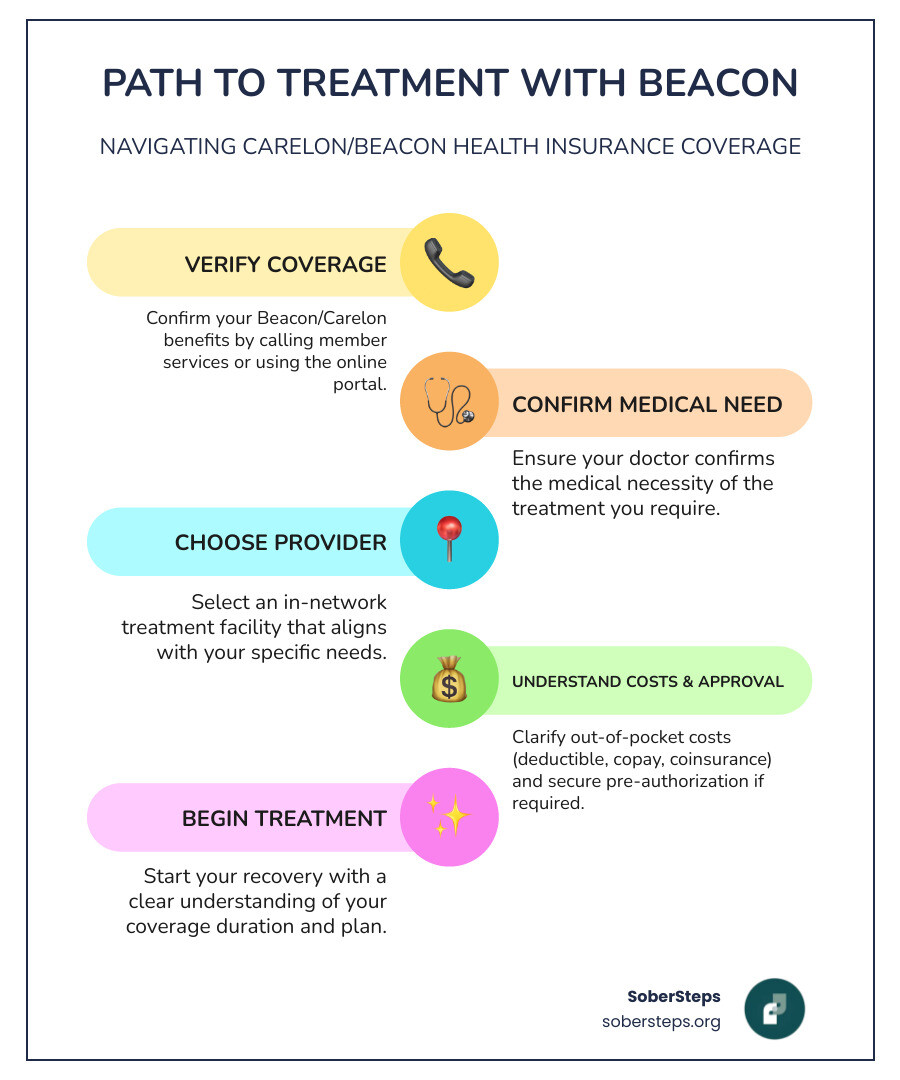
Once you’re ready to get help, how do you use your Guide Health Insurance Coverage for Drug Rehab? The process involves a few key steps: verifying your coverage, understanding your costs, and finding a facility. It can feel overwhelming, but we’re here to guide you through it.
Verify your Beacon insurance coverage now with SoberSteps.
Step-by-step guide to using your insurance at SoberSteps.
How to Verify Your Guide Health Insurance Coverage for Drug Rehab
Verifying your coverage is the most important first step to avoid unexpected costs. Here are the best ways to do it:
- Call Member Services: The phone number on the back of your insurance card is your direct line to a representative. Have your policy information ready and ask about your benefits for detox, inpatient, and outpatient rehab, as well as your specific costs.
- Use the Online Member Portal: Most insurance companies have a member portal where you can view your benefits summary and search for in-network providers.
- Contact SoberSteps (The Easiest Way): Our admissions specialists are experts at this. Provide us with your insurance information, and we’ll contact Carelon on your behalf. We’ll confirm your benefits, explain your coverage, and outline your potential costs, taking the burden off you.
Ready to get started? Start your confidential insurance verification.
Understanding Your Out-of-Pocket Costs
Even with good insurance, you’ll likely have some out-of-pocket costs. Here are the key terms to know:
- Deductible: The amount you must pay for covered services before your insurance starts paying. Deductible
- Copayment (Copay): A fixed amount you pay for a service (e.g., $25 per therapy session) after your deductible is met. Copayment
- Coinsurance: A percentage of the cost you pay for a service after meeting your deductible (e.g., you pay 20%, insurance pays 80%). Coinsurance
- Out-of-Pocket Maximum: The absolute most you’ll pay for covered services in a policy year. Once you hit this limit, your insurance typically pays 100% of covered costs.
We can help you estimate your potential costs. Contact SoberSteps for a cost estimate with your insurance.
In-Network vs. Out-of-Network Facilities
Whether a facility is “in-network” or “out-of-network” is a major factor in your final cost. This depends on your plan type (HMO, PPO, etc.).
- In-Network: These are providers that have a contract with your insurance company. Using them results in the lowest out-of-pocket costs. HMO and EPO plans usually only cover in-network care.
- Out-of-Network: These providers do not have a contract with your insurer. PPO plans may offer some coverage, but you’ll pay significantly more.
Preauthorization is Key: For planned treatment, especially inpatient care, you must get pre-authorization from Carelon before starting. Without it, your claim could be denied, even at an in-network facility. Sticking to in-network providers and getting pre-authorization is the most cost-effective strategy.
Find in-network rehab centers with SoberSteps.
What to Do When Insurance Isn’t Enough
Even with Guide Health Insurance Coverage for Drug Rehab, you might face out-of-pocket costs. This can be discouraging, but financial concerns should never stop you from getting help. There are always other options to explore.
Exploring Alternative Payment Options
If your insurance leaves a gap, many treatment centers offer ways to make care affordable:
- Sliding Scale Fees: Costs are adjusted based on your income.
- Payment Plans: Allow you to pay your balance in installments over time.
- Scholarships and Grants: Non-profits and some rehabs offer financial awards for treatment.
- State-Funded Programs: You may qualify for free or low-cost treatment based on income and residency.
- HSA/FSA Accounts: You can use pre-tax dollars from a Health Savings Account or Flexible Spending Account to pay for treatment.
The long-term cost of untreated addiction far exceeds the investment in rehab.
Learn about financial assistance for rehab at SoberSteps.
Don’t let finances hold you back. Ask SoberSteps about payment flexibility.
Leveraging Guide’s Additional Support Resources
Carelon Behavioral Health offers more than just treatment coverage. These resources can be valuable for you and your family:
- Employee Assistance Program (EAP): If offered by your employer, an EAP provides free, confidential counseling sessions and referrals. It’s a great first step. Employee Assistance Program (EAP)
- 24/7 Crisis Hotlines: For immediate mental health and substance use support.
- Care Coordination: Helps you steer the healthcare system and manage your treatment plan.
- Family Support: Many plans cover family therapy, which is crucial for healing relationships affected by addiction.
These resources reflect Carelon’s holistic approach to recovery.
Access support resources for you and your family at SoberSteps.
The Appeals Process for Denied Claims
If a claim for your Guide Health Insurance Coverage for Drug Rehab is denied, don’t give up. You have the right to appeal the decision.
Here’s the general process:
- Understand the Denial: Review the denial letter to see the reason (e.g., “not medically necessary”).
- Gather Documents: Collect all medical records and letters of medical necessity from your doctors.
- Submit a Formal Appeal: Follow the instructions in the denial letter to submit a written appeal within the specified timeframe.
4aws. Get Help: Patient advocates, like those at SoberSteps, can help you build a strong case. The core of most appeals is proving medical necessity with clear clinical documentation.
Many appeals are successful with the right documentation and persistence.
How to appeal an insurance denial with SoberSteps.
Need help fighting for your coverage? Get help with your insurance appeal from SoberSteps.
Frequently Asked Questions about Guide Rehab Coverage
How long will Guide cover an inpatient rehab stay?
The duration of a covered inpatient stay under your Guide Health Insurance Coverage for Drug Rehab depends on medical necessity and your specific plan.
- Initial Authorization: An initial period, often 30 days, is typically approved based on your clinical assessment.
- Extensions: Continued stay requires ongoing clinical reviews to prove that inpatient care is still medically necessary.
- Plan Limits: Your plan will have a maximum number of covered inpatient days per year. It’s essential to check your plan documents or call member services to understand these limits.
Your treatment team and Carelon will work to ensure you get the appropriate length of care for your recovery.
Learn more about your specific plan’s coverage.
Curious about your specific plan? Ask SoberSteps about your coverage duration.
Does Guide cover treatment for specific substances like alcohol, opioids, or stimulants?
Yes. Guide Health Insurance Coverage for Drug Rehab (through Carelon) covers treatment for a wide range of substance use disorders (SUD), not just specific substances. If you have a medical diagnosis for an SUD involving alcohol, opioids, stimulants, cannabis, or prescription drugs, your treatment should be covered as long as it’s medically necessary.
Coverage includes detox, therapy, and Medication-Assisted Treatment (MAT) where appropriate (e.g., for alcohol and opioid use disorders). Carelon’s specialization in behavioral health ensures they are equipped to manage benefits for a broad spectrum of addictions.
See which substance use disorders SoberSteps treats.
Ready to confirm your coverage for your specific needs? Contact SoberSteps to confirm your coverage.
Will my employer find out I am seeking treatment through my Guide plan?
No, your employer will generally not find out. Your privacy is protected by federal law (HIPAA), which mandates strict confidentiality for your health information.
Carelon Behavioral Health and your treatment providers are legally bound to keep your information private and cannot disclose it to your employer without your explicit written consent. Services used through an Employee Assistance Program (EAP) are also confidential.
Your employer will not see your specific diagnosis or treatment details. The process of seeking help for addiction through your insurance is a private matter.
Learn about privacy at SoberSteps.
Still have questions about confidentiality or anything else? Have more questions? Contact our team for answers.
Take the Next Step Towards Recovery
Navigating Guide Health Insurance Coverage for Drug Rehab can feel complex, but it’s a powerful tool for accessing life-saving treatment. Through the plans they manage, Carelon Behavioral Health provides comprehensive coverage for detox, inpatient and outpatient care, MAT, and dual diagnosis support.
The key is to verify your specific plan’s benefits and understand your potential costs. While insurance can be tricky, financial concerns should not be a roadblock to recovery.
At SoberSteps, we believe everyone deserves a clear and simple path to getting well. We’re here to help you understand your options, verify your Guide Health Insurance Coverage for Drug Rehab, and connect you with a trusted treatment provider that fits your needs. Don’t let confusion stop you from taking the most important step of your life.
- Verify your insurance
- Explore treatment programs
- Contact SoberSteps
- Learn about dual diagnosis
- Family support resources
- Step-by-step insurance guide
Don’t wait—verify your Beacon coverage and start your recovery journey with SoberSteps now!